$ 0
0
$ 0
0

Komatsu PW148-10, PW160, PW180-10 Hydraulic Excavator Operation and Maintenance Manual (VENAM63023)

Format: PDF (Printable Document)

File Language: English

File Pages: 638

File Size: 58.61 MB (Speed Download Link)

Brand: Komatsu

Model: PW148-10, PW160, PW180-10 Hydraulic Excavator

Book No: VENAM63023

Type of Document: Operation and Maintenance Manual

Categories: ,

$ 40

Share:

Komatsu PW148-10, PW160, PW180-10 Hydraulic Excavator Operation and Maintenance Manual (VENAM63023)

Komatsu PW148-10, PW160, PW180-10 Hydraulic Excavator Operation and Maintenance Manual (VENAM63023)

📘 Show Index

Komatsu PW148-10, PW160, PW180-10 Hydraulic Excavator Index:

  • 1. Foreword
    • 1.1 Foreword
      • EU Directives
    • 1.2 Safety information
      • 1.2.1 Signal words
      • 1.2.2 Safety labels
      • 1.2.3 Emergency steering
      • 1.2.4 Emergency braking
    • 1.3 Introduction
      • 1.3.1 Use of machine
      • 1.3.2 Intended use
      • 1.3.3 Directions of machine
      • 1.3.4 Visibility from operator’s seat
      • 1.3.5 Running in your new machine
    • 1.4 Necessary information
      • 1.4.1 Product Identification Number (PIN)/Machine serial no. plate and position
      • 1.4.2 ROPS/FOPS-Cab serial no. plate
      • 1.4.3 Engine serial no. plate and position
      • 1.4.4 Fluorinated greenhouse gases
      • 1.4.5 Position of service meter
      • 1.4.6 Retrofitting by third-party suppliers
      • 1.4.7 Table to enter serial no. and dealer
      • 1.4.8 Explanation of acronyms
    • 1.5 Declaration of conformity
    • 1.6 Noise
      • 1.6.1 Noise emission levels
      • 1.6.2 Vibration levels
    • 1.7 Contents
  • 2. Safety
    • 2.1 Safety labels
      • 2.1.1 Location of safety labels
    • 2.2 General precautions
      • Understanding the machine
      • 2.2.1 Precautions before starting operation
      • 2.2.2 Preparations for safe operation
      • 2.2.3 Fire prevention
      • 2.2.4 Precautions when getting on or off machine
      • 2.2.5 Rotating beacon
      • 2.2.6 Electromagnetic interference
      • 2.2.7 Do not get caught in articulated portion
      • 2.2.8 Precautions related to protective structures
      • 2.2.9 Precautions against falling, flying, or intruding objects
      • 2.2.10 Unauthorized modification
      • 2.2.11 Precautions related to attachments and options
      • 2.2.12 Precautions related to cab glass
      • 2.2.13 Precautions when running engine inside building
    • 2.3 Precautions for operation
      • 2.3.1 Precautions for jobsite
      • 2.3.2 Starting engine
      • 2.3.3 Operation
      • 2.3.4 Transportation
      • 2.3.5 Towing
      • 2.3.6 Bucket with hook or bucket link with lifting eye
      • 2.3.7 Handling of fluids
    • 2.4 Precautions for maintenance
      • 2.4.1 Precautions before starting
      • 2.4.2 Precautions for inspection and maintenance
      • 2.4.3 Tyres
    • 2.5 Lifting capacity charts
      • 2.5.1 One piece boom PW148-10
      • 2.5.2 Two piece boom PW148-10
      • 2.5.3 One piece boom PW160-10
      • 2.5.4 Two piece boom PW160-10
      • 2.5.5 One piece boom – 2.5 metre undercarriage PW180-10
      • 2.5.6 Two piece boom – 2.5 metre undercarriage PW180-10
      • 2.5.7 One piece boom – 2.75 metre undercarriage PW180-10
      • 2.5.8 Two piece boom – 2.75 metre undercarriage PW180-10
    • 2.6 Overload caution
      • 2.6.1 Overload caution
      • 2.6.2 One piece boom – Overload caution PW148-10
      • 2.6.3 Two piece boom – Overload caution PW148-10
      • 2.6.4 One piece boom – Overload caution PW160-10
      • 2.6.5 Two piece boom – Overload caution PW160-10
      • 2.6.6 One piece boom – Overload caution PW180-10
      • 2.6.7 Two piece boom – Overload caution PW180-10
  • 3. Operation
    • 3.1 General view
      • 3.1.1 General view of machine
      • 3.1.2 General view of controls and gauges
      • 3.1.3 General view of Monitor
    • 3.2 Explanation of components
      • 3.2.1 Machine monitor
      • 3.2.2 Basic operation of machine monitor
      • 3.2.3 Monitor switch portion
      • 3.2.4 Machine settings
    • 3.3 Switches
    • 3.4 Control levers, pedals
    • 3.5 Window
      • 3.5.1 Ceiling window
      • 3.5.2 Front window
      • 3.5.3 Emergency escape hammer
      • 3.5.4 Door lock
    • 3.6 Cap, cover with lock
      • 3.6.1 Opening and closing cap with lock
      • 3.6.2 Opening and closing cover with lock
      • 3.6.3 Drink box
      • 3.6.4 Magazine box
      • 3.6.5 Cup holder
    • 3.7 Cab radio
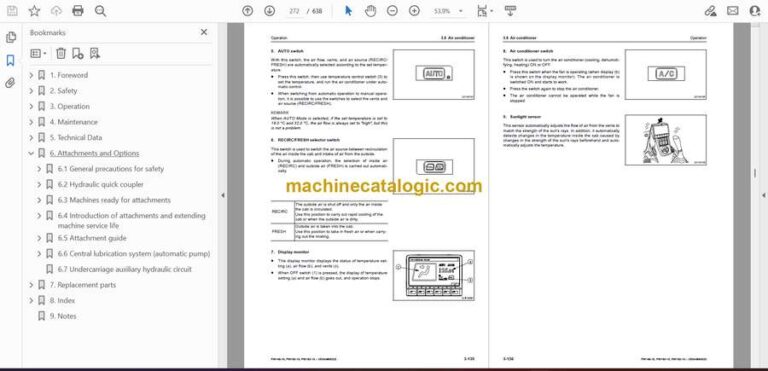
    • 3.8 Air conditioner
      • 3.8.1 Air conditioner control panel
      • 3.8.2 Method of operation
      • 3.8.3 Precautions when using air conditioner
      • 3.8.4 Check, maintain machine equipped with air conditioner
      • 3.8.5 Auxiliary electric power
    • 3.9 Fuses
      • Fuse box 1
      • Fuse box 2
    • 3.10 Fusible link
    • 3.11 Controller
    • 3.12 Tool box (chassis)
    • 3.13 Fire extinguisher
    • 3.14 Battery main switch
    • 3.15 System operation lamp
    • 3.16 Refuelling pump
    • 3.17 Handling accumulators
      • 3.17.1 Control circuit accumulator (A)
      • 3.17.2 Clutch control accumulator (B)
      • 3.17.3 Brake circuit accumulators (C) × 3
      • 3.17.4 Brake circuit accumulators (C) × 4
    • 3.18 Handling KDPF (only PW180-10)
      • Operation procedure of manual stationary regeneration
      • KDPF regeneration disable procedure
      • While regeneration is not being performed: setting for regeneration disable
      • While regeneration is being performed: stopping regeneration
      • KDPF regeneration disable cancel procedure
    • 3.19 Handling KCCV
    • 3.20 Handling machines equipped with KOMTRAX
      • 3.20.1 Basic precautions
    • 3.21 Operation
      • 3.21.1 Check before starting engine
      • 3.21.2 Check before starting
      • 3.21.3 Adjustment of operator’s seat (air suspension seat)
      • 3.21.4 Adjustment of operator’s seat (mechanical seat)
      • 3.21.5 Seat belt
      • 3.21.6 Rear view mirrors
      • 3.21.7 Adjust rear view camera angle
      • 3.21.8 Operations and checks before starting engine
      • 3.21.9 Starting engine
      • 3.21.10 Ambient temperature range for operation and storage
      • 3.21.11 Stopping engine
      • 3.21.12 Machine operation
      • 3.21.13 Steering
      • 3.21.14 Travelling on public highway
      • 3.21.15 Travelling with cruise control
      • 3.21.16 Stopping and parking
      • 3.21.17 Swinging
      • 3.21.18 Operation of work equipment
      • 3.21.19 Working mode selection
      • 3.21.20 Prohibitions for operation
      • 3.21.21 Precautions for operation
      • 3.21.22 Recommendations for travelling
      • 3.21.23 Precautions when travelling up or down hills
      • 3.21.24 How to escape from mud
      • 3.21.25 Recommended applications
      • 3.21.26 Replacement and inversion of bucket
      • 3.21.27 Parking machine
      • 3.21.28 Check after stopping engine
      • 3.21.29 Machine inspection after daily work
    • 3.22 Transportation
      • 3.22.1 Transportation procedure
      • 3.22.2 Loading, unloading work
      • 3.22.3 Securing machine
      • 3.22.4 Unloading
      • 3.22.5 Lifting the machine
      • 3.22.6 Precautions for transportation
      • 3.22.7 Travelling posture
    • 3.23 Cold weather operation
      • 3.23.1 Precautions for low temperature
      • 3.23.2 Precautions after completion of work
      • 3.23.3 After cold weather
    • 3.24 Long-term storage
      • 3.24.1 Before storage
      • 3.24.2 During storage
      • 3.24.3 After storage
      • 3.24.4 Starting machine after long-term storage
    • 3.25 Troubleshooting
      • 3.25.1 Running out of fuel
      • 3.25.2 Phenomena that are not failures
    • 3.26 Method of towing machine
    • 3.27 Precautions on particular jobsites
    • 3.28 Discharged battery
      • 3.28.1 Removal and installation of battery
      • 3.28.2 Battery charges
      • 3.28.3 Starting engine with booster cables
    • 3.29 Other trouble
      • 3.29.1 Electrical system
      • 3.29.2 Chassis and work equipment
      • 3.29.3 Engine
      • 3.29.4 Electronic control system
  • 4. Maintenance
    • 4.1 Guides to maintenance
    • 4.2 Outline of service
      • Handling oil, fuel, coolant and performing oil clinic
      • Fuel
      • Coolant and water for dilution
      • Grease
      • Carrying out KOWA (Komatsu Oil Wear Analysis)
      • KOWA analysis items
      • Oil sampling
      • Storing oil and fuel
      • Filters
      • 4.2.1 Outline of electric system
      • 4.2.2 Outline of hydraulic system
    • 4.3 Standard tightening torques for bolts and nuts
      • 4.3.1 Introduction of necessary tools
      • 4.3.2 Tightening torque specifications
    • 4.4 Maintenance schedule chart
    • 4.5 Maintenance interval for hydraulic breaker
    • 4.6 Maintenance procedure
      • 4.6.1 Initial 50 hours maintenance (only after the first 50 hours)
      • 4.6.2 Initial 250 hours maintenance (only after the first 250 hours)
      • 4.6.3 When required
      • 4.6.4 Check before starting
      • 4.6.5 Every 100 hours maintenance
      • 4.6.6 Every 250 hours maintenance
      • 4.6.7 Every 500 hours maintenance
      • 4.6.8 Every 1000 hours maintenance
      • 4.6.9 Every 2000 hours maintenance
      • 4.6.10 Every 4000 hours maintenance
      • 4.6.11 Every 4500 hours maintenance
      • 4.6.12 Every 5000 hours maintenance
      • 4.6.13 Every 8000 hours maintenance
  • 5. Technical Data
    • 5.1 Specifications
      • 5.1.1 Operating weight (kg)
      • 5.1.2 Dimensions
      • 5.1.3 Working range – One piece boom
      • 5.1.4 Working range – Two piece boom
  • 6. Attachments and Options
    • 6.1 General precautions for safety
      • 6.1.1 Precautions when selecting
      • 6.1.2 Read the instruction manual thoroughly
      • 6.1.3 Precautions when removing or installing
      • 6.1.4 Precautions when using
    • 6.2 Hydraulic quick coupler
      • 6.2.1 Locations
      • 6.2.2 Operation
    • 6.3 Machines ready for attachments
      • Clamshell operation valves
      • Handling the clamshell bucket
      • How to install clamshell bucket
      • How to operate
      • 6.3.1 Two-Piece boom control pedal
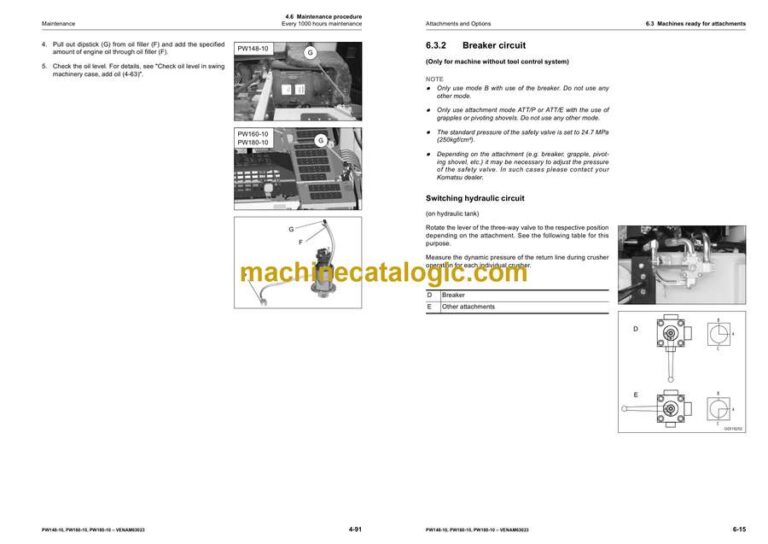
      • 6.3.2 Breaker circuit
      • 6.3.3 Attachment operations
      • 6.3.4 Tool control system
      • 6.3.5 Method for releasing pressure in control circuit of machines equipped with accumulator
      • 6.3.6 Long-term storage
      • 6.3.7 Specifications
    • 6.4 Introduction of attachments and extending machine service life
      • 6.4.1 Hydraulic breaker
      • 6.4.2 Power ripper
      • 6.4.3 Fork grab
      • 6.4.4 Grapple bucket
      • 6.4.5 Scrap grapple
      • 6.4.6 Crusher and smasher
      • 6.4.7 Hydraulic pile driver
    • 6.5 Attachment guide
      • Upper boom control pedal (two piece boom)
      • Excavator’s work
    • 6.6 Central lubrication system (automatic pump)
      • 6.6.1 Changing the lubrication interval times
      • 6.6.2 Operating the central lubrication system
      • 6.6.3 Display and control unit
    • 6.7 Undercarriage auxiliary hydraulic circuit
  • 7. Replacement parts
    • 7.1 Safety critical parts
      • Safety critical parts
    • 7.2 Wear parts list
    • 7.3 Recommended fuel, coolant and lubricant
      • 7.3.1 Lubrication chart PW148-10 and PW160-10
      • 7.3.2 Lubrication chart PW180-10
      • 7.3.3 Proper selection of fuel, coolant and lubricants
      • 7.3.4 Recommended brands, recommended quality for products other than Komatsu genuine oil
  • 8. Index
    • 8.1 Index
  • 9. Notes

Komatsu

Latest Product

0
    0
    Your Cart
    Your cart is emptyReturn to Shop