$ 0
0
$ 0
0

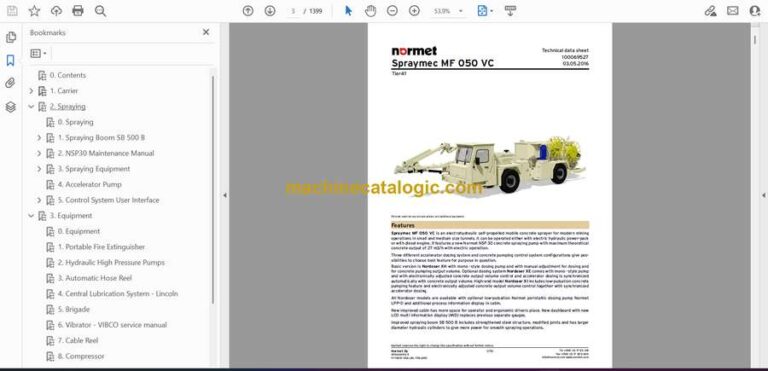
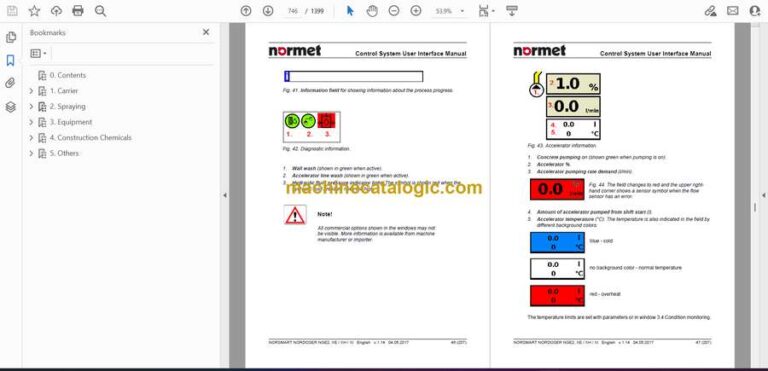
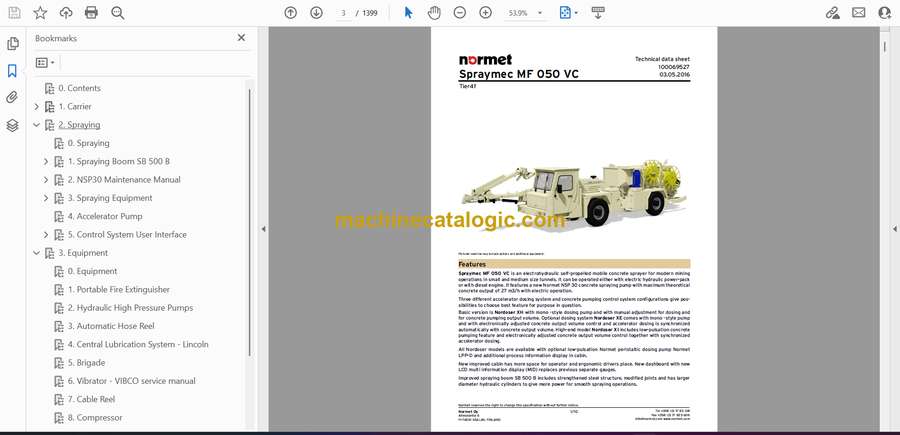
Normet Spraymec MF050 VC Technical Information (5F787E1_1000)

Format: PDF (Printable Document)

File Language: English

File Pages: 1399

File Size: 78.88 MB (Speed Download Link)

Brand: Normet

Model: Spraymec MF050 VC

Book No: 5F787E1_1000

Type of Document: Technical Information

Categories: ,

$ 55

Share:

Normet Spraymec MF050 VC Technical Information (5F787E1_1000)

Normet Spraymec MF050 VC Technical Information (5F787E1_1000)

📘 Show Index

Normet Spraymec MF050 VC Technical Information (5F787E1_1000) Index:

  • 0. Contents
  • 1. Carrier
    • 0. Carrier
    • 1. Technical Data Sheet
    • 2. Operator’s Manual
      • Spraymec MF 050 VC
      • Contents
      • 1. Introduction
        • 1.1. Carrier
        • 1.2. Carrier identification
        • 1.3. Frame Structure
          • 1.3.1. Engine end Frame
          • 1.3.2. Load end Frame
          • 1.3.3. Oscillation
        • 1.4. Engine
          • 1.4.1. General
        • 1.5. Hydrodynamic Transmission
          • 1.5.1. General
          • 1.5.2. Torque Converter
          • 1.5.3. Transmission
          • 1.5.4. Transmission Controls
        • 1.6. Mechanical Transmission
          • 1.6.1. General
          • 1.6.2. Driveshafts
          • 1.6.3. Axle Assemblies
        • 1.7. Hydraulics
          • 1.7.1. Pumps
          • 1.7.2. Brakes
          • 1.7.3. Steering
      • 2. Safety Rules
        • 2.1. General Safety Rules
        • 2.2. Operating Safety Rules
      • 3. Operator Controls
        • 3.1. Dashboard
          • 3.1.1. TB7
          • 3.1.2. TB7b
          • 3.1.3. TB9
          • 3.1.4. Norsmart Control system.
          • 3.1.5. Automatic Brake Application System
          • 3.1.6. Engine Control System
        • 3.2. Radio remote control box
        • 3.3. TB5
        • 3.4. TB51
        • 3.5. Joysticks
        • 3.6. High voltage box HVB
        • 3.7. Main Switch
        • 3.8. Circuit Breakers
        • 3.9. Driving Controls
        • 3.10. Seat
        • 3.11. Emergency Stop
        • 3.12. Windshield Wipers
        • 3.13. Air Conditioning
      • 4. Operation and Use
        • 4.1. Commissioning on Delivery
        • 4.2. Daily Operation
          • 4.2.1. Daily Maintenance Operations
          • 4.2.2. Instrumentation Checks
          • 4.2.3. Testing the Brakes
        • 4.3. Driving the Carrier
          • 4.3.1. General
          • 4.3.2. Before Start
          • 4.3.3. Engine Start
          • 4.3.4. Gear Shifting
          • 4.3.5. Steering
          • 4.3.6. Setting The Carrier In Motion
          • 4.3.7. Driving on Slopes
          • 4.3.8. Road Driving
          • 4.3.9. Stopping
        • 4.4. Carrie Transfer
          • 4.4.1. Towing
          • 4.4.2. Lifting
          • 4.4.3. Lowering the Carrier Down a Mine
        • 4.5. Special Operating Conditions
          • 4.5.1. Winter Operation
          • 4.5.2. High Ambient Temperature, High Altitude
          • 4.5.3. Jump Start
          • 4.5.4. Engine Storage
      • Notes
    • 3. Service Schedule
    • 4. Maintenance manual
      • Carrier
      • Contents
      • 1. Safety precautions
        • 1.1. Mechanical support
        • 1.2. Service
        • 1.3. Hydraulics
        • 1.4. Other precautions
      • 2. Oil samples
        • 2.1. Evacuation and sample line operation
        • 2.2. Sample lines
      • 3. Engine
        • 3.1. Safety Precautions
        • 3.2. General
          • 3.2.1. Lubricating Oil
          • 3.2.2. Fuel
          • 3.2.3. Coolant
          • 3.2.4. Diesel Exhaust Fluid (DEF)
        • 3.3. Procedures
          • 3.3.1. Daily or once per shift
          • 3.3.2. Every 250 hours
          • 3.3.3. Every 500 hours
          • 3.3.4. Every 1000 hours
          • 3.3.5. Every 2000 hours
          • 3.3.6. Every 4000 hours
          • 3.3.7. Every 5000 hours
      • 4. Powershift transmission
        • 4.1. Lubricant recommendations
        • 4.2. Procedures
          • 4.2.1. Daily or once per shift (10 hours)
          • 4.2.2. Every 500 hours
          • 4.2.3. Every 1000 hours
        • 4.3. Troubleshooting
          • 4.3.1. General
          • 4.3.2. Procedures
          • 4.3.3. Troubleshooting guide
      • 5. Mechanical transmission
        • 5.1. Lubricant Recommendations
        • 5.2. Procedures
          • 5.2.1. Daily or once per shift (10 hours)
          • 5.2.2. Weekly (50 hours)
          • 5.2.3. Every 125 hours
          • 5.2.4. Every 250 hours
          • 5.2.5. Every 500 hours
          • 5.2.6. Every 1000 hours
          • 5.2.7. As required
        • 5.3. Troubleshooting
      • 6. Hydraulic system
        • 6.1. Lubricant Recommendations
        • 6.2. Pressure accumulator safety precautions
        • 6.3. Procedures
          • 6.3.1. Daily or once per shift (10 hours)
          • 6.3.2. Every 500 hours
          • 6.3.3. Every 1000 hours
          • 6.3.4. As required maintenance
        • 6.4. Troubleshooting
          • 6.4.1. Steering
          • 6.4.2. Service brakes
          • 6.4.3. Safety/parking brakes
      • 7. Frame
        • 7.1. Lubricant Recommendations
        • 7.2. Procedures
          • 7.2.1. Weekly (50 hours)
          • 7.2.2. Every 1,000 hours
      • 8. Enclosed Cabin Equipments
        • 8.1. Procedures
          • 8.1.1. Daily or once in shift (10 hours)
          • 8.1.2. Every 500 hours
          • 8.1.3. Every 2 years
          • 8.1.4. As required maintenance
      • 9. Tightening torques
        • 9.1. Screws
        • 9.2. Screws with locking washers
          • 9.2.1. Wedge lock washers (e.g. Wurth®, HEICO®)
          • 9.2.2. Nord-lock® Steel washers
      • Notes
    • 5. Hydraulic Suspension
      • Hydraulic front axle suspension
      • Contents
      • 1. Safety precautions
      • 2. Maintenance
        • 2.1. Lubricant Recommendations
        • 2.2. Pressure accumulator safety precautions
        • 2.3. Procedures
          • 2.3.1. Daily or once per shift (10 hours)
          • 2.3.2. Weekly (50 hours)
          • 2.3.3. Every 1000 hours
      • Notes
    • 6. Safety Instructions
    • 7. Engine Fault Codes
    • 8. Schemas
  • 2. Spraying
    • 0. Spraying
    • 1. Spraying Boom SB 500 B
      • Spraying Boom SB 500 B
      • Contents
      • 1. Foreword
      • 2. Introduction
        • 2.1. Technical Information SB 500 B
        • 2.2. SB 500 B Boom System
          • 2.2.1. Description
          • 2.2.2. Hydraulics
          • 2.2.3. System control
      • 3. Safety instructions
        • 3.1. General
        • 3.2. Boom Operation
        • 3.3. Boom Maintenance
        • 3.4. In case of danger
        • 3.5. Working Environment
      • 4. Operation
        • 4.1. Before Operation of the Boom
        • 4.2. Boom Handling
        • 4.3. Storage
        • 4.4. Extreme Conditions
      • 5. Maintenance
        • 5.1. Lubricant recommendations
        • 5.2. Schedule
        • 5.3. Maintenance Procedures
          • 5.3.1. Daily or once per shift (10 hours)
          • 5.3.2. Weekly (50 hours)
          • 5.3.3. Every 500 hours
          • 5.3.4. Every 1000 hours
    • 2. NSP30 Maintenance Manual
      • Concrete pump NSP30/NSP40
      • Contents
      • 1. Introduction
        • 1.1. Technical data
      • 2. Safety precautions
        • 2.1. Service
        • 2.2. Hydraulics
      • 3. Maintenance
        • 3.1. Lubricant recommendations
        • 3.2. Schedule
        • 3.3. Maintenance procedures
          • 3.3.1. Daily or once per shift (10 hours)
          • 3.3.2. Weekly (50 hours)
          • 3.3.3. Every 125 hours
          • 3.3.4. Every 250 hours
          • 3.3.5. Every 500 hours
          • 3.3.6. Every 1000 hours
      • 4. Repairs
        • 4.1. Switching overlap
        • 4.2. Delivery piston change
    • 3. Spraying Equipment
      • Spraying Equipment
      • Contents
      • 1. Introduction
        • 1.1. Technical description
          • 1.1.1. Wet mix process
          • 1.1.2. Pumped concrete
          • 1.1.3. Accelerators
          • 1.1.4. Concrete pump
          • 1.1.5. Boom
      • 2. Controls
        • 2.1. Waterline
          • 2.1.1. Shut-off valves for water
          • 2.1.2. Water pressure regulator
          • 2.1.3. Water box emptying valve
          • 2.1.4. Water reel
          • 2.1.5. Boots washing
          • 2.1.6. Pressure washer
        • 2.2. Nozzle washing valves
        • 2.3. Pressure air line
          • 2.3.1. Shut -off valves for compressed air
        • 2.4. Cable reel
        • 2.5. Concrete pump controls
          • 2.5.1. Control system by-pass
        • 2.6. Form oil system
        • 2.7. High Pressure Wall Washing System
      • 3. Operation and Use
        • 3.1. Concrete pumping – Electric
        • 3.2. Concrete pumping – Diesel
        • 3.3. Useful tips
        • 3.4. Spraying technique
      • 4. Maintenance
        • 4.1. Schedule
        • 4.2. Maintenance procedures
          • 4.2.1. Daily or once per shift (10 hours)
          • 4.2.2. After use
          • 4.2.3. As required
    • 4. Accelerator Pump
    • 5. Control System User Interface
      • NORSMART NORDOSER NGE2, XE / XH / XI
      • 1. General
        • 1.1. Purpose of the system
        • 1.2. Warnings and notifications
        • 1.3. Definitions, terms and abbreviations used
      • 2. General description of the system
        • 2.1. Multi Information Display (MID)
        • 2.2. Can Hub Module (HUB)
        • 2.3. Controller Module HCM2000
        • 2.4. Controller Module HCM3100
        • 2.5. Controller Module HCM3200
      • 3. User Interface
        • 3.1. Navigation in the user interface
        • 3.2. Adjusting values
        • 3.3. Access rights of the user interface
        • 3.4. Pop-up windows of the user interface
        • 3.5. User interface alerts
        • 3.6. Drive display (1)
        • 3.7. Process Display (2)
        • 3.8. Shift information (3)
          • 3.8.1. Edit shift information (3.1)
          • 3.8.2. Process settings (3.2)
          • 3.8.3. Close shift (3.3)
          • 3.8.4. Condition monitoring settings (3.4) (Only XI control systems)
        • 3.9. Data logging (4)
          • 3.9.1. Process log window (4.1)
          • 3.9.2. Alerts window (4.2)
          • 3.9.3. Platform operating hours (4.3)
          • 3.9.4. File transfer settings (4.4) (Commercial option)
        • 3.10. Display settings window (5)
        • 3.11. Advanced settings window (6)
          • 3.11.1. Access level selection (6.1)
          • 3.11.2. Commercial options (6.2)
          • 3.11.3. Factory & default parameters (6.3)
          • 3.11.4. System versions and settings (6.4)
          • 3.11.5. System backup (6.5)
        • 3.12. Process maintenance window (7)
          • 3.12.1. Calibrations (7.1)
          • 3.12.2. Process parameters (7.2)
        • 3.13. Vehicle maintenance window (8)
          • 3.13.1. Pedal calibrations (8.2)
          • 3.13.2. Engine and drivetrain (8.3)
          • 3.13.3. Drive speed calibration (8.4)
          • 3.13.4. Inclinometer calibration (8.5) (Optional)
        • 3.14. Boom maintenance window (9)
          • 3.14.1. Boom control parameters (9.1)
          • 3.14.2. Joystick calibrations (9.2)
          • 3.14.3. Boom adjustments (9.3)
        • 3.15. Diagnostics window (10)
          • 3.15.1. Module I/O diagnostics (10.1)
          • 3.15.2. Camera view (10.2)
          • 3.15.3. Support leg diagnostics (10.3)
          • 3.15.4. Measures (10.4)
          • 3.15.5. CAN diagnostics (10.5)
          • 3.15.6. Process diagnostics (10.6)
          • 3.15.7. Controller diagnostics (10.7)
          • 3.15.8. Wireless controller diagnostics (10.8)
        • 3.16. Compact Display Controller
      • 4. FUNCTIONS
        • 4.1. Starting up the system
        • 4.2. System update
        • 4.3. System backup
        • 4.4. System backup restoration
        • 4.5. Changing the access level using a code or a login key
          • 4.5.1. Changing the access level using a code
          • 4.5.2. Changing the access level using a login key
      • 5. Appendices
        • APPENDIX 1. System alert and info texts
          • Table 1:
          • Table 1:
        • APPENDIX 2. I/O-errors
        • APPENDIX 3. NORDOSER system alert and info texts
        • APPENDIX 4. NORDOSER/NORSTREAMER process start up enabling
        • APPENDIX 5. Warning symbol explanations
  • 3. Equipment
    • 0. Equipment
    • 1. Portable Fire Extinguisher
    • 2. Hydraulic High Pressure Pumps
    • 3. Automatic Hose Reel
    • 4. Central Lubrication System – Lincoln
    • 5. Brigade
    • 6. Vibrator – VIBCO service manual
    • 7. Cable Reel
    • 8. Compressor
    • 9. Hose Reel 883
    • 10. Wiggins Fuel System
  • 4. Construction Chemicals
    • Mining
    • Tunnelling
    • Normet Sprayed Concrete
  • 5. Others
    • ABB Softstarters
      • Chapter 1 Introduction
        • 1:1 About the complete set of documentation for a softstarter
        • 1:2 About the installation and commissioning manual
          • 1:2.1 Intended audiences
          • 1:2.2 Chapters included
          • 1:2.3 Revision notes
          • 1:2.4 Acronyms and abbreviations
      • Chapter 2 Quickstart
        • 2:1 Connection
        • 2:2 Configuration
        • 2:3 Start of the motor
      • Chapter 3 Description
        • 3:1 Overview
        • 3:2 Functions
        • 3:3 Markings and connections
        • 3:4 Type designation
        • 3:5 Industrial IT
        • 3:6 Environmental influence
        • 3:7 Specifications
        • 3:8 Technical data
          • 3:8.1 General
          • 3:8.2 Semi-conductor fuses
          • 3:8.3 Softstarter types
          • 3:8.4 Weights
          • 3:8.5 UL information
          • 3:8.6 Dimensions
      • Chapter 4 Mounting
        • 4:1 Receiving, unpacking and checking
          • 4:1.1 Intermediate storage
        • 4:2 Mounting
          • 4:2.1 Handling when mounting
          • 4:2.2 Requirements
          • 4:2.3 Minimum distance to wall/front
          • 4:2.4 Minimum enclosure sizes
          • 4:2.5 Addings for marine applications
      • Chapter 5 Connection
        • 5:1 General
        • 5:2 Electrical connection
          • 5:2.1 Main circuit
          • 5:2.2 Supply voltage and control circuit
          • 5:2.3 Emergency closing of contactor (PSTB370…1050 only)
        • 5:3 Connection of communication devices (optional)
          • 5:3.1 Fieldbus communication
          • 5:3.2 External keypad
          • 5:3.3 Transferring of parameters
      • Chapter 6 Human-Machine Interface (HMI)
        • 6:1 Overview
          • 6:1.1 Application
          • 6:1.2 Design
          • 6:1.3 Password
          • 6:1.4 Locking/unlocking the keypad
        • 6:2 Menu tree
          • 6:2.1 Overview
          • 6:2.2 Top level
          • 6:2.3 Settings menu
          • 6:2.4 Local Control menu
          • 6:2.5 Event Log menu
          • 6:2.6 Status Information menu
          • 6:2.7 Reset Events menu
      • Chapter 7 Settings and configuration
        • 7:1 Settings
          • 7:1.1 Overview of all accessible settings (different menus)
          • 7:1.2 Parameter list
        • 7:2 Description of menus
          • 7:2.1 Top level
          • 7:2.2 Application Setting
          • 7:2.3 Basic Settings
          • 7:2.4 Functional Settings
          • 7:2.5 Presentation Settings
          • 7:2.6 Service Settings
          • 7:2.7 All Settings
      • Chapter 8 Fieldbus communication (option)
        • 8:1 Overview
          • 8:1.1 Required accessories
          • 8:1.2 Instructions
      • Chapter 9 Maintenance
        • 9:1 Regular maintenance
        • 9:2 Service and repair
      • Chapter 10 Functions
        • 10:1 Setting current
        • 10:2 Start mode
        • 10:3 Stop mode
        • 10:4 Tune torque control
        • 10:5 Start ramp
        • 10:6 Stop ramp
        • 10:7 Initial voltage
        • 10:8 End voltage
        • 10:9 Step down voltage
        • 10:10 Current limit
        • 10:11 Torque limit
        • 10:12 Kick start
        • 10:13 Kick start level
        • 10:14 Kick start time
        • 10:15 Start ramp range
        • 10:16 Stop ramp range
        • 10:17 Overload protection type
        • 10:18 Overload protection class
        • 10:19 Overload protection, dual type, start class
        • 10:20 Overload protection, dual type, run class
        • 10:21 Overload protection, type of operation
        • 10:22 Locked rotor protection
        • 10:23 Locked rotor protection level
        • 10:24 Locked rotor protection time
        • 10:25 Locked rotor protection, type of operation
        • 10:26 Underload protection
        • 10:27 Underload protection level
        • 10:28 Underload protection time
        • 10:29 Underload protection, type of operation
        • 10:30 Phase imbalance protection
        • 10:31 Phase imbalance protection level
        • 10:32 Phase imbalance protection, type of operation
        • 10:33 High current protection
        • 10:34 High current protection, type of operation
        • 10:35 Phase reversal protection
        • 10:36 Phase reversal protection, type of operation
        • 10:37 PTC protection
        • 10:38 PTC protection, type of operation
        • 10:39 External by-pass
        • 10:40 High current warning
        • 10:41 High current warning level
        • 10:42 Low current warning
        • 10:43 Low current warning level
        • 10:44 Overload warning
        • 10:45 Overload warning level
        • 10:46 Thyristor (SCR) overload warning
        • 10:47 Phase loss fault, type of operation
        • 10:48 Fieldbus fault, type of operation
        • 10:49 Frequency fault, type of operation
        • 10:50 Heat sink over-temperature fault, type of operation
        • 10:51 Thyristor short circuit fault, type of operation
        • 10:52 By-pass doesn’t open fault, type of operation
        • 10:53 By-pass doesn’t close fault, type of operation
        • 10:54 Programmable inputs, In0 and In1
        • 10:55 Programmable output relays, K4, K5, and K6
        • 10:56 Programmable software output V7
        • 10:57 Analog output
        • 10:58 Analog output, reference
        • 10:59 Analog output, type of value
        • 10:60 Analog output, range max
        • 10:61 Fieldbus control
        • 10:62 Fieldbus type
        • 10:63 Fieldbus address
        • 10:64 Fieldbus auto disable
        • 10:65 Sequence start, number of sequences
        • 10:66 Start ramp, first sequence
        • 10:67 Initial voltage, first sequence
        • 10:68 Current limit, first sequence
        • 10:69 Setting current, first sequence
        • 10:70 Start ramp, second sequence
        • 10:71 Initial voltage, second sequence
        • 10:72 Current limit, second sequence
        • 10:73 Setting current, second sequence
        • 10:74 Start ramp, third sequence
        • 10:75 Initial voltage, third sequence
        • 10:76 Current limit, third sequence
        • 10:77 Setting current, third sequence
        • 10:78 Language
        • 10:79 LCD automatic switch-off
        • 10:80 Password
        • 10:81 Date type
        • 10:82 Year
        • 10:83 Month
        • 10:84 Day
        • 10:85 Hour
        • 10:86 Minutes
        • 10:87 Dual current limit time
        • 10:88 Dual current limit level
      • Chapter 11 Trouble shooting
        • 11:1 General
        • 11:2 Overview of indications
        • 11:3 General problems and faults
        • 11:4 Start up faults
        • 11:5 Fault indication
        • 11:6 Protection indication
      • Chapter 12 Diagrams
        • 12:1 Circuit diagram PST30..PST300
        • 12:2 Circuit diagram PSTB370…PSTB1050
      • Chapter 13 Index
        • Numerics
        • A
        • B
        • C
        • D
        • E
        • F
        • H
        • I
        • J
        • K
        • L
        • M
        • N
        • O
        • P
        • Q
        • R
        • S
        • T
        • U
        • W

Normet

Latest Product

0
    0
    Your Cart
    Your cart is emptyReturn to Shop