Format: PDF (Printable Document)
File Language: English
Brand: Terex
Model: AC100
Type of Document: Operator Manual
$ 50
Terex AC100 All Terrain Crane Index:
1 Safety Instructions
1 Safety Instructions ……………………………………………………………1
2 Crane Chassis
2.1 Overview of Crane Chassis ………………………………………………3
2.2 Serial Plates ……………………………………………………………………3
3 —
4 Driver’s Cab
4 Driver’s Cab ………………………………………………………………….. 3
4.1 Operator’s Platform ………………………………………………………… 3
4.1.1 Ignition-starter switch (135) ……………………………………………… 7
4.1.2 Steering wheel setting …………………………………………………….. 7
4.1.3 Driver’s seat ………………………………………………………………….. 9
4.1.4 Headrest ……………………………………………………………………… 13
4.1.5 Safety belt ……………………………………………………………………. 13
4.1.6 Door controls ……………………………………………………………….. 17
4.1.7 Window controls (Z 200 141, Z 171 027) ………………………….. 17
4.1.8 Combination switch (1) (on the left of the steering column) …. 19
4.1.9 Combination switch (3) (on the right of the steering column) .. 21
4.2 Dashboard installation (overview) …………………………………… 23
5 Engine
5 Engine (OM 502 LA) …………………………………………………………3
5.1 Checks before Starting ……………………………………………………..5
5.2 Starting …………………………………………………………………………..7
5.3 Stopping the Engine ………………………………………………………..13
5.4 Jump Starting with the Help of a Second Battery ………………..13
5.4.1 Jump Starting ………………………………………………………………..15
5.5 Engine Cutout Switch (Optional) ………………………………………15
5.6 Electronic Engine Management ………………………………………..17
5.6.1 Engine Control ……………………………………………………………….17
5.6.2 Monitoring the Engine ……………………………………………………..21
5.6.2.1 Fault Display ………………………………………………………………….21
5.6.2.2 Warnings using Separate Lamps ……………………………………..21
5.6.2.3 Warnings on the Multi-function Display (MFD 10) ……………….23
5.6.3 Reading Off the Fault Memory ………………………………………….25
5.6.4 Evaluation of the Displayed Faults ……………………………………25
e100-2000-285 2/4
Contents
Date: 27.CW/05
6 Driving
6 Driving – General Information ……………………………………………. 1
6.1 Axle Loads and Transport Conditions ……………………………….. 9
6.2 Driving ………………………………………………………………………… 15
6.2.1 Starting and Changing Gear …………………………………………… 15
6.2.2 Speed Limitation …………………………………………………………… 17
6.2.3 Engine Control / Retarder Brake …………………………………….. 17
6.2.4 Cruise Control ……………………………………………………………… 17
6.2.5 Temposet (Maximum Speed Setting) ………………………………. 21
6.2.6 Stopping and Switching Off the Vehicle ……………………………. 23
6.2.7 Driving over Hill Summits and Driving through Depressions .. 25
6.2.8 Driving with Axle Loads Over 12 t up to Max. 14.5 t ………….. 27
6.2.9 Driving on the Construction Site in the Transport Condition … 29
6.3 Driving in Erect Mode ……………………………………………………. 31
6.3.1 Driving the Crane without Load ………………………………………. 35
6.3.2 Driving the Crane with Main Boom Extension
(9.2 or 17.0 m) Fitted …………………………………………………….. 35
6.3.3 Driving the Crane with Main Boom Extension
(25.0 or 33.0 m) Fitted …………………………………………………… 39
6.4 Preparation of the Dolly (Optional) ………………………………….. 41
61 Additional chapter „Driving in the UK“
61 Driving in the United Kingdom ………………………………………….. 1
61.1 Driving with axle loads over 12 t ……………………………………….. 1
61.2 Driving with axle loads of up to 12.5 t ………………………………… 3
61.3 Driving with axle loads of up to 16.5 t ………………………………… 5
61.4 Shorter maintenance intervals for axle loads above 12.5 t ……. 7
61.5 Approval of axle loads of up to 16.5 t Application of the “Special
Type General Order” (STGO) in the United Kingdom (UK) …… 9
61.6 Driving with uneven axle loads ……………………………………….. 11
7 Drive
7.1 Operation ………………………………………………………………………. 3
7.2 Operating Modes ……………………………………………………………. 5
7.2.1 Automatic Operating Mode ………………………………………………. 9
7.2.2 Manual Operating Mode ………………………………………………… 17
7.3 Analysis, Initial Troubleshooting ……………………………………… 27
7.3.1 Emergency Clutch Pedal ……………………………………………….. 27
7.3.1.1 Folding Out the Emergency Clutch Pedal ………………………… 27
7.3.2 Emergency Shifting with Emergency Switch (9) ……………….. 31
7.3.2.1 Emergency Shifting with the Vehicle at a Standstill ……………. 33
7.3.2.2 Changing Gear …………………………………………………………….. 35
7.3.3 Manual Emergency Shifting on the Transmission ……………… 37
8 Brakes
8 Brakes ……………………………………………………………………………. 3
8.1 Braking System ……………………………………………………………….. 3
8.1.1 Properly Sealed Compressed Air Brake System ………………….. 3
8.2 Service Brake ………………………………………………………………….. 5
8.3 Parking Brake ………………………………………………………………….. 5
8.4 Sustained-action Brake …………………………………………………….. 9
8.4.1 Engine Control / Sustained-action Brake via Lever (3) ………….. 9
8.4.1.1 Engine Brake …………………………………………………………………. 11
8.4.1.2 Retarder………………………………………………………………………… 13
8.4.2 Actuating Lever ……………………………………………………………… 13
8.4.2.1 Switching on the Sustained-action Brake …………………………… 15
8.5 Anti-lock Brake System (ABS) …………………………………………. 17
9 Steering
9.1 Steering during Road Travel ………………………………………………. 3
9.2 Independent Rear Axle Steering …………………………………………. 5
9.2.1 Steering Combinations ……………………………………………………… 7
9.2.2 Disengaging “Independent Rear Axle Steering” ……………………. 9
10 Differential Locks
10 Differential Locks ……………………………………………………………… 1
11 Hydraulic Suspension
11.1 Suspension Circuits …………………………………………………………. 3
11.2 Overall Level Adjustments…………………………………………………. 5
11.3 Checking the Hydraulic Suspension …………………………………… 9
11.3.1 Monitoring the Pressure ……………………………………………………. 9
11.3.2 Monitoring the Level ………………………………………………………… 11
11.4 Lock the Suspension (Travel Operation) ……………………………. 13
11.4.1 Switching on suspension block ………………………………………… 13
11.4.2 Switching off the suspension block …………………………………… 17
11.5 Height Adjustment ………………………………………………………….. 21
11.6 Raising the Axles……………………………………………………………. 23
12 Outriggers
12.1 Instructions for Supporting the Crane on the Outriggers ………… 3
12.1.1 Support Pressure Display (Optional)…………………………………… 3
12.2 Arrangement of the Control Elements for the Outriggers………… 5
12.3 Before Extending the Outriggers ………………………………………… 7
12.4 Procedure for Extending the Outriggers ………………………………. 9
12.4.1 Extending the Outriggers
(Support Area 4.5 m x 7.1 m and 7.0m x 7.1 m) ……………………. 9
12.4.2 Retracting the Outriggers
(for Driving the Crane in Transport Condition) …………………….. 15
12.4.3 Retracting the Outriggers
(for Driving the Crane in Configured Condition) …………………… 17
12.5 Permissible Ground Pressures ………………………………………… 19
12.5.1 Safety Distances from Slopes and Ditches ………………………… 21
e100-2000-285 4/4
Contents
Date: 27.CW/05
13 Parking
13 Parking ………………………………………………………………………………… 1
13.1 Leaving the Vehicle in Transport Condition ……………………………….. 1
13.2 Leaving the Crane in Configured Condition and with
Outriggers Extended ……………………………………………………………… 2
14 Towing the Crane and Towing the Crane to Start
14 Manoeuvring, Tow Starting and Towing ……………………………………. 1
14.1 Tow Starting …………………………………………………………………………. 1
14.2 General Towing Regulations …………………………………………………… 3
14.2.1 Towing with Engine Damage …………………………………………………… 7
14.2.2 Towing in the Event of Damage to the Transmission
with the Drive Motor at a Standstill …………………………………………… 9
14.2.3 Towing with Gear Damage when the drive Motor is running ………… 9
14.2.4 Towing in the Event of Damage to the Distributor Gear …………….. 11
14.3 Towing the Crane Free on Soft Ground…………………………………… 13
15 Heating and Ventilation
15 Heating and ventilation …………………………………………………………… 3
15.1 Generalnotes ………………………………………………………………………… 3
15.2 Cab heater arrangement (engine-dependent) …………………………….. 3
15.3 Engine-independent heating with radiator preheater (optional) ……… 5
15.3.1 Operating modes …………………………………………………………………… 7
15.3.2 Operating elements ……………………………………………………………….. 9
15.3.3 Setting………………………………………………………………………………… 11
15.3.4 Heating operation without pre-set times ………………………………….. 13
15.3.5 Heating operation with preselection ………………………………………… 15
15.3.6 Rectifying faults …………………………………………………………………… 21
15.4 Air Conditioning, (optional) …………………………………………………….. 23
15.5 Liquid gas heating (optional) ………………………………………………….. 25
15.6 Instructions for winter operation …………………………………………….. 29
18 Driving with additional axle (optional)
18 Additional axle (optional) …………………………………………………………. 3
18.1 Designs ……………………………………………………………………………….. 3
18.2 Functional characteristics of the additional axle (1) …………………….. 5
18.3 Transport configurations with the additional axle ………………………… 7
18.3.1 Design 1 (see sect. 18.1, page 3) ……………………………………………. 7
18.3.2 Design 2 (see sect. 18.1, page 3) ………………………………………….. 11
18.3.3 Design 3 (see sect. 18.1, page 3) ………………………………………….. 13
18.4 Ladders / rails ……………………………………………………………………… 17
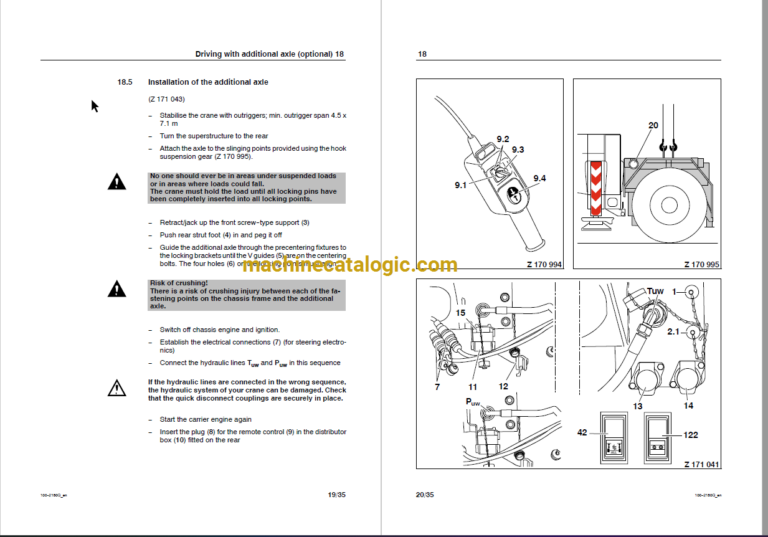
18.5 Installation of the additional axle …………………………………………….. 19
18.5.1 Removal of the additional axle ……………………………………………….. 25
18.6 Assembly of special 7.8 t counterweight (2) …………………………….. 29
18.6.1 Disassembly of special 7.8 t counterweight …………………………….. 31
18.7 Raising loads – slewing the superstructure ……………………………… 31
18.7.1 Ballasting the additional axle ………………………………………………….. 35
18.8 Maintenance note ………………………………………………………………… 35
Manufacturer’s Specifications
Foreword
1 Safety Instructions
1 Safety Instructions ……………………………………………………………. 1
1.1 General …………………………………………………………………………… 1
1.2 Intended Use …………………………………………………………………… 3
1.3 Operating Conditions and Computed Design of the Crane …….. 7
1.3.1 General …………………………………………………………………………… 7
1.3.2 Classification of the Crane…………………………………………………. 7
1.3.3 Classification of the Engines ……………………………………………… 9
1.3.4 Workplace Ergonomics……………………………………………………. 11
1.3.5 Load and Utilisation of the Crane ……………………………………… 11
1.3.6 Required Ambient Conditions …………………………………………… 13
1.3.7 Service Life ……………………………………………………………………. 15
1.3.8 Standards and Calculation Regulations …………………………….. 17
1.3.9 Dangers to Air Traffic………………………………………………………. 19
1.4 Safety Regulations …………………………………………………………. 21
1.4.1 Organisational Measures…………………………………………………. 23
1.4.2 Selection and Qualifications of Personnel ………………………….. 25
1.4.3 Particular Hazards ………………………………………………………….. 27
1.4.4 Combination of Hazards with Combined Operation“of
Two or More Cranes ……………………………………………………….. 39
1.4.5 Driving Operation……………………………………………………………. 43
1.4.6 Crane Operation …………………………………………………………….. 47
1.4.7 Power Supply Failure ……………………………………………………… 65
1.4.8 When Assembling and Dismantling Crane Components ……… 67
1.5 Hand Signals …………………………………………………………………. 73
1.5.1 General Hand Signals …………………………………………………….. 75
1.5.2 Hand Signals for Working Movements ………………………………. 77
1.5.3 Hand Signals for Driving Movements ………………………………… 79
2 Structure of the Mobile Crane
2.1 Serial Plate ……………………………………………………………………… 3
2.2 Safety Signs ……………………………………………………………………. 5
2.3 Overview…………………………………………………………………………. 7
2.4 Crane Chassis …………………………………………………………………. 9
2.5 Superstructure ……………………………………………………………….. 11
2.6 Boom System ………………………………………………………………… 13
2.6.1 Boom Lengths ……………………………………………………………….. 13
3 —
e100-1000-285 2/6
Contents
Date: 27.CW/05
4 Crane operator’s cab
4 Crane operator’s cab …………………………………………………… 3
4.1 Controls and Displays………………………………………………….. 3
4.1.1 Dashboard installation (overview) …………………………………. 5
4.2 Entering / leaving the cab …………………………………………… 21
4.3 Tilting the Cab ………………………………………………………….. 23
4.4 Workplace Ergonomics………………………………………………. 25
4.4.1 Adjusting the Crane Operator’s Seat ……………………………. 25
4.4.2 Sun shield ………………………………………………………………… 27
4.4.3 Lighting equipment ……………………………………………………. 27
4.4.4 Open / close window …………………………………………………. 29
4.4.5 Storage ……………………………………………………………………. 31
5 Engine
5 Engine (Mercedes Benz OM 904 LA) …………………………….. 3
5.1 Checks before Starting ………………………………………………… 3
5.2 Starting Procedure ………………………………………………………. 5
5.3 Switching Off the Engine ……………………………………………… 9
5.4 Jump Starting …………………………………………………………….. 9
5.5 Engine Cutout Switch (Optional) …………………………………… 9
6 Driving (Optional)
6.1 Driving from Above from the Crane Operator’s Cab ………… 1
6.1.1 Driving from Above in the Transport Condition
(only on the Construction Site) ……………………………………… 5
6.2 Driving in Erect Mode ………………………………………………….. 7
6.3 Supporting the Crane on Outriggers from the Superstructure
Cab (optional) …………………………………………………………….. 9
7 —
8 Slewing
8 Slewing ……………………………………………………………………… 3
8.1 Preparations for Slewing ……………………………………………… 3
8.2 Slewing the Superstructure ………………………………………….. 5
8.3 Slew Speeds………………………………………………………………. 7
8.4 Braking the Superstructure using the pedal (12)
(opened slewing gear circuit)………………………………………… 9
9 Counterweight
9 General Information …………………………………………………….. 1
9.1 Procedure for Fitting and Removing the Counterweight …… 3
9.2 Allocation of Counterweights for the Various Configurations 5
9.2.1 Counterweight Combination 2.0 t (Total Weight of the Crane
48 t / Axle Load Version 10 t) ……………………………………….. 5
9.2.2 Counterweight Combination 12.0 t / 13.3 t ……………………… 7
9.2.3 Counterweight Combination 25 t …………………………………… 9
9.2.4 Operating configuration 32t ………………………………………… 13
15 Main Boom Extension
15 General …………………………………………………………………………… 1
15.1 Fitting the Main Boom Extension ………………………………………… 3
15.2 Folding the Main Boom Extension 9.2 / 17 m ……………………….. 3
15.2.1 Folding the 9.2 m Lattice Mast out of the Travel Lock into
the Operating Position ………………………………………………………. 5
15.2.2 Folding the 17.0 m Main Boom Extension out of the Travel
Lock into the Operating Position……………………………………….. 13
15.3 Fitting the Main Boom Extension 25 m / 33 m …………………….. 17
15.3.1 Fitting the Main Boom Extension 25 m ………………………………. 17
15.3.2 Fitting the Main Boom Extension 33 m ………………………………. 19
15.4 Erection and Assembly Programme for Mounting
and/or Folding the Main Boom Extension…………………………… 23
15.4.1 Folding the Main Boom Extension out of Position “0”
into the Operating Position 20o or 40o ………………………………… 23
15.4.2 Telescoping the Main Boom in the “Raise Load” Position…….. 29
15.5 Fitting Procedure Main Boom Extension 9.2 / 17 m …………….. 33
15.6 Securing the Box Top Piece to the Main Boom …………………… 33
16 Heating and Ventilation
16 Heating and ventilation ……………………………………………………… 3
16.1 Hot-water heater (engine-dependent) …………………………………. 3
16.2 Engine-independent heating with radiator preheater……………… 5
16.2.1 Generalnotes …………………………………………………………………… 5
16.2.2 Operating elements ………………………………………………………….. 7
16.2.3 Setting ……………………………………………………………………………. 9
16.2.4 Heating operation without pre-set times …………………………….. 11
16.2.5 Heating operation with preselection ………………………………….. 13
16.2.6 Rectifying faults ……………………………………………………………… 19
16.3 Air conditioning equipment ………………………………………………. 21
16.4 Liquid gas heating (optional) ……………………………………………. 23
17 Reeving
17.1 Rope Equipment and Reeving……………………………………………. 3
17.2 Load Lifting Equipment ……………………………………………………… 7
17.2.1 Hoist ropes ……………………………………………………………………… 9
17.2.1.1 General …………………………………………………………………………… 9
17.2.1.2 Rope End Connections……………………………………………………… 9
17.2.2 Hook Blocks…………………………………………………………………… 13
17.2.2.1 Definition……………………………………………………………………….. 13
17.2.2.2 Markings ……………………………………………………………………….. 13
17.2.2.3 Handling ……………………………………………………………………….. 15
17.3 Reeving the Hoist Rope on the Main Boom Head……………….. 19
17.3.1 HD Attachment ………………………………………………………………. 21
17.3.2 Other Accessories / Other Reevings …………………………………. 21
e100-1000-285 6/6
Contents
Date: 27.CW/05
36 Emergency Operation
36 Emergency Operation (Optional) ………………………………………… 3
41 Runner
41 Runner for Hoist 2 ……………………………………………………………. 1
41.1 Fitting ……………………………………………………………………………… 3
41.2 Removal …………………………………………………………………………. 5
41.3 Runner in Transport Position ……………………………………………… 5
41.4 Feeding the Rope …………………………………………………………….. 7
1 Notes on Safety
1 Notes on Safety …………………………………………………………….. 1
2 Fuels and Lubricants
3 Capacities
4 Lubrication and Maintenance Schedule
4 Lubrication and Maintenance Schedule…………………………….. 2
4.1 Initial Lubrication and Maintenance ………………………………….. 2
4.2 Regular Routine Lubrication and Maintenance …………………… 2
4.3 Maintenance List……………………………………………………………. 4
5 Drive
5 Drive ……………………………………………………………………………. 1
5.1 Engine OM 502 LA ………………………………………………………… 1
6 Transmission
6 Transmission ………………………………………………………………… 1
6.1 Transmission – Checking the Oil Level ……………………………… 2
6.2 Changing the Oil in the Drive Gearbox ……………………………… 3
6.3 Checking the Oil Level on the Retarder …………………………….. 5
6.4 Retarder – Oil Change …………………………………………………….. 7
6.5 Distributor Gear – Checking and Topping Up the Oil Level ……. 10
6.6 Distributor Gear – Changing the oil …………………………………. 11
7 Joint Shafts
7 Joint Shafts …………………………………………………………………… 1
7.1 Flange Connections ……………………………………………………….. 1
7.2 Lubricating the Joint Shaft Intermediate Bearing ………………… 1
e100-4000_a 2/3
Contents
Date: 31.CW/05
8 Axles
8 Axles ……………………………………………………………………………. 1
8.1 Checking and Tightening the Axle Fixings …………………………. 1
8.2 Lubricating the Axles ……………………………………………………… 2
8.3 Steering and Track Arm ………………………………………………….. 2
8.4 Axle Drive – Checking and Topping Up the Oil Level …………… 3
8.5 Wheel Hub Drive – Checking and Topping Up the Oil Level …. 4
8.6 Axle Drive – Changing the Oil ………………………………………….. 4
8.7 Wheel Hub Drive – Changing the Oil …………………………………. 6
8.8 Wheel Hub Bearing – Changing the Grease ………………………. 7
8.9 Suspension Cylinders …………………………………………………….. 8
9 Steering
9 Steering ……………………………………………………………………….. 1
9.1 Steering Components …………………………………………………….. 1
9.2 Lubricating the Steering Components ………………………………. 3
9.3 Replacing the Hoses………………………………………………………. 4
9.4 Lubricating Independent Rear Axle Steering ……………………… 4
10 Braking System
10 Braking System……………………………………………………………… 1
10.1 Check brake linings for wear …………………………………………… 2
10.2 Renew brake linings ………………………………………………………. 2
10.3 Replace brake drums……………………………………………………… 3
10.4 Perform brake function check ………………………………………….. 3
10.5 Check expanding cylinder……………………………………………….. 3
10.6 Replace other brake parts ………………………………………………. 3
10.7 Air Drier with Integrated Pressure Regulator ……………………… 4
10.8 Draining Water from the Air Tanks……………………………………. 4
11 Wheels and Tyres
11 Wheels and Tyres ………………………………………………………….. 1
11.1 Tightening the Wheel Nuts ……………………………………………… 1
11.2 Changing the Wheels and Tyres ……………………………………… 2
11.3 Tyres – Checking Pressure and Tread Depth and
Checking for Damage …………………………………………………….. 2
12 Hydraulic System
12 Hydraulic System …………………………………………………………… 1
12.1 Hydraulic Tank – Checking and Topping Up the Oil Level ……. 2
12.2 Hydraulic Tank – Return oil filter ……………………………………….. 3
12.3 Hydraulic Tank – Replace the Aeration Filter ……………………… 7
12.4 Changing the Hydraulic Oil ……………………………………………… 8
12.5 Bleeding the Hydraulic System ………………………………………. 10
12.6 Hydraulic System – Pressure Accumulator,
Checking the Preliminary Gas Tension …………………………… 11
13 Outriggers
13 Outriggers …………………………………………………………………….. 1
13.1 Lubricating the Sliding Surfaces on the Outrigger Struts ……… 1
14 Electrical System
14 Electrical System …………………………………………………………… 1
14.1 Checking the Lighting System …………………………………………. 1
14.2 Replacing bulbs – e.g. spotlight ………………………………………… 1
14.3 Battery maintenance ………………………………………………………. 1
14.4 Fuses …………………………………………………………………………… 2
15 Fuel System
15 Fuel System ………………………………………………………………….. 1
16 Air Intake and Cooling System
16 Air Intake and Cooling System ………………………………………… 1
17 Piston Rods
17 Piston Rods ………………………………………………………………….. 1
18 Optional Equipment
18 Optional Equipment ……………………………………………………….. 1
18.1 Auxiliary Heating ……………………………………………………………. 1
18.2 Auxiliary Heating – Checking the System is
Functioning Correctly ……………………………………………………… 1
18.3 Replacing the Heat Exchanger ………………………………………… 2
18.4 Switching on the Hot Water Heating …………………………………. 2
18.5 Checking and Replacing the Fuel Filter …………………………….. 2
18.6 Lubricating the Dolly Coupling …………………………………………. 3
18.7 Servicing the Dolly Coupling ……………………………………………. 3
18.8 Refilling the Central Lubrication System ……………………………. 4
19 Visual Inspections
19 Visual Inspections …………………………………………………………..