Takeuchi TCR50-2 Crawler Dumper Operators Manual (AAA0EN013) (SN 305400002-)
On a machine like the Takeuchi TCR50-2 crawler dumper, you’re usually hauling spoil, stone or pipe across muddy, uneven sites where space is tight and visibility isn’t great. This operators manual is what I’d keep handy to understand how the controls should respond under load, how the dumper behaves on slopes, and what to check every day before you start shuttling material. If, for example, the machine feels sluggish climbing a ramp or the dump body doesn’t tip as expected, I’d use this book to verify proper operating steps, confirm indicator meanings, and rule out simple operator or setup issues before chasing a mechanical fault.
Applications & Use Cases
- Teach new operators how to run the TCR50-2 smoothly without shocking the drivetrain or undercarriage.
- Plan daily walk‑around checks so leaks, loose tracks, or damaged rollers are caught early.
- Verify correct use of travel and dump controls when working on side slopes or soft ground.
- Improve load awareness so the operator doesn’t overfill or dump in an unstable position.
- Reduce premature wear by following proper warm‑up, shutdown, and idling habits.
FAQ
Q: Can I keep this manual on a tablet in the cab?
A: Yes, as long as the file is accessible offline and the screen is readable in glare, it’s fine; I still print key pages for quick reference.
Q: Is this manual useful for basic troubleshooting?
A: It won’t replace a service manual, but it helps you isolate operator errors, misused controls, and unsafe conditions before calling a technician.
Safety Note
Always follow the manual’s operating limits and stay aware of ground conditions before traveling or dumping on a slope.
Takeuchi TCR50-2 Crawler Dumper Index:
- Safety alert symbol
- Signal words
- Introduction
- Foreword
- Manual storage compartment
- Serial numbers
- Machine description
- Front, rear, left and right
- Designated operations
- Features
- Break-in period
- Notes on reading this manual
- Abbreviation used in this manual
- Revision history
- Safety
- General precautions
- Precautions when preparing
- Precautions when starting
- Precautions when operating
- Precautions when stopping
- Precautions when transporting
- Precautions on maintenance
- Safety signs (decals)
- Controls
- Names of components
- Covers
- Ignition key
- Fuel filler port
- DEF/AdBlue® refill port
- Engine hood
- Side cover (tool box)
- Battery cover
- Dump body prop
- Cab
- Cab door
- Emergency exit
- Front window
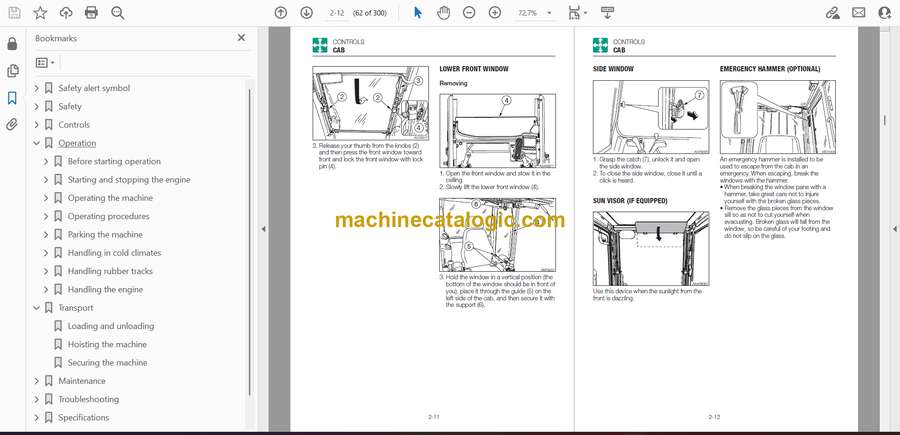
- Lower front window
- Side window
- Sun visor (if equipped)
- Emergency hammer (optional)
- Seat and seat belt
- Multi-information display
- Home screen
- Warning lamps
- Indicators
- Screen control key
- Screen navigation
- Switching images
- Switches
- Ignition switch
- Engine shutdown switch
- Throttle controller
- Horn button
- Deceleration button
- Turn signal buttons
- Travel speed button
- Automatic deceleration switch
- DPF manual regeneration/inhibit select switch
- Parking brake switch
- Working light switch
- Front wiper switch
- Washer switch
- Beacon lamp switch (If equipped)
- Rear wiper/Washer switch
- Levers and Pedals
- Safety lock lever
- Control levers
- Throttle pedal
- Accessories
- Air conditioner (If equipped)
- Heater (If equipped)
- Cup holder
- Power supply socket
- External power socket
- Interior light
- Radio (Digital Audio Broadcasting not supported)
- Radio (Digital Audio Broadcasting supported)
- Fuel Supply Pump (if equipped)
- Rear light (if equipped)
- Mirrors
- Camera
- Auto camera mode
- Operation
- Before starting operation
- Getting on or off the machine
- Walk-around inspection
- Daily inspection
- Starting and stopping the engine
- Before starting the engine
- Starting the Engine
- Warming up the engine
- Stopping the engine
- Operating the machine
- Lever pattern
- Warming up the machine (hydraulic oil)
- Inspection after warm-up
- Traveling the machine
- Stopping travel
- Operating the dump body
- Operating procedures
- Cautions on operating
- Precautions on using the machine in water
- Precautions when traveling on slopes
- Operations possible with this machine
- Parking the machine
- Parking
- Inspection and checks after stopping the engine
- Handling in cold climates
- Preparing for cold climates
- Cautions after operations
- After the cold climate
- Handling rubber tracks
- Prohibitions
- Cautions
- Preventing the rubber tracks from coming off
- Handling the engine
- Prohibitions
- Cautions
- Diesel fuel
- Transport
- Loading and unloading
- Hoisting the machine
- Securing the machine
- Maintenance
- General
- Maintenance overview
- Cautions on maintenance
- Service data
- Fuel and lubricant table
- Handling of DEF/AdBlue®
- List of consumables
- List of tools (If equipped)
- List of tightening torques
- Safety-critical parts
- Maintenance list
- Walk-around inspection
- Inspecting by opening the engine hood and covers
- Inspecting by walking around the machine
- Inspecting while sitting in the operator’s seat
- Daily inspection (every 10 hours)
- Inspecting and replenishing the coolant
- Inspecting and replenishing the engine oil
- Inspecting the water separator
- Inspecting the fuel level
- Inspecting the hydraulic oil tank level and replenishing
- Lubricating the dump body and track rollers
- Checking the DEF/AdBlue® level and refilling
- After the initial 50 hours (only for new machines)
- Replacing the hydraulic oil return filter
- Replacing the pilot line filter
- Inspecting and adjusting the fan belt
- Inspecting and adjusting the compressor belt (Air conditioner)
- Every 50 hours
- Inspecting the track tension
- Inspecting the battery fluid level and replenishing
- After the initial 250 hours (only for new machines)
- Replacing the travel motor gear oil
- Every 250 hours
- Inspecting and adjusting the fan belt
- Inspecting and adjusting the compressor belt (Air conditioner)
- Draining the water from the fuel tank
- Cleaning the air cleaner
- Cleaning the radiator fins and the oil cooler fins
- Cleaning the condenser (Air conditioner)
- Cleaning the air filters (Air conditioner/Heater)
- Inspecting the refrigerant (gas) level (Air conditioner)
- Lubricating the swing bearing
- Every 500 hours
- Replacing the pilot line filter
- Replacing the engine oil and the oil filter
- Replacing the fuel filter
- Replacing the water separator filter
- Inspecting the slew pinion gear
- Replacing the air cleaner element
- Every 1000 hours
- Replacing the hydraulic oil return filter
- Replacing the travel motor gear oil
- Replacing the hydraulic oil and cleaning the suction strainer
- Inspecting and adjusting the engine valve clearance
- Inspecting the radiator cap
- Every 1500 hours
- Inspecting the crankcase breather system
- Every 2000 hours
- Cleaning the engine cooling system
- Every 3000 hours
- Inspecting the ECU and related sensors and actuators
- Inspecting the turbocharger (blow wash as necessary)
- Inspecting the DPF and DOC
- Inspecting the operation of the air intake throttle valve
- Inspecting the SCR catalyst and related sensors and actuators
- Inspecting and replacing the supply module main filter
- Inspecting and cleaning the fuel injector
- When required
- Inspecting and replenishing the windshield washer fluid
- Lubricating the levers
- Draining the water from the water separator
- Inspecting and cleaning the DPF soot filter
- Inspecting the rubber tracks
- Replacing the rubber tracks
- Every 2 years
- Replacing the receiver dryer
- Maintenance during extended storage period
- Troubleshooting
- Symptoms that are not malfunctions
- If the engine overheats
- If the battery goes dead
- If a fuse blows
- Inspecting and replacing the fuse
- Restarting after adding fuel
- Bleeding air from the fuel system
- Restarting when the DEF/AdBlue® level is low or the tank is empty
- If a warning lamp flashes
- Vehicle error code list
- Engine error code list
- Other symptoms
- Towing
- Lowering the dump body
- If the cab is damaged
- Exhaust gas control system error
- Error code list
- NOx control diagnostic system (NCD)
- Particulate control diagnostic system (PCD)
- Limiting the engine output
- Output limitation performed by inducement due to an abnormality detected in the SCR system
- Output limitation performed by inducement due to decreased DEF/AdBlue® tank level
- Specifications
- Basic Specifications
- Machine dimensions
- Operating ranges
- Options
- General precautions
- Safety precautions
- Cautions when installing attachments
- Precautions when operating attachments
- Optional equipment mass
- Takeuchi Security System
- Ignition key
- Starting the engine
- Registering and deleting the ignition key
- If the master key is lost
- Countries where the system can be used
- Takeuchi Fleet Management (TFM)
Weidemann