Case 270BC Backhoe Loader Operators Manual (92699155) (September 2025)
On a site, this Case 270BC backhoe loader’s usually living in mud, ruts, frozen ground, and tight spots around forms and utilities. This operators manual helps you run it the way it was meant to be run—how the controls actually respond when you’re digging, loading, or holding on a slope, and what to trace and check every day so it’ll start and work when you need it. Say you’re trenching near a buried line on a wet morning: the book walks you through how to set up, stabilize, dig, and swing the load without fighting the hydraulics or skating the machine sideways.
Applications & Use Cases
- Trace and verify all the daily walk‑around checks so you catch loose pins, leaks, and bad hoses before they strand you in the hole.
- Learn how the loader and backhoe controls behave under load, so you can feather the hydraulics instead of jerking the bucket or stalling the machine.
- Isolate weird noises or vibrations by following the manual’s inspection routines, then decide if you can finish the day or need it in the shop.
- Route and stow hoses, buckets, and attachments properly so you don’t pinch a line when you crowd a wall or trailer it.
- Check and bleed fuel and hydraulic systems the right way after filter changes, so you don’t crank forever or air-lock the system.
FAQ
Q: Is this a PDF I can search on my phone or laptop?
A: Yes, it’s typically a searchable PDF, so you can jump to sections by keyword instead of scrolling forever.
Q: Can I print just a few pages to keep in the cab?
A: You usually can; most folks print the lubrication, daily checks, and safety pages, then keep the full file on a tablet or phone for deeper stuff.
Safety Note
Always drop the bucket and backhoe to the ground, kill the engine, and release system pressure before you crack any hydraulic fitting or pull a hose.
Case 270BC Backhoe Loader Index:
- 1. Introduction
- 1.1. General information
- 1.2. Identification
- 1.2.1. Product Identification Number
- 1.3. Alignment reference
- 1.4. Adjustment of Operator’s seat
- 2. Description and definitions
- 2.1. Description
- 2.2. Definitions
- 2.3. Overview
- 3. Safety instructions
- 3.1. General information
- 3.1.1. Guards
- 3.1.2. Warning, prohibition and information decals
- 3.1.3. Explanation of warning levels
- 3.2. Symbol explanation
- 3.3. Mounting of backhoe
- 3.3.1. Checklist – Commissioning the backhoe:
- 3.4. Protection equipment
- 3.4.1. Safety belt
- 3.4.2. Operator’s Protection
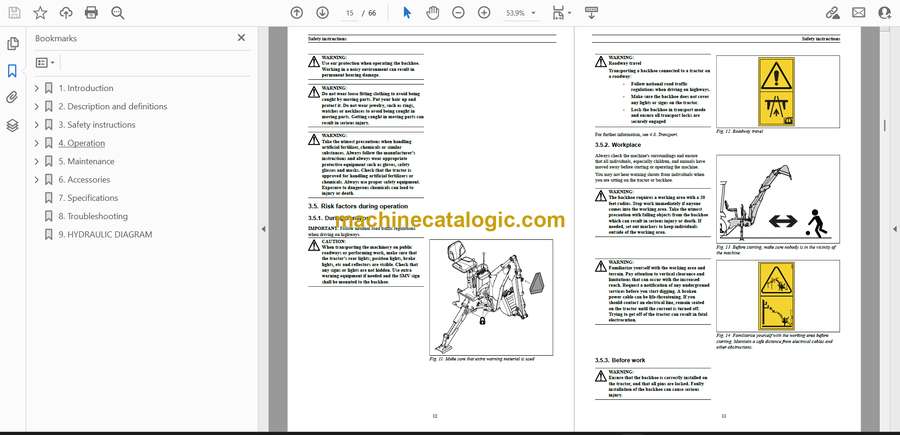
- 3.5. Risk factors during operation
- 3.5.1. During transport
- 3.5.2. Workplace
- 3.5.3. Before work
- 3.5.4. Replacement parts
- 3.5.5. Health aspects
- 3.5.6. Maintenance
- 3.5.7. Safety instruction for installing the backhoe
- 3.5.8. Safety instructions for operating
- 3.5.9. Safety instructions for transport
- 3.5.10. Safety instructions for shutdown
- 3.5.11. Safety instructions for maintenance
- 3.6. Location of warning, prohibition and information decals
- 4. Operation
- 4.1. General information
- 4.1.1. Engine speed
- 4.1.2. Operator controls
- 4.1.3. Control lever Boom/Swing
- 4.1.4. Use Dipperstick/Bucket
- 4.2. Positioning the backhoe on a platform
- 4.3. Using the stabilizers
- 4.3.1. Lowering the stabilizers
- 4.3.2. Left stabilizer
- 4.3.3. Right stabilizer
- 4.4. Using the backhoe
- 4.4.1. Fill the bucket
- 4.4.2. Emptying the bucket
- 4.5. Digging vertical walls
- 4.6. Backfilling
- 4.7. Coupling and uncoupling attachments
- 4.8. Transport
- 4.8.1. Swing frame lock
- 4.8.2. Boom lock
- 4.8.3. Stabilizer locks
- 4.9. Connecting and disconnecting the backhoe
- 4.9.1. Disconnecting the backhoe
- 4.10. Coupling the backhoe
- 4.10.1. Three-point linkage
- 5. Maintenance
- 5.1. Storage
- 5.2. Use after storage
- 5.3. Hydraulic hoses
- 5.4. Bucket teeth
- 5.5. Tightening torques – bolt connections
- 5.6. Lubrication
- 6. Accessories
- 6.1. “Thumb” for the bucket
- 6.2. Stabilizer street pads
- 6.3. Large foot pads
- 6.4. Bucket availability
- 7. Specifications
- 8. Troubleshooting
- 9. HYDRAULIC DIAGRAM
CNH