Case 810LA, 815LA, 830LA, 835LA, 850LA, 855LA, 857LA, 910LA, 915LA, 917LA, 935LA, 937LA Front loader Operators Manual (92760685 Replaces 92249141) (December 2025)
These Case LA loaders usually live on farms, construction sites, and yards where you’re moving dirt, gravel, bales, or pallets all day. This operators manual helps you run the loader the way it was meant to be run—how the controls react with a full bucket, how it behaves on a slope, and what to check before you even turn the key. Say you’re climbing a wet pile with a loaded bucket: the book walks you through how to feather the controls, keep the rear end planted, and not overload the front frame.
Applications & Use Cases
- Trace and check daily points—pins, hoses, cylinders—so you catch play or seepage before something lets go under load.
- Verify you’re using the right attachment position and lift angle when stacking bales or pallets, so you don’t lose the load when you tilt back.
- Isolate hydraulic issues by learning the normal sound and response of the joystick, then test step‑by‑step instead of just swapping parts.
- Inspect and route hoses and lines correctly after a repair, then bleed the system the way Case expects, not “close enough.”
- Align your approach on slopes or mud so the loader stays stable while you crowd into the pile and back out without spinning or digging holes.
FAQ
Q: Is this a PDF I can search on my phone or laptop?
A: Yes, it’s typically a searchable PDF, so you can jump to sections and keywords instead of flipping pages.
Q: Can I print just a few pages to keep in the cab?
A: You usually can; most folks print the safety, daily checks, and lubrication pages and leave the rest digital.
Safety Note
Always drop the bucket, kill the engine, and release hydraulic pressure before you crack any hose or fitting loose.
Case 810LA, 815LA, 830LA, 835LA, 850LA, 855LA, 857LA, 910LA, 915LA, 917LA, 935LA, 937LA Front loader Index:
- GENERAL INFORMATION
- Note to the owner
- Intended use
- Electro-Magnetic Compatibility (EMC)
- Metric and imperial units abbreviations
- Product Identification Number (PIN)
- Operator’s manual storage
- Implement orientation
- Definition
- SAFETY INFORMATION
- Safety rules and signal word definitions
- Safety rules
- Safety instructions
- Ecology and the environment
- Personal protective equipment (PPE)
- Loader use limits
- Using loader attachments
- Safety signs
- OPERATING INSTRUCTIONS
- Commissioning the unit
- Loader preparation
- Counterweights
- Hydraulic controls
- Installing the loader
- Removing the loader
- Re-installing the loader
- Check list
- TRANSPORT OPERATIONS
- Road transport
- Transporting by truck or trailer
- Lifting points
- WORKING OPERATIONS
- General information
- Operating the loader
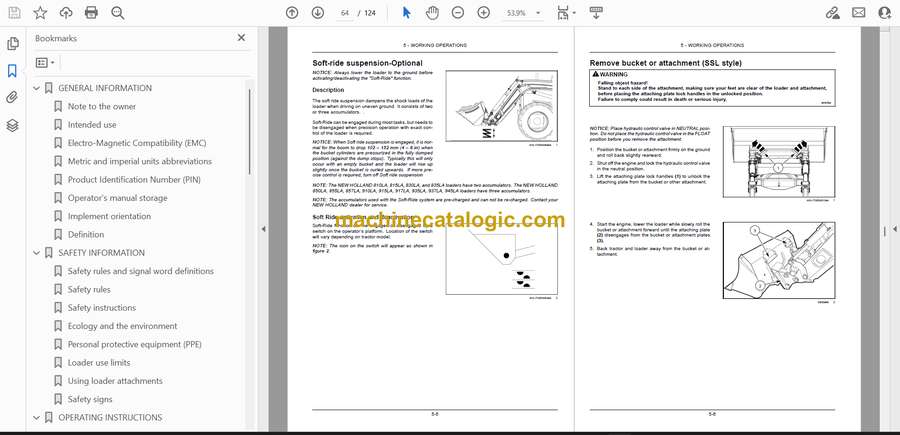
- Soft-ride suspension-Optional
- Remove bucket or attachment (SSL style)
- Install bucket or attachment (SSL style)
- Remove bucket or attachment (EURO Style)
- Install bucket or attachment (EURO style)
- Remove bucket or attachment with hydraulic lock (EURO Style)-Optional
- Install bucket or attachment with hydraulic lock (EURO style)-Optional
- Operation with grapple fork attachment
- Operation with H.D. bale grip
- Operation with bale spike attachment
- MAINTENANCE
- General information
- Note to the owner
- Torque – Minimum tightening torques for normal assembly
- Torque – Standard torque data for hydraulics
- Storage
- Consumables
- Maintenance planning
- Every 8 hours or daily
- After the first 10 hours
- Loader subframe torque-Check
- Every 50 hours
- Loader subframe torque-Check
- Check the hydraulic system for leaks
- TROUBLESHOOTING
- Symptom(s)
- Basic instructions
- Loader attachment – Troubleshooting
- SPECIFICATIONS
- ACCESSORIES
- FORMS AND DECLARATIONS
- Predelivery report – Dealer copy
- Predelivery report – Owner copy
CNH