Case 221G, 321G, 321G XR Compact Wheel Loader Operators Manual (92705654) (December 2025)
These Case 221G / 321G loaders usually live in dirt, gravel, feed yards, snow piles, and tight construction sites—lots of backing, tight turns, and working around people and trucks. This operators manual helps you understand what every control really does, how the machine reacts under load or on a slope, and the daily checks that keep it earning instead of sitting dead. Think about easing into a wet pile of gravel on a cold morning: this manual walks you through how to set the controls, how to feather the throttle and hydraulics, and what to inspect when the bucket won’t curl like it should.
Applications & Use Cases
- Trace and check hydraulic issues step by step before you start throwing parts at it.
- Verify you’re using the right work mode and differential settings for mud, snow, or hardpack so the machine doesn’t just spin and dig holes.
- Isolate weird warning lights or beeps, then test the simple stuff first—switches, fuses, connections.
- Route your daily walk‑around: fluids, tires, pins, couplers, so you typically catch problems before they get expensive.
- Learn how to park, lower, and bleed off pressure correctly so you don’t fight hoses or blow fittings at the end of the day.
FAQ
Q: Is this a PDF I can search on my phone or laptop?
A: Yes, it’s typically a searchable PDF, so you can jump to what you need by keyword instead of scrolling forever.
Q: Can I print just a few sections to keep in the cab?
A: You can usually print any pages you want, which is handy for keeping the lubrication chart or control layout right in the machine.
Safety Note
Always lower the attachment, chock if needed, and bleed off hydraulic pressure before you inspect or disconnect any hoses.
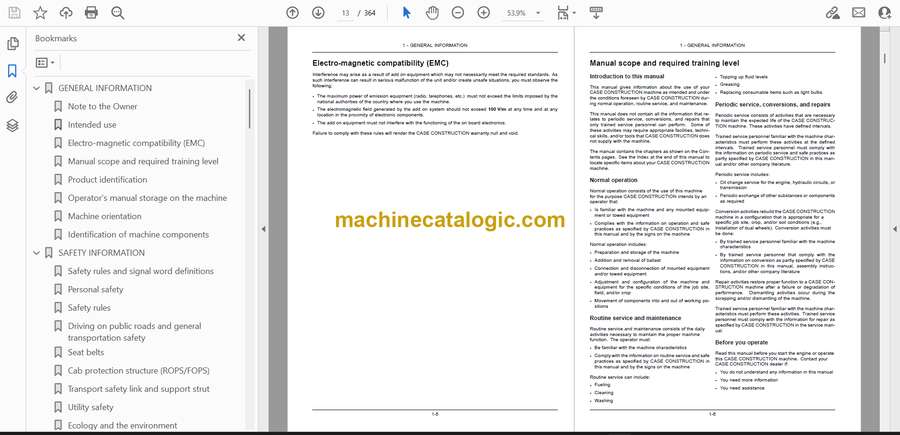
Case 221G, 321G, 321G XR Compact Wheel Loader Index:
- GENERAL INFORMATION
- Note to the Owner
- Intended use
- Electro-magnetic compatibility (EMC)
- Manual scope and required training level
- Product identification
- Operator’s manual storage on the machine
- Machine orientation
- Identification of machine components
- SAFETY INFORMATION
- Safety rules and signal word definitions
- Personal safety
- Safety rules
- Driving on public roads and general transportation safety
- Seat belts
- Cab protection structure (ROPS/FOPS)
- Transport safety link and support strut
- Utility safety
- Ecology and the environment
- Hand signals
- Safety signs
- CONTROLS AND INSTRUMENTS
- Access to operator’s platform
- Operator’s seat
- Forward controls
- Front console
- Steering column
- Pedals
- Climate controls
- Left-hand side controls
- Right-hand side controls
- Side console overview
- Joystick
- Wrist rest
- Encoder
- Keypad
- Side window
- Exterior controls
- Display
- Display overview
- Display description
- OPERATING INSTRUCTIONS
- Starting the unit
- Starting the unit
- Operating in extreme temperatures
- Stopping the unit
- Moving the unit
- Joystick control
- High Flow (optional)
- Differential lock (optional)
- TRANSPORT OPERATIONS
- Road transport
- Recovery transport
- Transporting the machine
- Manual disengagement gears
- Parking brake discs disabling
- Parking brake discs enabling
- Towing
- Lifting
- WORKING OPERATIONS
- General information
- Operating tips
- Loader attachments
- Coupling to the attachment
- Uncoupling the attachment
- MAINTENANCE
- General information
- Servicing
- Remote Service Tool (RST)
- Tool box
- Releasing pressure in the hydraulic system
- General specification – Diesel fuel – Diesel fuel
- General specifications – Biodiesel fuels – Biodiesel fuels
- Fluids and lubricants
- Oil recommended operating temperature range
- Engine cooling system
- Maintenance planning
- Every 10 hours
- General inspection
- Engine oil level – Check
- Hydraulic oil level – Check
- Engine coolant level – Check
- Every 50 hours
- Grease fittings
- Cab air filter – Cleaning
- Cab air recirculation filter – Cleaning
- Engine air filter – Cleaning
- Brake oil level – Check
- Front axle oil level – Check
- Rear axle oil level – Check
- Axles reduction gears oil level – Check
- Gearbox oil level – Check
- Tire pressure – Check
- Wheel nuts tightening – Check
- Initial 150 hours
- Front axle oil – Change (initial 150 hours)
- Rear axle oil – Change (initial 150 hours)
- Axles reduction gears oil – Change (initial 150 hours)
- Gearbox oil – Change (initial 150 hours)
- Every 250 hours
- Air conditioning condenser – Cleaning
- Compressor drive belt – Check
- Parking brake – Check
- Every 500 hours
- Engine oil – Change
- Engine oil filter – Replace
- Fuel pre-filter – Replace
- Fuel filter – Replace
- Every 1000 hours
- Air intake lines
- Engine coolant – Replace
- Hydraulic oil – Change
- Hydraulic oil filter – Replace
- Cab air filter – Replace
- Cab air recirculation filter – Replace
- Front axle oil – Change
- Rear axle oil – Change
- Axles reduction gears oil – Change
- Gearbox oil – Change
- Battery charge – Check
- Every 2000 hours
- Engine air filters – Replace
- Blowby recirculation filter – Replace
- Brake oil – Change
- Every 3000 hours
- Drive belt – Replace
- Fuel tank
- As required
- Radiators – Cleaning
- Windshield washer fluid level – Check
- Hydraulic connectors and hoses – Replace
- Battery – Replace
- Lights and rotary beacon – Replace
- Fuses and relays
- Storage
- Preparation
- Every 30 days
- Removal
- SPECIFICATIONS
- General specifications
- Lift capacities
- Machine specifications and dimensions – 221G General specifications
- Machine specifications and dimensions – 321G General specifications
- Tires
- ACCESSORIES
CNH