Case 622TL, 627TL, 632TL, 637TL Front Loader Front loader Operators Manual (92760691 Replaces 47886200) (October 2025)
These Case loaders usually live in dirt and gravel, bouncing between job sites, farm yards, and yards full of pallets. This operators manual helps you run the loader the way it was meant to be run—how the controls actually feel, what to watch when you’re crowding a bucket, how it reacts on a slope or in soft ground. Say you’re loading trucks on a wet morning: the book walks you through how to trace a hydraulic issue, check your attachment locking, and verify you’re not overloading the front end before something bends or breaks.
Applications & Use Cases
- Learn the proper start‑up and shutdown routine so you can inspect, grease, and check fluids without skipping steps.
- Follow the recommended way to route hoses and park attachments, so you don’t pinch lines or damage couplers.
- Use the control descriptions to test and isolate odd behavior—slow lift, jerky tilt, loader drifting down under load.
- Get the right method to bleed trapped pressure before you unhook a hose, so you’re not fighting fittings or getting sprayed.
- Understand how to align and level the bucket or forks for cleaner grading, safer pallet work, and less wear on pins.
FAQ
Q: Is this a PDF I can search on my laptop or phone?
A: Yes, it’s typically a searchable PDF, so you can jump to sections by keyword instead of flipping pages.
Q: Can I print just a few pages to keep in the cab?
A: You usually can; most folks print the daily checks, safety, and control layouts, then keep the full file on a device.
Safety Note
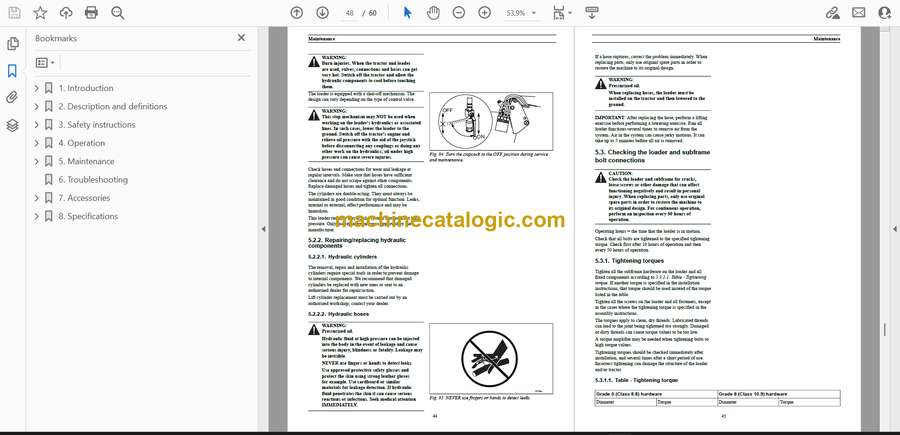
Always drop the loader to the ground, kill the engine, and cycle the controls to release pressure before you crack any hydraulic fitting.
Case 622TL, 627TL, 632TL, 637TL Front Loader Front loader Index:
- 1. Introduction
- 1.1. General information
- 1.2. Identification
- 1.2.1. Model and serial number
- 1.2.2. Component identification
- 1.3. Alignment reference
- 2. Description and definitions
- 2.1. Description
- 2.2. Definitions
- 2.2.1. Implement
- 2.2.2. Third hydraulic function
- 2.2.3. Multi Coupling MC 4 (Optional)
- 2.2.4. Position indicator
- 2.2.5. Control valve
- 2.2.6. Hose kit
- 2.2.7. SoftDrive Load Damping System (Optional)
- 2.2.8. Loader with mechanical self-leveling, MSL, with Euro carrier
- 2.2.9. Loader without mechanical self-levelling
- 2.2.10. Tool carrier
- 2.3. Tool carrier
- 3. Safety instructions
- 3.1. General information
- 3.1.1. Guards
- 3.1.2. Warning, prohibition and information decals
- 3.1.3. Explanation of warning levels
- 3.2. Symbol explanation
- 3.3. Installing the loader
- 3.3.1. Checklist – Loader installation:
- 3.4. Joystick operation
- 3.5. Protection equipment
- 3.5.1. Safety belt
- 3.5.2. ROPS, Rollover protection structure
- 3.5.3. Counterweight and tread width
- 3.6. Operation
- 3.6.1. Before work
- 3.6.2. Workplace
- 3.6.3. Stability
- 3.7. Risk factors
- 3.7.1. During transport and work
- 3.7.2. During service
- 3.7.3. After work
- 3.8. Replacement parts
- 3.9. Location of warning, prohibition and information decals
- 4. Operation
- 4.1. General information
- 4.2. Tractor/Loader Stability
- 4.2.1. Determination of Ballast
- 4.2.2. Minimum Tread Settings
- 4.3. Joystick operation
- 4.4. Connection and Operation Options
- 4.5. Operation with joystick
- 4.5.1. Mechanically controlled control valve and joystick
- 4.5.2. Button functions
- 4.6. Connecting a loader
- 4.7. Disconnecting a loader
- 4.8. SoftDrive Load Damping System (optional)
- 4.9. Loader Operation
- 4.9.1. Counterweight and tread width
- 4.9.2. Checking attachment
- 4.9.3. Load stability
- 4.10. Bale spike operation
- 4.11. Connect and disconnect implements
- 4.11.1. Uncoupling implements, Euro 8 Tool carrier
- 4.11.2. Coupling implements, Euro 8 Tool carrier
- 4.11.3. Uncoupling Implements, Skid Steer Tool carrier
- 4.11.4. Coupling Implements, Skid Steer Tool carrier
- 5. Maintenance
- 5.1. Lubrication
- 5.2. Hydraulic system
- 5.2.1. Hoses and cylinders
- 5.2.2. Repairing/replacing hydraulic components
- 5.3. Checking the loader and subframe bolt connections
- 5.3.1. Tightening torques
- 5.4. Storage
- 5.5. Recycling the loader
- 5.6. Transporting the loader
- 6. Troubleshooting
- 7. Accessories
- 7.1. Third hydraulic function
- 7.2. Boom suspension, SoftDrive
- 8. Specifications
CNH