Case 630LU, 635LU, 650LU, 655LU Tractor Operators Manual (92745156 Replaces 92669063) (September 2025)
These Case 630LU–655LU tractors usually live in fields, feedlots, and on construction sites where it’s dusty, uneven, and you’re always up against the clock. This operators manual helps you run the machine right—how the controls actually behave when you’re pulling an implement uphill, turning on soft ground, or working in sloppy mud. Say you’re backing a loaded trailer down a wet slope: the book walks you through which ranges to use, how to feather the clutch and brakes, and what to check after, so you don’t cook anything or twist something out of line.
Applications & Use Cases
- Trace and set up the controls so you know exactly how throttle, hitch, and hydraulics respond under load and on slopes.
- Check daily items—fluids, tire condition, linkage, hoses—so you catch leaks and loose hardware before they strand you.
- Verify and adjust PTO and hitch settings when you swap implements, so they lift, lower, and track straight instead of fighting you.
- Isolate and test basic electrical or hydraulic issues using the manual’s procedures before you start throwing parts at it.
- Inspect and bleed fuel or hydraulic systems the way Case expects, so you don’t introduce air or crack fittings by over-tightening.
FAQ
Q: Is this a PDF I can search on my phone or laptop?
A: It’s typically a searchable PDF; you can usually jump to sections and use keyword search while you’re in the shop or cab.
Q: Can I print just the pages I need to take to the field?
A: Yeah, most folks print the key procedures or diagrams, stick them in a plastic sleeve, and keep them in the tractor or service truck.
Safety Note
Always dump pressure and verify hydraulics are neutral before you crack any line or pull a quick-coupler.
Case 630LU, 635LU, 650LU, 655LU Tractor Index:
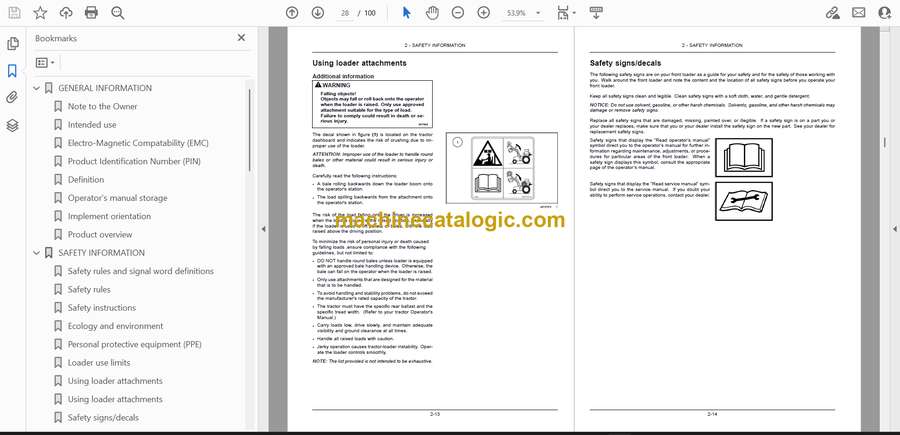
- GENERAL INFORMATION
- Note to the Owner
- Intended use
- Electro-Magnetic Compatability (EMC)
- Product Identification Number (PIN)
- Definition
- Operator’s manual storage
- Implement orientation
- Product overview
- SAFETY INFORMATION
- Safety rules and signal word definitions
- Safety rules
- Safety instructions
- Ecology and environment
- Personal protective equipment (PPE)
- Loader use limits
- Using loader attachments
- Using loader attachments
- Safety signs/decals
- CONTROLS AND INSTRUMENTS
- Right-hand side controls
- Operating the front loader with the joystick
- Mid-mount control valve
- OPERATING INSTRUCTIONS
- Commissioning the unit
- Loader preparation
- Counterweight
- TRANSPORT OPERATIONS
- Road transport
- Transporting by truck or trailer
- Lifting points
- WORKING OPERATIONS
- General information
- Setting the parking stands
- Loader unhitching
- Loader hitching
- Implement unhitching
- Implement hitching
- Implement models
- Implement carrier models
- Usage recommendations
- Implement position indicator
- Soft-ride suspension-Optional
- Grapple fork attachment – Operation
- MAINTENANCE
- General information
- Note to the owner
- Maintenance
- Maintenance planning
- Every 10 hours
- Front loader arm – Grease
- Front loader arm – Tighten Loader bolt and screw
- Every 20 hours
- Front loader arm – Check Locking system
- Every 50 hours
- Front loader arm – Tighten Hydraulic connections
- Every 100 hours
- Hydraulic hoses – Check
- Front loader arm – Check
- Implements Check
- General check
- Hydraulic system- Check for leaks
- Storage
- Front loader arm hydraulic system – Storing
- TROUBLESHOOTING
- Fault code resolution
- Basic instructions – Troubleshooting
- Loader attachment – Troubleshooting
- SPECIFICATIONS
- General specifications
- Consumables
- FORMS AND DECLARATIONS
- Pre-delivery report – Owner’s copy
CNH