Case E12D, E14D Mini Excavator Operators Manual (92710445, B280201084) (June 2025)
These Case E12D and E14D minis usually live in tight spots—driveways, backyards, trenches, small commercial sites—anywhere a big excavator won’t fit. This operators manual helps you run the machine the way it was meant to be run: how the controls actually respond, what to check before you swing, and how to trace problems before they turn into downtime. Picture this: you’re tracking across a wet slope with a loaded bucket, not sure how much you can swing without sliding—this is the book that explains how the machine behaves so you don’t find out the hard way.
Applications & Use Cases
- Learn how each joystick and pedal reacts so you can feather movements, hold grade, and keep the machine steady on slopes or in mud.
- Set up daily walk‑around checks to inspect hoses, track tension, pins, and fluid levels, so you catch leaks and play early.
- Trace and isolate basic hydraulic issues, then safely bleed off pressure before you crack a fitting or pull a quick‑coupler.
- Verify proper bucket changes and attachment mounting so pins align and hoses route cleanly without rubbing or twisting.
- Use the startup and shutdown routines to avoid cold starts abused under load and hot engines killed too fast.
FAQ
Q: Is this a PDF I can search through on my phone or laptop?
A: It’s typically a downloadable PDF, so you can search terms, zoom diagrams, and keep it handy in the truck or site office.
Q: Can I print just the sections I need for the jobsite?
A: Yes, most folks print the safety, controls, and maintenance sections, stick them in a binder, and leave the clean copy in the office.
Safety Note
Always verify the hydraulic system is fully depressurized and the attachment is on the ground before you inspect, disconnect, or test any line.
Case E12D, E14D Mini Excavator Index:
- 1 - Introduction
- 1.1 – Regarding this manual
- 1.1.1 – Manual consultation and terminology
- 1.2 – Machine identification data
- 1.3 – Manufacturer
- 1.3.1 – Contact the after-sales network
- 1.3.2 – Spare Parts
- 1.4 – Information to the owner of the machine
- 1.5 – Intended use
- 1.6 – Prohibited use
- 1.7 – Emissions overview
- 2 - Safety
- 2.1 – Safety symbol
- 2.2 – General safety
- 2.2.1 – Consulting the safety signs in the manual
- 2.3 – Safety signs and operation related labels
- 2.4 – Machine driver
- 2.4.1 – Personal Protective Equipment (PPE)
- 2.5 – Work Area – Hazard Zone – No entry zone
- 2.6 – List of Residual Risks
- 2.7 – Safety procedures
- 2.8 – Safety devices
- 2.8.1 – Operator guard structure
- 2.8.1.1 – FOPS Level I canopy (optional)
- 2.8.2 – Seat belt
- 2.8.3 – Controls cut-out lever
- 2.8.4 – Slewing locking lever
- 3 - Technical data
- 3.1 – General data
- 3.2 – Engine
- 3.3 – Hydraulic system
- 3.4 – Performance
- 3.5 – Digging arms
- 3.6 – Counterweight
- 3.7 – Dozer blade
- 3.8 – Undercarriage
- 3.9 – Fluid capacities
- 3.10 – Electrical system
- 3.11 – Brakes
- 3.12 – Nominal lifting capacity
- 3.13 – Rotating structure
- 3.14 – Overall dimensions
- 4 - Transporting the machine
- 4.1 – Transportation dimensions
- 4.2 – Loading/unloading Operations
- 4.3 – Securing the machine on the mean of transport
- 4.4 – Lifting of the machine
- 4.4.1 – Lifting procedure
- 4.5 – Recovering and pulling the machine
- 5 - Controls and tools
- 5.1 – Description of main controls and levers
- 5.2 – Description of left control console
- 5.3 – Description of right control console
- 5.4 – Roller operation
- 5.5 – Auxiliary power socket on console
- 5.6 – Flashing light (optional)
- 5.7 – Control panel
- 5.8 – Hour meter
- 5.9 – Battery disconnect switch
- 5.10 – Electric immobiliser (optional)
- 5.11 – Geo-localisation system (optional)
- 6 - Using the machine
- 6.1 – Commissioning
- 6.2 – Battery disconnect switch
- 6.3 – Driver’s seat
- 6.4 – Seat belt
- 6.5 – Controls cut-out lever
- 6.6 – Slewing locking lever
- 6.7 – Visibility
- 6.8 – Starting the engine
- 6.8.1 – Inspections prior to starting
- 6.8.2 – Procedure for starting the machine
- 6.9 – Start-up procedure with electric immobiliser (optional)
- 6.10 – Engine jump-starting procedure
- 6.10.1 – Connecting the additional cables
- 6.10.2 – Starting the engine
- 6.10.3 – Removing the additional cables
- 6.11 – Horn
- 6.12 – Work lights
- 6.13 – Operating at low temperatures
- 6.14 – Precautions during operation
- 6.15 – Stopping and parking the machine
- 6.16 – Refuelling
- 6.17 – Throttle lever
- 6.18 – Machine movement
- 6.18.1 – Travel movement horn (optional)
- 6.18.2 – Forward and reverse travel
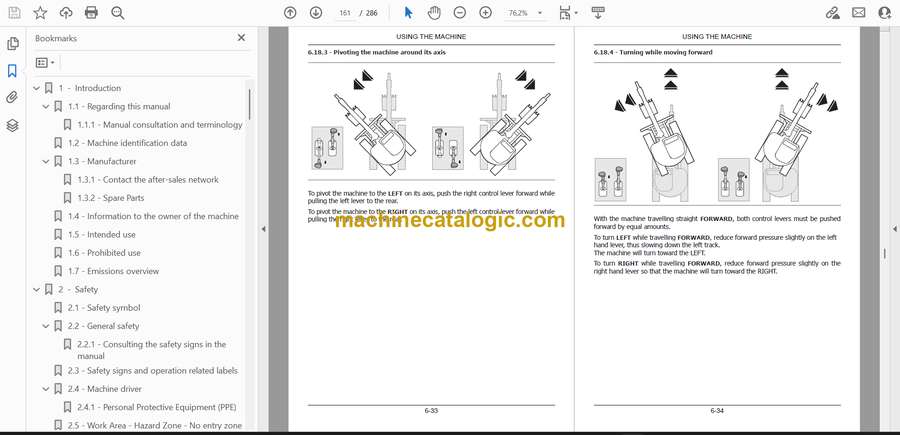
- 6.18.3 – Pivoting the machine around its axis
- 6.18.4 – Turning while moving forward
- 6.18.5 – Turning while reversing
- 6.18.6 – Precautions during the operation of the tracks
- 6.19 – Travel speed
- 6.20 – Dozer blade control/undercarriage width adjustment lever
- 6.20.1 – Dozer blade control
- 6.20.2 – Undercarriage width adjustment control
- 6.21 – Extendible dozer blade with extensions
- 6.22 – Boom movement
- 6.22.1 – Left Joystick
- 6.22.2 – Right joystick
- 6.22.3 – TPSS Valve ISO-SAE (optional) control layout
- 6.23 – Boom swing control
- 6.24 – Discharge residual pressure in the hydraulic system
- 6.25 – Boom swing/hydraulic system AUX2 selector button
- 6.26 – Auxiliary hydraulic systems
- 6.26.1 – Connection of equipment to the hydraulic systems
- 6.26.2 – Connections on second boom
- 6.26.3 – AUX1 Auxiliary hydraulic system
- 6.26.3.1 – AUX1 hydraulic system three-way switch
- 6.26.3.2 – Single-acting mode AUX1
- 6.26.3.3 – Double-acting mode AUX1
- 6.26.4 – AUX2 Auxiliary hydraulic system (optional)
- 6.27 – Emergency lifting-boom lowering procedure
- 6.28 – Protective structure opening procedure
- 6.28.1 – Precautions to be taken during transport
- 6.28.2 – Precautions to be taken when travelling in low-height spaces
- 6.28.3 – Procedure
- 6.29 – Procedure for installing and removing the supplementary counterweight
- 6.29.1 – Supplementary counterweight
- 6.30 – Daily storage
- 7 - Recommended optional equipment
- 7.1 – Safety precautions
- 7.1.1 – Specifications on authorised equipment
- 7.2 – Equipment with standard coupling (pins)
- 7.2.1 – Installation and removal
- 7.3 – Quick-coupling
- 7.4 – Demolition hammer
- 7.4.1 – Installation and removal
- 7.4.2 – Precautions when using the demolition hammer
- 7.4.3 – Drive
- 8 - Maintenance
- 8.1 – Safety
- 8.1.1 – Putting the machine out of service for maintenance
- 8.2 – Tools and equipment for maintenance
- 8.3 – Safety devices
- 8.3.1 – Central compartment hood
- 8.3.2 – Rear compartment cover
- 8.3.3 – Battery compartment guard
- 8.3.4 – Document glove box guard
- 8.4 – Electrical system
- 8.5 – Tracks
- 8.6 – Refilling
- 8.6.1 – Refilling quantity table
- 8.6.2 – Products for lubrication
- 8.6.3 – Fuel
- 8.6.4 – Engine oil
- 8.6.5 – Cooling liquid
- 8.6.6 – Hydraulic system oils
- 8.6.6.1 – Requirements for using ecological hydraulic oil
- 8.6.6.2 – Scheduled plan for analysis and control of ecological hydraulic oil
- 8.6.6.3 – Requirements for the sampling of ecological hydraulic oil
- 8.7 – Battery
- 8.7.1 – Fitting and removing the battery
- 8.7.2 – Recharging the battery
- 8.8 – Tightening torque tables
- 8.9 – Regular maintenance
- 8.9.1 – Performance check
- 8.9.2 – Check of engine oil level
- 8.9.3 – Replacement of engine oil
- 8.9.4 – Replacement of engine oil filter
- 8.9.5 – Check of cooling liquid level
- 8.9.6 – Replacement of cooling liquid
- 8.9.7 – Check and replacement of cooling liquid sleeves
- 8.9.8 – Cleaning the radiator
- 8.9.9 – Check of hydraulic oil level
- 8.9.10 – Change discharge circuit hydraulic oil filter
- 8.9.11 – Hydraulic system oil sampling/replacement
- 8.9.12 – Replacement of intake circuit hydraulic oil filter
- 8.9.13 – Check of hydraulic line condition
- 8.9.14 – Check that the screws of the drive wheel/rollers are tight
- 8.9.15 – Track service position
- 8.9.16 – Check of track tension
- 8.9.17 – Adjusting the track tension
- 8.9.18 – Checking and replacing the alternator/fan belt tension
- 8.9.19 – Check and replacement of air filter
- 8.9.20 – Replacement of fuel filter
- 8.9.21 – Draining the fuel tank
- 8.9.22 – Replacing the fuel pre-filter
- 8.9.23 – Bleeding air from the fuel circuit
- 8.9.24 – Translation motors and rotation gear motors
- 8.9.25 – Lubrication of pins
- 8.10 – Long inactivity periods
- 8.11 – Long-term storage
- 9 - electrical components
- 9.1 – Fuses and relays
- 9.1.1 – Control box fuses
- 9.1.2 – Control unit relays
- 9.2 – Work lights replacement
- 9.3 – LED strip replacement
CNH