$ 0
0
$ 0
0

Case TL100EV Mini Track Loader Operator’s Manual (92808920)

Format: PDF (Printable Document)

File Language: English

File Pages: 270

File Size: 34.54 MB (Speed Download Link)

Brand: Case

Model: TL100EV

Equipment: Mini Track Loader

Book No: 92808920

Date: April 2026

Type of Document: Operator’s Manual

Categories: ,

$ 45

Share:

Case TL100EV Mini Track Loader Operator’s Manual (92808920)

The TL100EV is Case's electric mini track loader. Think skid steer on tracks, compact enough for tight jobs but still doing real grading, loading, and dirt work. People grab this operator's manual when they just bought the machine, are putting a new hand in the seat, or want the right intervals and fluids so it doesn't quit in the middle of a weekend push. If that's what you're after, this is the right book.

What this manual helps you do

  • Operate the TL100EV correctly, with the right control functions and indicator lights
  • Set up the machine for different work, including understanding work modes and limits on the electric system
  • Check daily items like track condition, safety systems, and warning lights before you start
  • Service routine items on schedule, like filters, inspections, and basic adjustments
  • Identify the correct fluids and grease points so pins, bushings, and drive components last

Who this is for

This is for an owner-operator, rental yard, or fleet that needs their TL100EV run safely and maintained on time. If you need repair, teardown, or troubleshooting procedures for the electric drive, hydraulics, or wiring, you want the service manual and the parts catalog instead.

FAQ

Q: Is this a searchable PDF, and can I read wiring or hydraulic diagrams clearly?

A: It should be a clear, zoomable PDF. Operator manuals usually only have basic schematics, not full diagnostic diagrams.

Q: Will this cover my year or serial number TL100EV?

A: It matches the TL100EV model in general. For edge cases, you'd match the manual number (92808920) against your dealer's listing by serial.

Q: I'm trying to fix a fault code and pull components apart. Is this the right manual?

A: No. This is for operation and routine maintenance. For fault codes and teardown, you need the TL100EV service manual.

Bottom line: If you need to run and maintain a Case TL100EV correctly, this operator's manual is what you want. If you're doing real repairs, it's not enough by itself.

📘 Show Index

Table of Contents:

  • 1 - Introduction
    • 1.1 – Regarding this manual
      • 1.1.1 – Manual consultation and terminology
    • 1.2 – Machine identification data
    • 1.3 – Manufacturer
      • 1.3.1 – Contact the manufacturer
      • 1.3.2 – Spare Parts
    • 1.4 – Information to the owner of the machine
    • 1.5 – Intended use
    • 1.6 – Prohibited use
  • 2 - Safety
    • 2.1 – Safety symbol
    • 2.2 – General safety
      • 2.2.1 – Manual safety sign consultation
    • 2.3 – Safety signs and operation related labels
    • 2.4 – Machine driver
      • 2.4.1 – Personal Protective Equipment (PPE)
    • 2.5 – Work Area – Hazard Zone – No Entry Zone
    • 2.6 – List of Residual Hazards
    • 2.7 – Safety procedures
    • 2.8 – Safety devices
      • 2.8.1 – Control cut-out button
      • 2.8.2 – Parking brake button
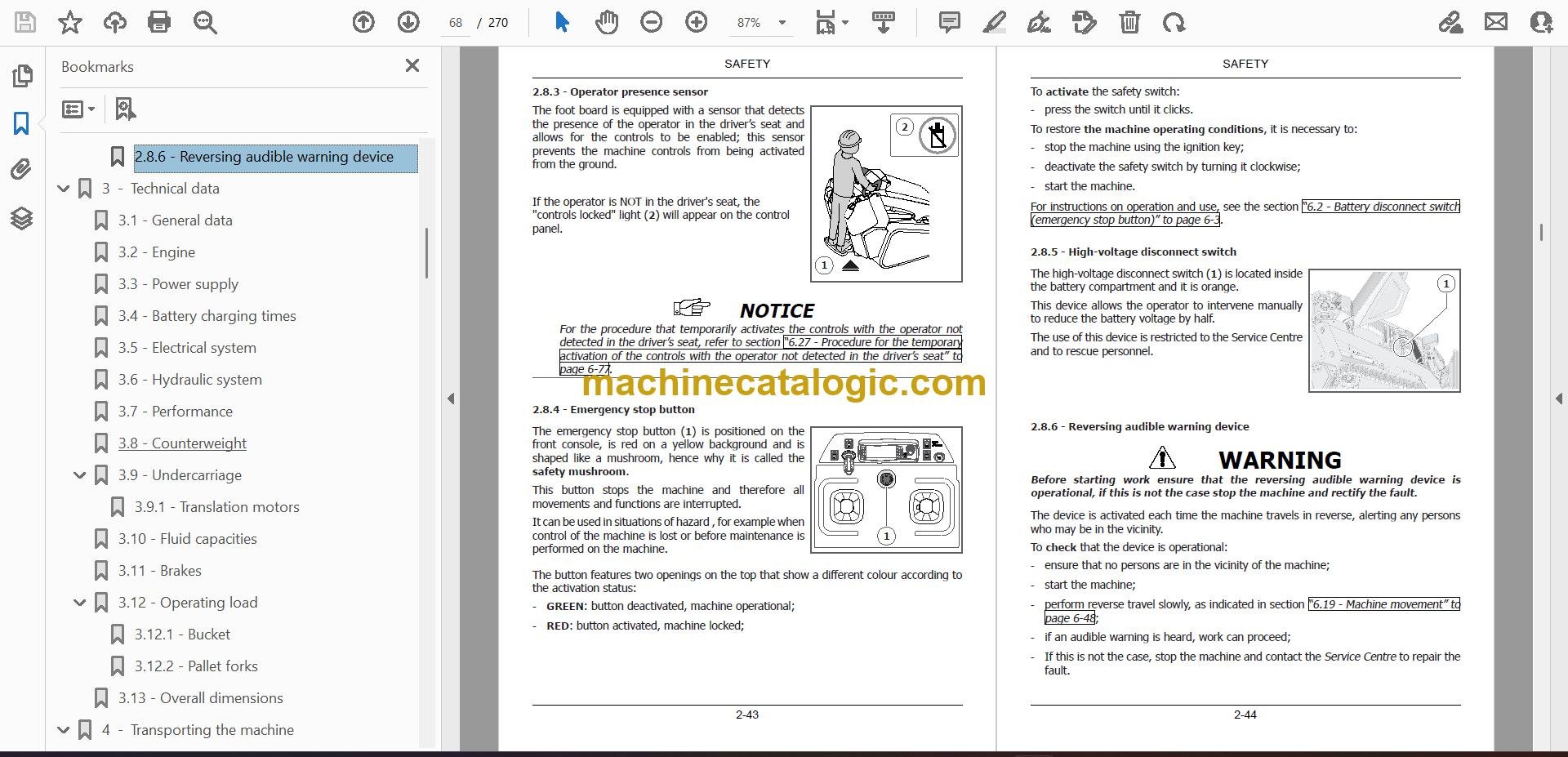
      • 2.8.3 – Operator presence sensor
      • 2.8.4 – Emergency stop button
      • 2.8.5 – High-voltage disconnect switch
      • 2.8.6 – Reversing audible warning device
  • 3 - Technical data
    • 3.1 – General data
    • 3.2 – Engine
    • 3.3 – Power supply
    • 3.4 – Battery charging times
    • 3.5 – Electrical system
    • 3.6 – Hydraulic system
    • 3.7 – Performance
    • 3.8 – Counterweight
    • 3.9 – Undercarriage
      • 3.9.1 – Translation motors
    • 3.10 – Fluid capacities
    • 3.11 – Brakes
    • 3.12 – Operating load
      • 3.12.1 – Bucket
      • 3.12.2 – Pallet forks
    • 3.13 – Overall dimensions
  • 4 - Transporting the machine
    • 4.1 – Transportation dimensions
    • 4.2 – Loading/unloading operations
    • 4.3 – Securing the machine on the mean of transport
    • 4.4 – Lifting the machine
      • 4.4.1 – Lifting procedure
    • 4.5 – Recovering and pulling the machine
  • 5 - Controls and instrumentation
    • 5.1 – Description of controls
    • 5.2 – Description of control levers
    • 5.3 – Description of dashboard
    • 5.4 – Roller operation
    • 5.5 – Auxiliary power socket on console
    • 5.6 – Control panel
    • 5.7 – Display
    • 5.8 – Battery disconnect switch (emergency stop button)
    • 5.9 – myCASEConstruction portal and app
  • 6 - Using the machine
    • 6.1 – Commissioning
    • 6.2 – Battery disconnect switch (emergency stop button)
    • 6.3 – Driver seat
    • 6.4 – Control cut-out button
    • 6.5 – Parking brake button
    • 6.6 – Control panel operation
      • 6.6.1 – Dashboard to scroll through the menu on the display
    • 6.7 – HOME page
      • 6.7.1 – Time
      • 6.7.2 – Machine hours
      • 6.7.3 – Drive speed and control sensitivity
      • 6.7.4 – Travel speed
      • 6.7.5 – Engine data and battery data
      • 6.7.6 – Pop-up messages (information/alarms)
      • 6.7.7 – Warning indicators
      • 6.7.8 – Pressure relief indicator light and button
      • 6.7.9 – Work lights indicator light and button
      • 6.7.10 – Boom float indicator light and button
      • 6.7.11 – Parking brake indicator light and button
      • 6.7.12 – Loader pump work mode
    • 6.8 – MENU screen
      • 6.8.1 – BATTERY screen
      • 6.8.2 – ENGINE screen
      • 6.8.3 – EQUIPMENT screen
        • 6.8.3.1 – Equipment SETTINGS sub-menu
      • 6.8.4 – TEMPERATURES screen
      • 6.8.5 – SOFTWARE screen
      • 6.8.6 – SERVICE screen
      • 6.8.7 – SETTINGS screen
      • 6.8.8 – LIFETIME DATA COUNTER Screen
        • 6.8.8.1 – START-UP DRIVING MODE
        • 6.8.8.2 – PRESSURE RELIEF
        • 6.8.8.3 – PARTIAL HOURS RESET
        • 6.8.8.4 – LANGUAGE sub-menu
        • 6.8.8.5 – DATE/TIME sub-menu
        • 6.8.8.6 – UNIT OF MEASURE
        • 6.8.8.7 – DISPLAY BRIGHTNESS
        • 6.8.8.8 – TRAVEL SPEED DOUBLE TAP
      • 6.8.9 – DRIVE SPEED AND CONTROL SENSITIVITY screen
        • 6.8.9.1 – INDIVIDUAL sub-menu
    • 6.9 – Visibility
      • 6.9.1 – Travel position
    • 6.10 – Starting the machine
      • 6.10.1 – Inspections prior to starting
      • 6.10.2 – Procedure for starting the machine
    • 6.11 – Battery power
    • 6.12 – Machine charging mode
      • 6.12.1 – On-board battery charger
      • 6.12.2 – Portable battery charger (optional)
    • 6.13 – Electrical isolation
    • 6.14 – Horn
    • 6.15 – Work lights
    • 6.16 – Operation at low temperatures or during winter
    • 6.17 – Precautions during operation
    • 6.18 – Stopping and parking the machine
    • 6.19 – Machine movement
      • 6.19.1 – Left Joystick
      • 6.19.2 – Forward and reverse travel
      • 6.19.3 – Turning while moving forward
      • 6.19.4 – Rotation while reversing
        • 6.19.4.1 – Precautions during the operation of the tracks
    • 6.20 – Travel speed
    • 6.21 – Operating the boom
      • 6.21.1 – Right joystick
      • 6.21.2 – Boom floating control
    • 6.22 – Using the bucket
    • 6.23 – Discharge residual pressure in the hydraulic system
    • 6.24 – Auxiliary hydraulic systems
      • 6.24.1 – Connection of equipment to the hydraulic systems
      • 6.24.2 – AUX1 Auxiliary hydraulic system
        • 6.24.2.1 – Single-acting mode AUX1
        • 6.24.2.2 – Double-acting mode AUX1
        • 6.24.2.3 – Auxiliary hydraulic system AUX1 latch with operator not in the driver's seat
      • 6.24.3 – Drain line (direct to tank – optional)
    • 6.25 – Electrical auxiliary systems (optional)
      • 6.25.1 – Connecting equipment to electrical systems
      • 6.25.2 – Operation of electrical auxiliary systems
    • 6.26 – Emergency boom lowering procedure
    • 6.27 – Procedure for the temporary activation of the controls with the operator not detected in the driver's seat
    • 6.28 – Supplementary counterweight installation and removal procedure
    • 6.29 – Daily storage
  • 7 - Recommended optional equipment
    • 7.1 – Safety precautions
    • 7.2 – Specifications on authorised equipment
    • 7.3 – Operating capacity
    • 7.4 – Quick-coupling
    • 7.5 – Precautions
  • 8 - Maintenance
    • 8.1 – Safety
      • 8.1.1 – Putting the machine out of service for maintenance
    • 8.2 – Tools and equipment for maintenance
    • 8.3 – Safety devices
      • 8.3.1 – Battery compartment hood
      • 8.3.2 – Upper compartment cover (cushion)
      • 8.3.3 – Lower compartment cover
      • 8.3.4 – Oil tank compartment guard
      • 8.3.5 – Charging compartment cover
      • 8.3.6 – Fuse and relay compartment guard
      • 8.3.7 – High-voltage component guards
    • 8.4 – Locking the boom for maintenance
    • 8.5 – Electrical system
    • 8.6 – Tracks
    • 8.7 – Refilling
      • 8.7.1 – Refilling quantity table
      • 8.7.2 – Products for lubrication
      • 8.7.3 – Hydraulic system oils
        • 8.7.3.1 – Requirements for using eco-friendly hydraulic oil
        • 8.7.3.2 – Scheduled plan for analysis and control of eco-friendly hydraulic oil
        • 8.7.3.3 – Requirements for the sampling of eco-friendly hydraulic oil
    • 8.8 – Tightening torque tables
    • 8.9 – Weights of the material in a pile
    • 8.10 – Regular maintenance
      • 8.10.1 – Performance check
      • 8.10.2 – Cleaning of radiator and heat sink
      • 8.10.3 – Check of hydraulic oil level
      • 8.10.4 – Operator foot board pad check
      • 8.10.5 – Change discharge circuit hydraulic oil filter
      • 8.10.6 – Hydraulic system oil sampling/replacement
      • 8.10.7 – Replacement of intake circuit hydraulic oil filter
      • 8.10.8 – Check of hydraulic line condition
      • 8.10.9 – Full charge of the battery
      • 8.10.10 – Checking that the screws of the undercarriage are tight
      • 8.10.11 – Check of track tension
      • 8.10.12 – Adjusting the track tension
      • 8.10.13 – Replacing the gear motor oil
      • 8.10.14 – Lubrication of pins
      • 8.10.15 – Electrical test
    • 8.11 – Long inactivity periods
    • 8.12 – Long-term storage
  • 9 - electrical components
    • 9.1 – Fuses and relays
      • 9.1.1 – Control box fuses
      • 9.1.2 – Control unit relays
    • 9.2 – Work lights replacement
    • 9.3 – LED strip replacement
  • 10 - RESCUE SHEET

CNH Manuals & Software

Related Manuals

0
    0
    Your Cart
    Your cart is emptyReturn to Shop