$ 0
0
$ 0
0

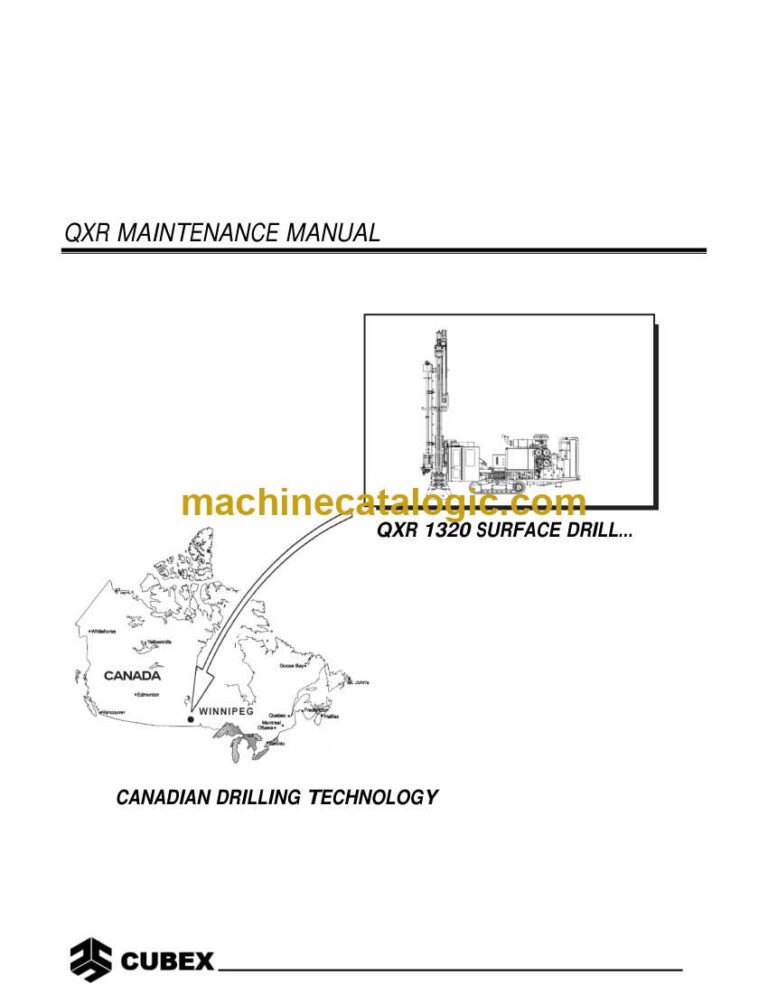
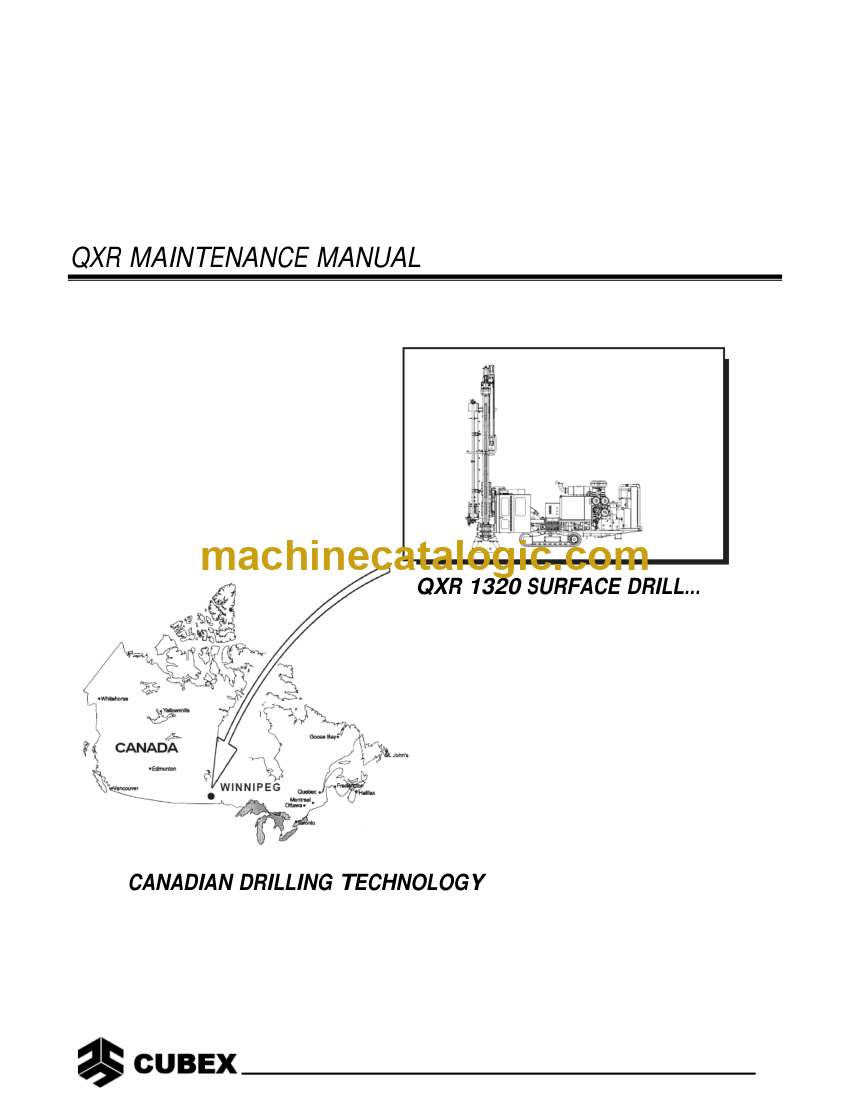
Cubex QXR 1320 10301 Surface Drill Maintenance Manual

Format: PDF (Printable Document)

File Language: English

File Pages: 340

File Size: 13.08 MB (Speed Download Link)

Brand: Cubex

Model: QXR 1320 10301 Surface Drill

Type of Document: Maintenance Manual

Category:

$ 45

Share:

Cubex QXR 1320 10301 Surface Drill Maintenance Manual

Cubex QXR 1320 10301 Surface Drill Maintenance Manual

Out on a benching or production blast pattern, the Cubex QXR 1320 surface drill lives in dust, vibration, and long hours. This maintenance manual is what I’d keep handy to plan routine services and decide what to inspect before the machine ever gives trouble. If, for example, the drill starts losing penetration rate or you’re seeing odd noises from the rotation head, I’d use this manual to trace possible causes, verify basic adjustments, and decide what needs to be stripped, cleaned, or replaced before it becomes a major failure.

Applications & Use Cases

  • Plan routine services so you know which components to inspect, lube, or tighten at set intervals to avoid unplanned downtime.
  • Prioritize inspections on wear items like drill string interfaces, guides, and moving joints to catch cracks, play, or leaks early.
  • Support troubleshooting by helping you isolate whether a problem is likely hydraulic, mechanical, or operator-related.
  • Standardize shop work so every tech routes hoses, secures fasteners, and reinstalls guards the same way.
  • Extend component life by following proper cleaning, alignment, and sealing practices after repairs.

FAQ

Q: Can I use this manual on a tablet in the field?

A: Yes, it’s practical to keep a digital copy; you can zoom diagrams and search terms while standing beside the drill.

Q: Is it worth printing parts of this manual?

A: I’d print the key service and inspection pages, laminate them, and keep them in the service truck for quick reference.

Safety Note

Always lock out, tag out, and verify stored energy is released before putting hands or tools near moving or pressurized components.

📘 Show Index

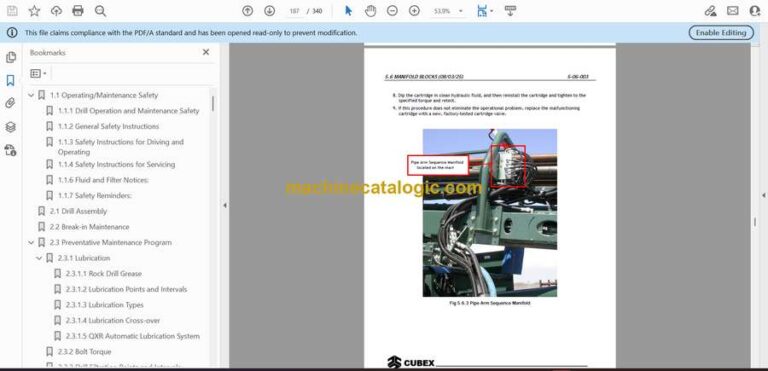
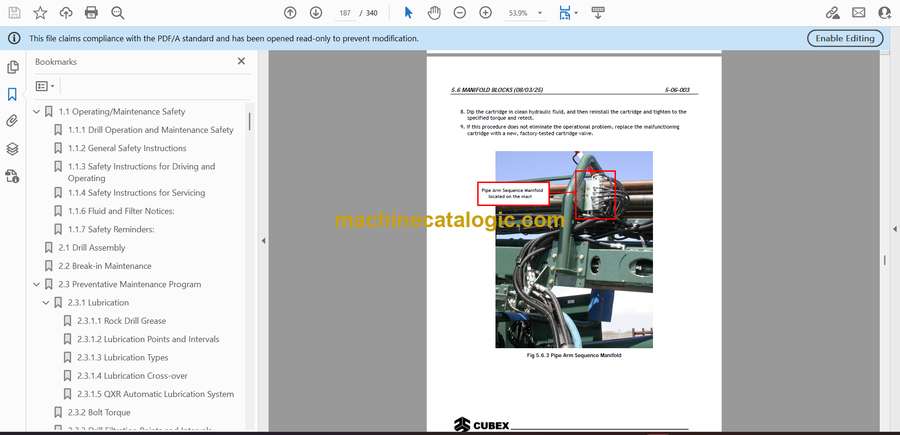
Cubex QXR 1320 10301 Surface Drill Index:

  • 1.1 Operating/Maintenance Safety
    • 1.1.1 Drill Operation and Maintenance Safety
    • 1.1.2 General Safety Instructions
    • 1.1.3 Safety Instructions for Driving and Operating
    • 1.1.4 Safety Instructions for Servicing
    • 1.1.6 Fluid and Filter Notices:
    • 1.1.7 Safety Reminders:
  • 2.1 Drill Assembly
  • 2.2 Break-in Maintenance
  • 2.3 Preventative Maintenance Program
    • 2.3.1 Lubrication
      • 2.3.1.1 Rock Drill Grease
      • 2.3.1.2 Lubrication Points and Intervals
      • 2.3.1.3 Lubrication Types
      • 2.3.1.4 Lubrication Cross-over
      • 2.3.1.5 QXR Automatic Lubrication System
    • 2.3.2 Bolt Torque
    • 2.3.3 Drill Filtration Points and Intervals
    • 2.3.4 Pipe Thread Grease Pump
      • 2.3.4.1 Safety
      • 2.3.4.2 Maintenance
  • 2.4 Recommended Tools
  • 3.1 Track Adjustment
  • 3.2 Final Drive
  • 4.1 Mast Feed System
    • 4.1.1 QXR Feed Chain Adjustment
      • 4.1.1.1 Top Chain Adjustment
      • 4.1.1.2 Bottom Chain Adjustment
    • 4.1.2 Slider Adjustment
    • 4.1.3 Carrier Block
    • 4.1.4 Feed Chain Block
    • 4.1.5 Jib Boom
    • 4.1.6 Triple Jaw Breakout (TJBO)
      • 4.1.6.1 Overhaul procedure
  • 4.2 Top Drive
    • 4.2.1 Using the Right Equipment
    • 4.2.2 Checking Bearing Pre-load
    • 4.2.3 Adjusting Bearing Pre-load
    • 4.2.4 Removing Top Drive
    • 4.2.5 Disassembly Procedure
    • 4.2.6 Assembly Procedure
      • 4.2.6.1 Lower Gear Housing Assembly
      • 4.2.6.2 Upper Gear Housing Assembly
      • 4.2.6.3 Driveshaft Assembly
      • 4.2.6.4 Final Assembly
    • 4.2.7 Top Drive Installation
    • 4.2.8 Saver Sub Field Procedures
      • 4.2.8.1 Removal
      • 4.2.8.2 Installation
    • 4.2.9 Air Swivel Field Procedures
      • 4.2.9.1 Removing Air Swivel
      • 4.2.9.2 Installation of Air Swivel
      • 4.2.9.3 Dismantling Air Swivel
      • 4.2.9.4 Assembly Procedure
      • 4.2.9.5 Inspection of Parts
    • 4.2.10 Cushion Sub
      • 4.2.10.1 Maintenance
      • 4.2.10.2 Operating Parameters
      • 4.2.10.3 Disassembly
      • 4.2.10.4 Assembly
      • 4.2.10.5 Removal
      • 4.2.10.6 Installation
  • 4.3 Top Drive Motor
    • 4.3.1 Dismantling Top Drive Motor
    • 4.3.2 Assembly Procedure
  • 4.4 Breakout Wrench
  • 4.5 Carousel Assembly
    • 4.5.1 Check Pipe Alignment Every 50 Hours
    • 4.5.2 Carousel Inspection at 250 Hours
    • 4.5.3 2000 Hour inspection
    • 4.5.4 Carousel Adjustment
      • 4.5.4.1 Pipe Clamp Adjustment
      • 4.5.4.2 Clamp Arm Adjustment
  • 4.6 Expander Pin System – Mast Boom
    • 4.6.1 Expander pin metric bolt size reference
    • 4.6.2 Torque and Maintenance Intervals
      • 4.6.2.2 Torque Schedule
      • 4.6.2.3 Mounting/Dismounting Tools
      • 4.6.2.4 Installation
      • 4.6.2.5 Dismounting
  • 5.1 Hydraulic Symbols
    • 5.1.1 Hydraulic Schematic
  • 5.2 Hydraulic Circuits
    • 5.2.1 Adjustment Sequence
  • 5.3 Hydraulic Pump
    • 5.3.1 Installation
      • 5.3.1.1 Pre Start-up
      • 5.3.1.2 Start-up
    • 5.3.2 Adjustments
      • 5.3.2.1 System (Operating) Pressure Adjustment
      • 5.3.2.2 Stand-by Pressure Adjustment
    • 5.3.3 Testing the Pump
    • 5.3.4 Troubleshooting the Pump
    • 5.3.5 Factors Affecting the Pump’s Life
      • 5.3.5.1 Contaminated Fluid
      • 5.3.5.2 Poor Suction Conditions
      • 5.3.5.3 Excessive Case Pressure
      • 5.3.5.4 Too Low an Operating Pressure
      • 5.3.5.5 Cavitation/Aeration
  • 5.4 Hydraulic Cylinders
    • 5.4.1 Double Acting Cylinders
    • 5.4.2 Cylinder Inspection
    • 5.4.3 Cylinder Overhaul
  • 5.5 Control Valves – On/Off Types
    • 5.5.1 Control Valves
    • 5.5.2 Relief Valve Adjustment
    • 5.5.3 Valve Pressure Adjustment
    • 5.5.4 Valve Flow Adjustment
    • 5.5.5 Valve Overhaul
    • 5.5.6 Valve Sections
    • 5.5.7 Solenoid
    • 5.5.8 Lever Section
    • 5.5.9 Valve Assembly
    • 5.5.10 Inlet Section
  • 5.6 Manifold Blocks
    • 5.6.1 Servicing Cartridge Valves
    • 5.6.2 Troubleshooting Cartridge Valves
    • 5.6.3 Installation Torque Values
  • 5.7 Counterbalance Valves
    • 5.7.1 Making Adjustments
    • 5.7.2 Troubleshooting
  • 5.8 Hydraulic Filtration
    • 5.8.1 Change Hydraulic Fluid Every 2000 Hours
    • 5.8.2 Return Filters
    • 5.8.3 Pressure Filter Element
  • 5.9 Proportional Valves
    • 5.9.1 Proportional Valve Settings
    • 5.9.2 Flow Settings
    • 5.9.3 Pressure Setting
  • 6.1 Air Schematic
  • 6.2 Sullair Compressor
    • 6.2.1 Compressor Unit Functional Description
    • 6.2.2 Compressor Discharge System Functional Description
    • 6.2.3 Compressor Cooling and Lubrication System Functional Description
    • 6.2.4 Air Inlet System Functional Description
    • 6.2.5 Lubrication Guide
    • 6.2.6 Application Guide
    • 6.2.7 Control System
      • 6.2.7.1 Purpose of Controls
      • 6.2.7.2 Butterfly Inlet Valve Functional Description
      • 6.2.7.3 Closed Inlet Start Program
      • 6.2.7.4 Normal Operation
      • 6.2.7.5 Modulation
      • 6.2.7.6 Unload
      • 6.2.7.7 Compressor Start Up Mode and Running Mode Low Air Pressure
      • 6.2.7.8 Manual Unload Mode
      • 6.2.7.9 Running Mode 350 psi Air Pressure
      • 6.2.7.10 Running Mode 500 psi Air Pressure
      • 6.2.7.11 Instrumentation and Protection
      • 6.2.7.12 Start Up Procedure
      • 6.2.7.13 Shutdown Procedure
      • 6.2.7.14 Adjustment Procedures
    • 6.2.8 Compressor Maintenance
      • 6.2.8.1 Main Fluid Filter Service
      • 6.2.8.2 Thermal/Bypass Valve
      • 6.2.8.3 Separator Element Replacement
      • 6.2.8.4 Running Blowdown Valve Maintenance
      • 6.2.8.5 Shutdown Blowdown Valve Maintenance
      • 6.2.8.6 Minimum Pressure/Check Valve Maintenance
      • 6.2.8.7 Discharge Check Valve Maintenance
      • 6.2.8.8 Safety Valve
      • 6.2.8.9 Pressure Regulator (High / Low Air Pressure Regulator)
      • 6.2.8.10 Fluid Stop Valve
    • 6.2.9 Screw Compressor
      • 6.2.9.1 Screw Compressor Arrangement
      • 6.2.9.2 Compressor Operator Daily Checklist
      • Compressor Operator Daily Checklist
      • 6.2.9.3 Maintenance Schedules
      • 6.2.9.4 Compressor Lubrication Cross-over
      • 6.2.9.5 Compressor Troubleshooting
  • 6.3 Water Pump
    • 6.3.1 Pump Speed Adjustment
    • 6.3.2 Preventative Maintenance
    • 6.3.3 Troubleshooting the Water Pump
    • 6.3.4 Service Procedures
    • 6.3.5 Water Pump Coupling Annual Maintenance
      • 6.3.5.1 Periodic Lubrication
  • 6.4 Grease Injection
    • 6.4.1 To Fill Reservoir
    • 6.4.2 To Prime System
    • 6.4.3 Operation
    • 6.4.4 Adjusting Flow Rate
      • 6.4.4.1 Setting for a 4” Hammer
      • 6.4.4.2 Setting for a 6” Hammer
    • 6.4.5 PanelView Settings for QXR
  • 7.1 Electrical Circuits
  • 7.2 Electrical Components
    • 7.2.1 Electrical Panel
    • 7.2.2 Control Panels
    • 7.2.3 Replacement Parts
  • 7.3 On/Off Valve Activation
  • 7.4 Types of Valves
  • 7.5 Testing of Valve Solenoids
  • 7.6 Testing On/Off Valves
  • 7.7 Proportional Valves
  • 7.8 Fault Monitoring System
    • 7.8.1 Testing Proportional Valves
  • 7.9 Accra-Feed System
    • 7.9.1 Accra-Feed Operation
    • 7.9.2 Accra-Feed Components
    • 7.9.3 PLC Operation
    • 7.9.4 Maintenance of PLC in Accra-Feed System
    • 7.9.5 Troubleshooting Guide
  • 7.10 Operator Interface PanelView 1000
    • 7.10.1 Maintenance of PanelView Terminal
    • 7.10.2 Troubleshooting PanelView Terminal
    • 7.10.3 Alarm Messages on the Terminal
  • 7.11 QXR Canbus Electrical System
    • 7.11.1 Components
      • 7.11.1.1 Cab Control Panel
      • 7.11.1.2 Rear Control Panel
      • 7.11.1.3 PanelView
      • 7.11.1.4 Joysticks
      • 7.11.1.5 Mast Sensor Junction Box
      • 7.11.1.6 Carousel Junction Box
      • 7.11.1.7 10-Channel Low-Pass Filter Module
    • 7.11.2 Canbus Components
      • 7.11.2.1 Vansco Multiplexing Module (VMM) 1210 Multiplexing Module
      • 7.11.2.2 Pocket Gateway Module (PGM)
    • 7.11.3 Operation
    • 7.11.4 VMM 1210 Hardware and Software
      • 7.11.4.1 Hardware
      • 7.11.4.2 VMM 1210 Software
      • 7.11.4.3 Updating the VMM 1210 Software
      • 7.11.4.4 PC Software Installation
    • 7.11.5 Functions
      • 7.11.5.1 QXR Input/Output List – Cab Control Panel – VMM1 PLC22
      • 7.11.5.2 QXR Input/Output List – Cab Control Panel – VMM2 PLC62
      • 7.11.5.3 QXR Input/Output List – Cab Control Panel VMM3 PLC102
      • 7.11.5.4 QXR Input/Output List – Rear Control Panel VMM4 PLC222
      • 7.11.5.5 QXR Input/Output List – Rear Control Panel VMM5 PLC262
      • 7.11.5.6 QXR Input/Output List – Rear Control Panel VMM6 PLC302
      • 7.11.5.7 QXR Input/Output List – Rear Control Panel VMM7 PLC342
      • 7.11.5.8 QXR Input/Output List – Rear Control Panel VMM8 PLC382
      • 7.11.5.9 QXR Input/Output List – Rear Control Panel VMM9 PLC422
      • 7.11.5.10 QXR Input/Output List – Mast Valve Junction Box VMM10 PLC482
      • 7.11.5.11 QXR Input/Output List – Mast Valve Junction Box VMM11 PLC522
      • 7.11.5.12 QXR Input/Output List – Mast Sensor Junction Box VMM12 PLC582
  • 8.0 Troubleshooting
  • 8.1 Troubleshooting the Tram Drive
    • Crawler Does Not Run but Tramming Motors Are Operating
    • Crawler Does Not Move and Tramming Motor Does Not Run
    • Crawler Does Not Tram Straight
  • 8.2 Troubleshooting the Hydraulic System
    • Pump Does Not Deliver Oil
    • Pump is Running Hot
    • Cavitation or Pump Noise
    • Insufficient Pressure
    • Slow Rotation at Top Drive
    • No Rotation at Top Drive Assembly
    • Slow or No Feed
    • Mast Does Not Rotate
    • Actuator Allows Mast to Move After Being Set
  • 8.3 Troubleshooting the Water Injection Pump
    • Discharge Pressure is Too Low
    • Cavitation Problems
    • No Water Discharge
    • Excessive Pump Noise
  • 8.4 Troubleshooting the Air Driven Oil Injection Pump
    • Air Motor Does Not Operate
    • Air Seepage from Air Exhaust While Pump is Not Working
    • Loss of Pressure, Volume, or Continuous Operation of Pump when Not in Normal Use
    • Excessive Amount of Air in Lubricant or Excessive Amount of Lubricant in Air
  • 8.5 Troubleshooting the Air Driven Grease Injection
    • Air Motor Does Not Operate
    • Grease Is Not Delivered to the Drilling Air Line
  • 8.6 Troubleshooting the Air Delivery System
    • Air Pressure Builds too Slowly
    • Compressor Shuts Down with Air Demand Present
    • Compressor Does Not Build-Up Full Discharge Pressure
    • Compressor Unloading with an Excessive Pressure Build-Up
    • Excessive Compressor Fluid Consumption
    • Compressor Overheating
  • 8.7 Troubleshooting the Hammer
    • Tool Does Not Start
    • Tool Stops Operating
    • Operating Pressure is Lower than Specifications
    • Low Penetration Rate
    • Galling of Internal Parts
  • 8.8 Troubleshooting the Drill Bit
    • Abrasive Wear
    • Loss of Carbides in Bit
    • Bit Breakage and Carbide Failure
    • Carbide Breakage
    • Uneven Wear Conditions
  • 8.9 Troubleshooting Depth Laser
    • Laser appears not working. No red light is coming out of aperture.
    • Laser appears working; red light is pulsing in even intervals, no output signal.
    • Laser appears working, red light is pulsing but in un-even intervals
    • General notes:

Cubex


Latest Product

0
    0
    Your Cart
    Your cart is emptyReturn to Shop