Develon DL06V Diesel Industrial Engine Operation and Maintenance Manual (950106-089008EN)
This DL06V usually lives in the rough stuff—construction sites, generators out behind plants, pumps sitting in mud and dust for weeks. This manual helps you set a steady maintenance rhythm so the engine stays predictable when you’re slammed. You’ll know what to trace on a cold-start issue, what to inspect before a night shift, and when to bleed the fuel or change filters before they bite you. Picture harvest season or a big pour coming up: you’ve already done the periodic checks the book lays out, so you’re not tearing into a dead engine at 4 a.m.
Applications & Use Cases
- Set up a daily walk‑around: check fluids, trace leaks, inspect belts and hoses so small problems don’t turn into lost days.
- Plan your weekly and monthly services; you’ll know when to change filters, test batteries, and verify warning lights instead of guessing.
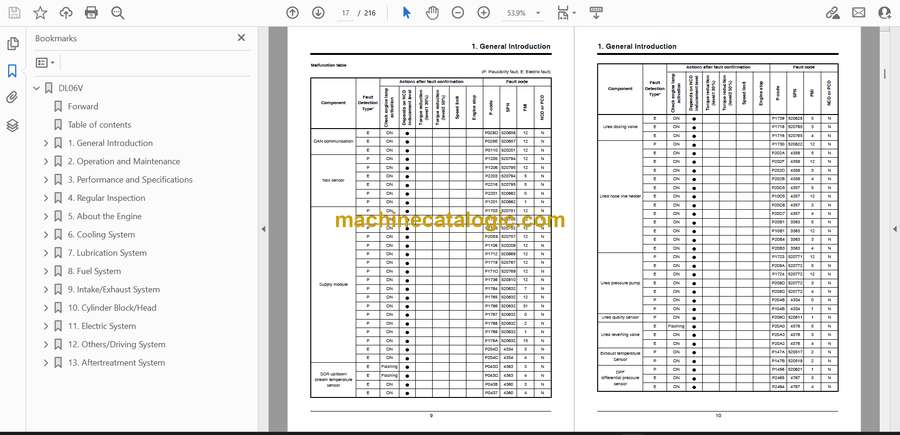
- Use the fault and indicator info to isolate issues: you can route your checks, confirm basics, then decide if you really need a tech.
- Align your maintenance with busy seasons so you service it during slow time, not when the machine’s booked solid.
- Train new operators on how to start, warm up, and shut down correctly, so they don’t abuse the engine without knowing it.
FAQ
Q: Is this manual searchable, or am I just scrolling forever?
A: It’s typically a searchable PDF, so you can jump straight to maintenance intervals, troubleshooting, or specific systems.
Q: Can I print just the service sections to keep in the shop?
A: Yeah, you can usually print selected pages; most folks print the periodic service charts and keep the full file on a tablet or laptop.
Safety Note
Always let the engine cool and verify pressure is bled off before you crack any fuel, coolant, or oil lines.
Develon DL06V Diesel Industrial Engine Index:
- DL06V
- Forward
- Table of contents
- 1. General Introduction
- General information
- Danger, warning, caution and note
- General information
- General instructions
- Cautions for starting the engine
- Cautions for inspection and repair
- General repair
- Other safety instructions and environmental pollution
- Use of genuine parts
- Emission Information
- Regulation (EU) 2017/654 ANNEX XV (Applies to customers using equipment in EU only.)
- Engine maintenance
- Prevention of damage and abrasion
- Prevention of pollution
- Handling of engine oil
- Biodiesel blend fuel
- HVO (Hydro treated Vegetable Oil)
- GTL (Gas To Liquids)
- 2. Operation and Maintenance
- Starting and stopping of the engine
- Preparing for start
- Starting the engine
- After starting the engine
- During operation
- Stopping the engine
- Break-in period of the engine
- General information
- Break-in period of a new engine
- Check points
- Operation after break-in
- Inspection after starting the engine
- Engine oil pressure
- Coolant temperature
- Revolutions per minute (rpm)
- Operation in winter
- Cold start
- Preventing coolant from freezing.
- Preventing overcooling of the engine
- Engine oil
- Inspection and repair of the engine
- Checking engine parts after prolonged operation
- Inspection and repair of turbocharger
- Intake unit
- Exhaust unit
- Lubrication system
- 3. Performance and Specifications
- Engine specifications and performance
- Engine specifications
- Engine performance curve (MFL00)
- Engine performance curve (MFL01)
- Engine performance curve (MFL02)
- Engine performance curve (MFE00/NEP00)
- Engine performance curve (MFE01)
- Engine performance curve (MFE02)
- Engine performance curve (MFE03)
- Engine performance curve (MFE04)
- Engine performance curve (MFE05)
- Engine performance curve (MFE06)
- Outside drawing of the engine
- Structure diagram
- Left/Right sectional view
- Top view
- Engine identification number
- Engine code and manufacturing number
- Engine number engraving
- 4. Regular Inspection
- General information
- General information
- Routine inspection
- Regular inspection table
- Cooling system
- General information
- Coolant standards
- Coolant level
- Checking the coolant
- Measurement of coolant concentration
- Replenishment of coolant
- Replacement of coolant
- Cleaning cooling circuit
- Lubrication system
- General information
- Engine oil specifications
- Engine oil capacity
- Checking engine oil
- Adding engine oil
- Changing engine oil
- Fuel system
- General information
- Fuel standards
- Fuel filter
- Air bleeding in the fuel circuit
- Cylinder block/head
- Valve clearance
- Valve clearance adjustment procedure
- Electric system
- Others/driving system
- 5. About the Engine
- Marking system of units
- Tightening torque
- Tightening torque of major parts
- Tightening torque for general bolts
- Tightening torque of plug screw
- Hollow screw (4-hole) tightening torque
- Engine disassembly
- Engine disassembly procedure
- Engine assembly
- 6. Cooling System
- General information
- General information
- Failure diagnosis
- Thermostat
- General information
- Cautions for replacement and handling of thermostat
- Thermostat inspection
- Cooling fan
- 7. Lubrication System
- General information
- General information
- Failure diagnosis
- Oil pump
- General information
- Oil pump disassembly and assembly
- Oil pump inspection
- 8. Fuel System
- General information
- General information
- Fuel high-pressure system components
- Injector
- General information
- How to operate an injector
- Injector protrusion
- Common rail
- Fuel injection pump
- Fuel feed pump
- 9. Intake/Exhaust System
- General information
- Turbocharger
- General information
- Structure
- Failure diagnosis
- How to maintain turbocharger
- Inspection items during disassembly/assembly of turbocharger
- Turbocharger inspection
- Intake pipe
- Major air heater specifications
- 10. Cylinder Block/Head
- General information
- Cylinder block
- Cylinder head
- Cylinder head disassembly
- Cylinder head assembly
- Cylinder head inspection
- Valve
- General information
- Valve inspection
- Valve guide inspection
- Valve seat inspection
- Valve spring inspection
- Rocker arm
- Rocker arm removal
- Rocker arm installation
- Rocker arm inspection
- Rocker arm shaft inspection
- Tappet and push rod
- Valve tappet inspection
- Push rod deflection inspection
- Camshaft
- Camshaft play
- Camshaft inspection
- 11. Electric System
- Circuit diagram
- General information
- Engine connector
- ECU (Engine Control Unit) engine connector
- Switches and sensors
- ECU (Electronic Control Unit)
- Boost pressure and temperature sensor
- Engine oil pressure sensor
- Engine coolant temperature sensor
- Exhaust gas temperature sensor
- NOx sensor
- Urea quality sensor
- DPF differential pressure sensor
- Crankshaft speed sensor
- Camshaft speed sensor
- Common rail pressure sensor
- Pressure limiter valve
- ECU (Electronic Control Unit)
- ECU (Engine Control Unit) connector
- ECU (Engine Control Unit) input/output
- Operational conditions of electronic control unit (ECU)
- Starter
- General information
- Circuit diagram
- Exhaust gas reduction
- General information
- Circuit diagram
- Aftertreatment connector
- Switches and sensors
- 12. Others/Driving System
- General information
- Crankshaft
- Crankshaft inspection
- Crankshaft bearing and connecting rod inspection
- Piston
- Piston disassembly
- Piston assembly
- Piston inspection
- Piston ring inspection
- Piston and piston pin inspection
- Connecting rod
- Connecting rod inspection
- Others
- 13. Aftertreatment System
- Exhaust gas reduction system
- General instructions
- Aftertreatment muffler and catalyst
- DNOX 2.2 EVO system
- DEF Tank
- Supply module
- Dosing module
- Replacing the DEF filter
- Components of the DNOX 2.2 EVO system
- Inspecting the DNOX 2.2 EVO system for faults
- DEF (Diesel Exhaust Fluid, urea)
- Diesel oxidation catalyst (DOC)
- Diesel particulate filter (DPF)
- Removing, assembling and disassembling the DOC/DPF muffler assembly
- Emission sensors
- Cautions for handling the DPF assembly
Develon