Develon DX350LC-7 Crawler Excavator Operation and Maintenance Manual (950106-02122EEU) (10001 and Up)
On a DX350LC-7 you’re usually working in mud, rock, demo rubble, or tight construction sites where downtime costs real money. This operation and maintenance manual helps you set a steady rhythm: what you trace every morning, what you check every 250-ish hours, what you inspect before a long shift so the machine stays predictable. Say you’re in peak season, running double shifts; this book walks you through how to verify fluids, filters, tracks, and hydraulics so you don’t blow a hose or cook a pump right when trucks are lined up waiting.
Applications & Use Cases
- Set up a simple daily walk‑around: trace leaks, check track tension, inspect teeth and hoses, and verify warning lights before you even climb in.
- Plan service intervals so you know when to change filters, bleed the fuel system, and test coolant, instead of guessing and hoping.
- Use the procedures to isolate odd noises or slow functions, then route your troubleshooting instead of just swapping parts.
- Align your seasonal prep: before heavy work, inspect boom and arm pins, test swing brake behavior, and check electrical connectors.
- When something feels off, compare the cab messages to the manual so you can decide if you park it now or finish the day.
FAQ
Q: Is this manual searchable on a laptop or tablet, or is it just a scanned book?
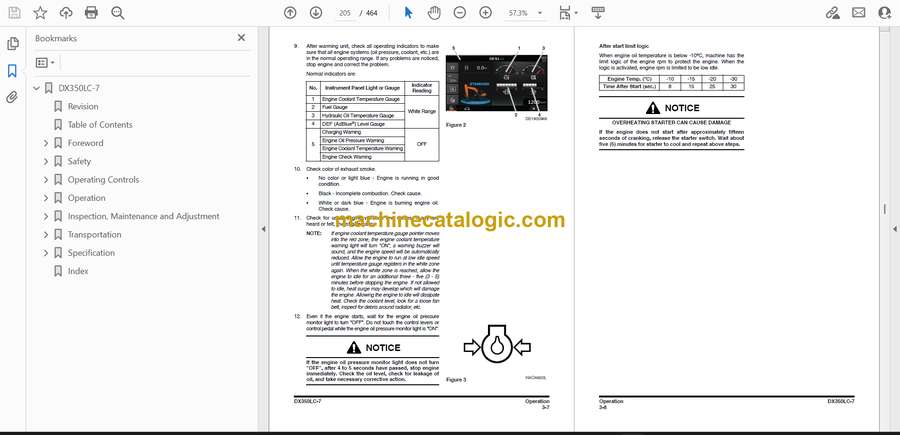
A: It’s usually a proper digital manual, so you can search by term, then zoom in on diagrams when you’re in the office or trailer.
Q: Can I print just a few sections to keep in the cab or toolbox?
A: Yes, most folks print the daily checks, lubrication chart, and basic fault procedures so they don’t wreck a tablet in the mud.
Safety Note
Always lock out the machine, lower the attachment, and bleed off hydraulic pressure before you get your hands near any lines or moving parts.
Develon DX350LC-7 Crawler Excavator Index:
- DX350LC-7
- Revision
- Table of Contents
- Foreword
- Intended Use
- Engine and Emission Control System Maintenance
- Machine Capacity
- Attachments
- Product Identification Number (PIN)
- Component Serial Numbers
- Engine Identification
- Your Machine Serial Numbers
- Safety Messages
- EC Declaration of Conformity
- EC DECLARATION OF CONFORMITY
- Regulation (EU) 2017/654 Annex XV
- Engine Operation and Maintenance
- Malfunctions & Inducement
- DEVELON Fleet Management System General Information and Privacy Notice
- Safety
- Safety Decals
- Information and Location for Safety Decals
- Information and Location for Safety Decals (Continued)
- General
- Safe Operation is Operator’s Responsibility
- Know Your Machine
- Proper Work Tools and Attachments
- Pressurized Fluids
- Flying or Falling Objects
- Personal Protective Equipment (PPE)
- Correction of Machine Problems
- Crushing and Cutting
- Hot Coolant and Oils – Burn Prevention
- Fire and Explosion Prevention
- Fire Extinguisher and First-aid Kit (Emergency Medical Kit)
- Electrical System and Electrical Shock
- Roll-over Protective Structure (ROPS)
- Regulation 8.35(2) of the Mines Safety and Inspection Regulations (1995)
- Transportation
- Obey State and Local Over-the-Road Regulations
- Loading and Unloading
- Transporting Machine
- Operation
- Before Engine Starting
- Work Site
- Mounting/Dismounting
- Cleaning
- Operator Station
- Seat Belt
- Visibility Information
- Boost Starting or Charging Engine Batteries
- Starting Engine
- Swinging or Traveling
- Lifting and Digging
- Operation on Slopes
- Towing
- Attachment
- Equipment Lowering with Engine Stopped
- Engine Stop
- Parking Machine
- Long Term Storage
- Before Storage
- During Storage
- After Storage
- Maintenance
- Warning Tag
- Cleaning
- Proper Tools and Clothing
- Disassembling Precautions
- Use of Lighting
- Fire and Explosion Prevention
- Burn Prevention
- Rubber That Contains Fluorides
- Rubber and Plastics
- Welding Repairs
- Warning for Counterweight and Front Attachment Removal
- Lock Inspection Covers
- Working on Machine
- Accumulator
- Compressed Air
- Track Tension Adjustments
- Supports and Blocking for Work Equipment
- High-pressure Lines, Tubes and Hoses
- Battery
- Environment and Circumstances
- Work Site Areas Requiring Extra Caution
- High-voltage Cables
- Underground Operation
- Working in Water
- Working in Contaminated Environment
- Operation in Extreme Conditions
- Exhaust Ventilation
- Asbestos Information
- Silica Dust Information
- Disposal of Hazardous Materials
- Sound
- Vibration Information
- Operating Controls
- Component Locations
- Operator’s Area
- Operational Controls and Panels
- 1. Starter Switch
- 1-1. Start/Stop Button
- 2. Smart Key
- 3. Air Conditioning and Heating Control Panel
- 4. 12V Power Socket
- 5. 24V Power Socket
- 6. USB Charger
- 7. Bluetooth Control Panel
- 8. Wiper Control Panel
- 9. Engine Speed Control Dial
- 10. After Treatment System Switch
- 11. Light Switch
- 12. Travel Speed Selector Switch
- 13. Lower Wiper Switch (If Equipped)
- 14. Overload Warning Switch (If Equipped)
- 15. Buzzer Alarm Stop Switch (If Equipped)
- 16. Intelligent Floating Boom Switch (If Equipped)
- 17. Auto Grease System Switch (If Equipped)
- 18. Air Compressor Switch (If Equipped)
- 19. Warning Light Switch (If Equipped)
- 20. Cabin Work Light Switch (If Equipped)
- 21. Emergency Start Mode Switch
- 22. Auxiliary Mode Switch
- 23. Swing Brake Release Switch
- 24. Quick Coupler Switch (If Equipped)
- 25. Horn Button
- 26. Breaker/Booster Button
- 27. One Touch Deceleration Button
- 28. Joystick One Touch Function Button
- 29. Rotating Switch (If Equipped)
- 30. Shear Switch (If Equipped)
- 31. Display Monitor
- 32. Around View Monitoring (AVM) Monitor (If Equipped)
- 33. Photo Sensor
- 34. Safety Lever
- 35. Hour Meter
- 36. Micro Phone (If Equipped)
- Display Monitor
- Functional Check
- Setting a Password
- 1. Fuel Gauge
- 2. DEF (AdBlue®) Level Gauge
- 3. Engine Coolant Temperature Gauge
- 4. Hydraulic Oil Temperature Gauge
- 5. Tachometer
- 6. Audio Display
- 7. Main Warning Lamp
- 8. Digital Clock
- 9. Favorites Button
- 10. Main Information Selector Button
- 11. Main Information Indicator
- 12. Power Mode Selector Button
- 13. Power Mode Indicator
- 14. Operating Mode/Flow Setting Selector Button
- 15. Auto Idle Selector Button
- 16. Menu Selector Button
- 17. Back Button
- 18. Camera Mode Selector / ESC Button
- 19. Jog Switch
- 20. Mode Symbol Display
- 21. Indicator Display
- 22. Display Warning Symbols
- Warning Pop-Up Messages
- User Menu
- User Menu – Access and Escape Methods
- Around View Monitoring (AVM) System
- Operating Conditions and Instructions
- Screen Components and View Modes
- Displaying Outlines of the Vehicle Area
- Proximity Alarm System
- Sensor Locations
- Sensor Operating Conditions and Settings
- Sensor Alarm Setting
- Operating Range and Display
- Heater and Air Conditioner Control Panel
- Location of Controls and Vents
- Control Panel
- Memory Function
- Additional Operating Instructions
- Stereo
- Miscellaneous Electrical Devices
- Cabin Light
- Safety Lever
- Circuit Breaker (50A, 80A)
- Fuse Boxes
- Seat Adjustment
- 1. Forward/Backward Adjustment
- 2. Adjusting Height of Seat and Depth of Cushion
- 3. Reclining Position Adjustment
- 4. Headrest
- 5. Lumbar Support Adjustment
- 6. Seat Heater Switch
- 7. Left and Right Control Stand Adjustment
- 8. Left and Right Control Stand Height Adjustment
- 9. Adjusting Height/Angle of Armrest
- Seat Belt
- Seat Belt Locking and Unlocking
- Engine Emergency Stop Switch
- Emergency Exit Glass Breaking Tool
- Miscellaneous Convenience Devices
- Ceiling Cover
- Front Windows
- Door Side Latch
- Cabin Storage Compartments
- Sun Visor
- Sunglasses Case
- Cup Holder
- Storage Box
- Miscellaneous Access Covers and Doors
- Side Door
- Storage Box Door
- Engine Hood
- Air Gun and Compressor (If Equipped)
- Air Gun
- How to Use Air Compressor
- How to Connect Air Gun
- Operation
- To Operate a New Excavator
- Starting and Stopping Engine
- Inspection Before Starting Engine
- Operational Checks Before Starting Engine
- Engine Start
- Diesel Heater (If Equipped)
- Plug Heater (If Equipped)
- Hydraulic System Warm-up
- Hydraulic System Warm-up – Cold Weather
- Stopping Engine
- Checks and Maintenance After Stopping Engine
- Wait to Disconnect Indicator
- Safety Lever
- Travel
- Automatic Travel Speed Control
- Travel Control Lever Operation
- General Travel Instructions
- Straight Travel Pedal (If Equipped)
- Operating Instructions
- Engine Speed Control
- Emission Control System
- After Treatment System
- Mode Selection
- Change Machine Control Pattern By Selector Valve (If Equipped)
- Work Levers (Joysticks) (ISO Pattern)
- Work Levers (Joysticks) (BHL Pattern)
- Intelligent Floating Boom Control (If Equipped)
- Two-Piece Boom (If Equipped)
- Smart Power Control (SPC)
- Operating Precautions
- Working in Water
- Escaping From Mud
- Parking Excavator
- Towing Procedure
- Attachments
- Bucket Replacement and Reversal
- Replacement
- Reversal (If Applicable)
- Hydraulic Attachments (If Equipped)
- Breaker Operation
- Shear Operation
- One-Way/Two-Way Valve Operation
- Rotating Operation
- Quick Coupler Operation
- Lifting Objects
- Lifting Objects with Quick Coupler
- Operation Under Abnormal Conditions
- Equipment Lowering with Engine Stopped
- Auto Grease System (If Equipped)
- Overview
- Location
- Lubricants
- Pump Display and Control Elements of Control Screen
- Pump Display Mode
- Pump Programming
- Maintenance
- Troubleshooting
- Inspection, Maintenance and Adjustment
- Maintenance Information
- Machine Setup Position for Maintenance
- Handling Oil, Fuel, DEF (AdBlue®), Coolant
- Oil
- Fuel
- DEF (AdBlue®)
- Engine Oil
- Grease
- Coolant and Water for Dilution
- Filters
- Electrical System Maintenance
- Recommend Fuel, Coolant, and Lubricant
- Lubrication
- Symbols for “Lubrication and Service Chart”
- Fluid Capacities
- Table of Recommended Lubricants
- Maintenance Intervals
- 10 Hour / Daily Service
- Grease Boom, Arm and Front Attachment Pins (for first 100 hours)
- Check Engine Oil Level
- Check for Leaks in Hydraulic System
- Check Level of Hydraulic Oil Tank
- Check for Leaks in Fuel System
- Check Fuel Level
- Check DEF (AdBlue®) Tank
- Check Water Separator and Pre Fuel Filter (Fuel Prefilter) and Drain Water As Required
- Check Oil Level of Swing Reduction Gear
- Clean Dust Net in Front of Oil Cooler and Radiator
- Check Cooling System and Refill As Required
- Check Level of Window Washer Liquid
- Inspect Bucket Teeth and Side Cutters for Signs of Wear
- Inspect Cooling Fan Blade
- Check Air Intake System and Emission Control System Components
- Inspect Seat Belt for Proper Operation
- Check for Normal Operation of AVM Camera (If Equipped)
- Inspect Mirrors for Damage and Adjust and Clean as Required
- Inspect Structure for Cracks and Faulty Welds
- Check Operation of All Switches and Travel Alarm (If Equipped)
- Check the Operation of Safety Lever
- Check Operation of All Exterior Lights, Horn and Control Console Indicator and Display Monitor
- Start Engine, Check Starting Ability, and Observe Exhaust Color at Start-up and at Normal Operating Temperature. Listen for Any Abnormal Sounds.
- Check Operation of All Controls and Linkages
- 50 Hour / Weekly Service
- Perform All Daily Service Checks
- Grease Arm and Bucket Joint Pins
- Grease Swing Bearing
- Drain Water and Sediment from Fuel Tank
- Check Air Compressor and Drain Water as Required
- Check Engine Fan Belt for Cracks and Wear (After First 50 Hours)
- Inspect the Track Assemblies for Proper Tension and Loose, Worn or Damaged Parts (Links, Shoes, Rollers, Idlers)
- 250 Hour / Monthly Service
- Perform All Daily and 50 Hour Service Checks
- Grease Boom and Arm Joint Pins (One – Piece Boom)
- Grease Boom and Arm Joint Pins (Two – Piece Boom)
- Check Engine Fan and Alternator Belts Wear
- Change Breaker Filter (If Equipped)
- Check Oil Bath Precleaner (If Equipped)
- Clean Oil Bath Precleaner (If Equipped)
- Replace Hydraulic Oil Return Filter (After First 250 Hours)
- Change Pilot Filter (After First 250 Hours)
- Inspect Pins and Bushings of the Front End Attachments for Signs of Wear
- Check Fluid Levels in Batteries
- Inspect for Any Loose or Missing Nuts and Bolts
- Inspect Fuel System Hose Clamps
- 500 Hour / 3 Month Service
- Perform All Daily, 50 and 250 Hour Service Checks
- Track Spring – Check
- Grease Swing Gear and Pinion
- Change Engine Oil and Filter
- Clean Air-conditioning Outer Filter
- Check and Clean Air-conditioning Inner Filter
- Clean Radiator, Oil Cooler, Intercooler, Fuel Cooler and Air Conditioner Condenser Cores
- Clean Outer Filter of Air Cleaner
- Change of Water Separator and Pre Fuel Filter (Fuel Prefilter)
- Change Main Fuel Filter
- Check Oil Level in Travel Reduction Gear (One on Each Side of Unit)
- Clean Air Compressor Filter (If Equipped)
- Change Oil in Travel Reduction Gear (One on Each Side of Unit) (After First 500 Hours)
- Change Oil in Swing Reduction Gear (Drain and Refill After First 500 Hours)
- 1,000 Hour / 6 Month Service
- Perform All Daily, 50, 250 and 500 Hour Service Checks
- Grease Swing Reduction Gear
- Change Hydraulic Oil Tank Breather Filter
- Replace Hydraulic Oil Return Filter
- Change Pilot Filter
- Change Oil in Travel Reduction Gear (One on Each Side of Unit)
- Change Oil in Swing Reduction Gear
- Change Air-conditioning Outer Filter
- Change Air-conditioning Inner Filter
- Change Fuel Cap Filter
- Check and Adjust Engine**
- 2,000 Hour / Yearly Service
- Perform All Daily, 50, 250, 500 and 1,000 Hour Service Checks
- Replace Outer and Inner Air Cleaner Filters
- Change Radiator Coolant
- Hydraulic Oil Exchange and Suction Strainer Cleaning
- Check Alternator and Starter**
- Check All Rubber Antivibration Shock Mounts
- Perform and Record Results of Cycle Time Tests
- Inspect Machine to Check for Cracked or Broken Welds or other Structural Damage
- Check, Adjust Valve Clearance**
- Check Head Bolt Torques
- 4,000 Hour / Biennial Service
- Major Parts – Periodic Replacement
- 4,500 Hour / Biennial Service
- Change DEF (AdBlue®) Filter
- 8,000 Hour / 4 Year Service
- 12,000 Hour / 6 Year Service
- Hose In-service Lifetime Limit (European Standard ISO 8331 and EN982 (CEN))
- Air-conditioning System
- Check Control Panel
- Check Air Conditioner Hoses
- Check Condenser
- Check Magnetic Clutch
- Bucket
- Bucket Tooth Replacement
- Bucket O-ring Replacement
- Electrical System
- Engine Cooling System
- General
- Antifreeze Concentration Tables
- Table of Standards for Allowed Tap Water
- Fuel Transfer Pump (If Equipped)
- Handling of Accumulator
- Track Tension
- Venting and Priming Hydraulic System
- Main System Pump
- Hydraulic Cylinders
- Swing Motor
- Travel Motor
- General Venting
- Maintenance in Special Conditions
- Transportation
- Loading and Unloading
- Warning for Counterweight and Front Attachment Removal
- Counterweight
- Lifting Machine
- Specification
- Standard Specification
- Overall Dimensions
- One – Piece Boom
- Two – Piece Boom
- Disassembled Parts, Dimension and Weight
- Ground Pressure
- Digging Force
- Working Range
- One – Piece Boom
- Two – Piece Boom
- Excavator Rated Lift Capacity Tables
- Approximate Weight of Workload Materials
- Index
Develon