$ 0
0
$ 0
0

Komatsu WB140PS-2, WB150PS-2 Backhoe Loader Operation and Maintenance Manual (WEAD002202)

Format: PDF (Printable Document)

File Language: English

File Pages: 259

File Size: 26.05 MB (Speed Download Link)

Brand: Komatsu

Model: WB140PS-2, WB150PS-2 Backhoe Loader

Book No: WEAD002202

Type of Document: Operation and Maintenance Manual

Categories: ,

$ 40

Share:

Komatsu WB140PS-2, WB150PS-2 Backhoe Loader Operation and Maintenance Manual (WEAD002202)

Komatsu WB140PS-2, WB150PS-2 Backhoe Loader Operation and Maintenance Manual (WEAD002202)

📘 Show Index

Komatsu WB140PS-2, WB150PS-2 Backhoe Loader Index:

  • MAIN MENU
  • COVER
  • TABLE OF CONTENTS
  • FOREWORD
  • INFORMATION ON SAFETY
  • INTRODUCTION
    • Intended Uses
    • Improper or Unauthrozied Uses
    • Main Characteristics
    • Running-In
    • Product Identification
    • Machine Serial Number
    • Machine Identification Plate
    • Engine Serial Number and Emission Label
    • Front Axle Serial Number
    • Rear Axle Serial Number
    • Transmission Serial Number
    • Cab Serial Number
    • Canopy Serial Number
    • Serial Numbers and Dealer’s Address
  • SAFETY AND ACCIDENT PREVENTION
    • 1. General Precautions
      • 1.1 General Safety Rules
      • 1.2 Safety Devices and Guards
      • 1.3 Clothing and Personal Protection Items
      • 1.4 Unauthorized Modifications
      • 1.5 Leaving the Operator’s Seat
      • 1.6 Getting On and Off the Machine
      • 1.7 Checking the Rear-View Mirror
      • 1.8 Preventing Fires Due to Fuel and Oil
      • 1.9 Preventing Burns
      • 1.10 Preventing Damage Due to Asbestos Powder
      • 1.11 Preventing Damage Caused by the Work Equipment
      • 1.12 Fire Extinguishers and First Aid Kit
      • 1.13 Precautions Concerning the Cab Structure
      • 1.14 Precautions Concerning the Equipment
  • PRECAUTIONS
    • 2. Precautions to be Taken Before Starting the Engine
      • 2.1 Safety on the Work Site
      • 2.2 Fire Prevention
      • 2.3 Precautions to be Taken for the Operator’s Cab
      • 2.4 Room Ventilation
      • 2.5 Cleaning Windows, Mirrors and Lights – Checking the Windshield Wiper Blades and the Bulbs
    • 3. Precautions to be Taken When Working
      • 3.1 Starting the Engine
      • 3.2 Rules for Road Travel
      • 3.3 Checks for Traveling in Reverse
      • 3.4 Moving the Machine
      • 3.5 Working on Slopes
      • 3.6 Preventing Electrocution
      • 3.7 Visibility
      • 3.8 Working on Icy or Snow-covered Surfaces
      • 3.9 Preventing Damage Caused by the Work Equipment
      • 3.10 Working of Loose Ground
      • 3.11 Parking the Machine
    • 4. Transporting the Machine on Other Vehicles
      • 4.1 Loading and Unloading
      • 4.2 The Route
    • 5. The Battery
      • 5.1 Safety Precautions for Work on Batteries
      • 5.2 Starting the Engine with Jump Leads
    • 6. Precautions for Emergency Recovery
    • 7. Precautions to be Taken During Maintenance
      • 7.1 Warning Plates
      • 7.2 Tools
      • 7.3 Personal Precautions
      • 7.4 Equipment
      • 7.5 Working Under the Machine
      • 7.6 Keeping the Machine Clean
      • 7.7 Running the Engine During Maintenance
      • 7.8 Periodical Change of the Parts That Are Critical for Safety
      • 7.9 Rules for Refueling and Adding Oil
      • 7.10 Level of Coolant in the Radiator
      • 7.11 Using Lamps
      • 7.12 Precautions Concerning the Gearshift
      • 7.13 Battery and Alternator Precautions
      • 7.14 Precautions Concerning the Starter
      • 7.15 Precautions Regarding High Pressure Hoses
      • 7.16 Precautions to be Taken When Working on High Pressure Systems
      • 7.17 Precautions for Maintenance Work Involving High Temperatures and Pressures
      • 7.18 The Radiator Cooling Fan and Fan Belt
      • 7.19 Waste Materials
      • 7.20 Precautions for Inflating Tires
      • 7.21 Precautions for the Installation of the Exhaust System Tailpipe
      • 7.22 Precautions for the Use of the Synthetic Biodegradable Oil Type HEES
    • 8. Safety Plates
      • 8.1 Position of the Safety Plates
      • 8.2 Position of the Pictograms
      • 8.3 Pictograms and Relevant Meanings
      • 8.4 Vibrations to Which the Operator is Subjected
  • TECHNICAL SPECIFICATIONS
    • 9. Technical Data
      • 9.1 Standard Overall Dimensions
      • 9.2 Techical Characteristics WB140PS-2
      • 9.3 Technical Characteristics WB150PS-2
      • 9.4 Lifting Capacities
  • DESCRIPTION AND USE OF THE MACHINE
    • 10. Safety Locks
      • 10.1 Front Loader Lock
      • 10.2 Backhoe Locks
    • 11. General Views
      • 11.1 Front General View
      • 11.2 Backhoe General View
      • 11.3 Cab Inside General View
    • 12. Instruments and Controls
      • 12.1 Front Instruments
      • 12.2 Side Instruments
      • 12.3 Push Buttons on the Front Loader Control Lever
      • 12.4 Electrical Accessories
      • 12.5 Machine Controls
    • 13. Fuses and Relays
      • 13.1 Equipment Fuses and Relays
      • 13.2 Engine Fuses and Relays
    • 14. Guards, Cab and Driver’s Seat
      • 14.1 Engine Hood
      • 14.2 Canopy
      • 14.3 Cab
      • 14.4 Ventilation and Heating
      • 14.5 Seat
      • 14.6 Safety Belt
      • 14.7 Fire Extinguisher
      • 14.8 First Aid Kit
      • 14.9 Technical Documentation
      • 14.10 Additional Tool Case ( if provided )
    • 15. Use of the Machine
      • 15.1 Checks Before Starting the Engine
      • 15.2 Starting the Engine
      • 15.3 Warming the Engine
      • 15.4 Heating the Hydraulic Oil
      • 15.5 How to Move the Machine
    • 16. Parking the Machine
      • 16.1 Parking on Level Ground
      • 16.2 Parking on Slopes
    • 17. Stopping the Machine
    • 18. Transporting the Machine on other Vehicles
      • 18.1 Loading and Unloading the Machine
      • 18.2 Transport
    • 19. Precautions to be Taken in the Cold Season
      • 19.1 Fuel and Lubricants
      • 19.2 Coolant
      • 19.3 Battery
      • 19.4 Other Precautions
      • 19.5 Precautions to be Taken at the End of Work
    • 20. Precautions to be Taken in the Warm Season
    • 21. Using the Machine as a Loader
      • 21.1 Bucket Position Indicator
      • 21.2 Organizing the Work Area
      • 21.3 Changing the Standard Front Bucket
    • 22. Using the Machine as an Excavator
      • 22.1 Positioning the Bucket According to the Work that Must be Carried Out
      • 22.2 Positioning the Machine for Digging Operations
      • 22.3 Digging Method
      • 22.4 Changing the Backhoe Bucket
    • 23. Troubleshooting
      • 23.1 How to Remove the Machine
      • 23.2 If the Fuel has Been Completely Depleted
      • 23.3 If the Battery is Depleted
      • 23.4 Other Troubles
  • MAINTENANCE
    • 24. Guide to Maintenance
    • 25. Maintenance Notes
      • 25.1 Notes Regarding the Engine
      • 25.2 Notes Regarding the Hydraulic System
      • 25.3 Notes Regarding the Electrical System
      • 25.4 Notes Regarding the Lubrication
      • 25.5 Parts Subject to Wear that Periodically Need Changing
    • 26. Fuel, Coolant and Lubricants
      • 26.1 Homologated HEES Synthetic Biodegradable Lubricants
      • 26.2 Lubrication Diagram
      • 26.3 Lubrication Diagram ( multipurpose bucket and pallet forks )
      • 26.4 Lubrication Diagram ( front bucket rapid couplings )
      • 26.5 Lubrication Diagram ( telescopic arm )
      • 26.6 Periodical Change of the Components Connected with Safety
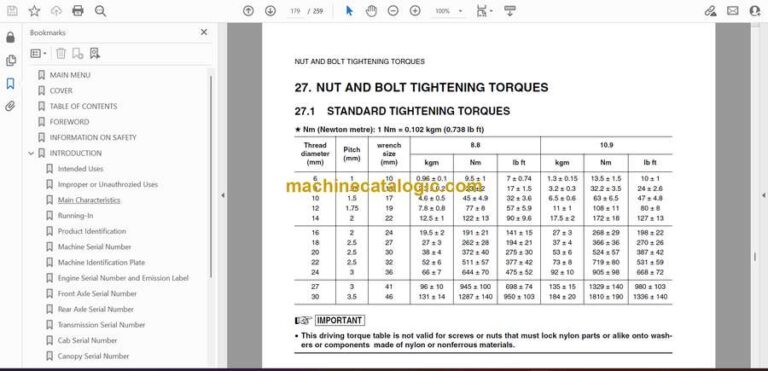
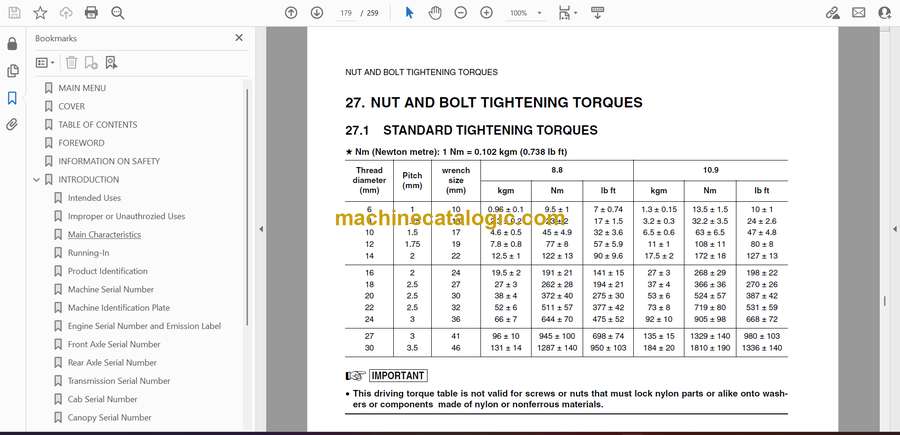
    • 27. Nut and Bolt Tightening Torques
      • 27.1 Standard Tightening Torques
      • 27.2 Specific Tightening Torques
    • 28. Maintenance Plan
      • 28.1 Checks Before Starting
      • 28.2 Maintenance Every 10 Hours of Operation
      • 28.3 Maintenance After the First 50 Hours of Operation ( only for machines in which the synthetic biodegradable oil type HEES is used )
      • 28.4 Maintenance Every 50 Hours of Operation
      • 28.5 Maintenance After the First 250 Hours of Operation
      • 28.6 Maintenance Every 250 Hours of Operation
      • 28.7 Maintenance After the First 500 Hours of Operation ( Only for machines in which the synthetic biodegradable oil type HEES is used )
      • 28.8 Maintenance Every 500 Hours of Operation
      • 28.9 Maintenance Every 1000 Hours of Operation
      • 28.10 Maintenance Every 2000 Hours of Operation
      • 28.11 When Required
      • 28.12 Maintenance Intervals in Case of Use of the Demolition Hammer
      • 29. Long Periods of Inactivity
  • AUTHORIZED OPTIONAL EQUIPMENT
    • 30. Authorized Optional Equipment
      • 30.1 Precautions Regarding Safety
      • 30.2 Characteristics of the Optional Equipment for Model WB140PS-2
      • 30.3 Characteristics of the Optional Equipment for Model WB150PS-2
    • 31. Front Equipment Quick Coupling Devices
      • 31.1 Manual Control Quick Coupling
      • 31.2 Hydraulic Control Quick Coupling for Standard Bucket
      • 31.3 Hydraulic Control Quick Coupling for Multipurpose Bucket and Optional Equipment with Unidirectional Oil Flow
    • 32. Multipurpose Bucket
      • 32.1 Description and Controls
      • 32.2 Safety Devices
      • 32.3 Installing the Multipurpose Bucket
      • 32.4 Using the Multipurpose Bucket
      • 32.5 Maintenance
    • 33. Pallet Forks
      • 33.1 Description
      • 33.2 Safety Devices
      • 33.3 Using the Forks
      • 33.4 Removing the Forks
      • 33.5 Installing the Forks
      • 33.6 Maintenance
    • 34. Backhoe Telescopic Arm
      • 34.1 Description and Control
      • 34.2 Safety Devices
      • 34.3 Using the Telescopic Arm
      • 34.4 Maintenance
    • 35. Arrangement for the Installation of the Demolition Hammer
      • 35.1 Description and Control
      • 35.2 Use of the Demolition Hammer and Rules to be Observed
      • 35.3 Installing and Removing the Demolition Hammer
      • 35.4 Maintenance
    • 36. Arrangement for the Operation of Optional Equipment with Unidirectional Oil Flow
      • 36.1 Description and Control
      • 36.2 Installing and Connecting the Equipment
      • 36.3 Maintenance
    • 37. Arrangement for the Installation of the Clamshell Bucket
      • 37.1 Description and Control
      • 37.2 Installing the Clamshell Bucket
      • 37.3 Using the Clamshell Bucket
      • 37.4 Maintenance
    • 38. Arrangement for the Installation of the Manual Hydraulic Hammer
      • 38.1 Description and Control
      • 38.2 Connecting and Removing the Hammer
      • 38.3 Using the Hammer
      • 38.4 Maintenance
    • 39. Load Stabilizer System ( LSS ) (Optional)
      • 39.1 Accumulator of the Load Stabilizer System ( LSS )
    • 40. Air Conditioner

Komatsu

Latest Product

0
    0
    Your Cart
    Your cart is emptyReturn to Shop