The M9000 is a utility-tractor-class machine that spends its life on hay, loader work, mowing, and tillage. The workshop manual is what I pull when something is worn, leaking, or out of spec and I've only got a weekend to sort it out. It's meant for repair and teardown, not daily operation. If you want to split the tractor, chase a hydraulic issue, or get into the engine, this is the book you want in the shop.
What this manual helps you do
- Diagnose hard-start, smoking, or low-power issues on the Kubota diesel and plan a teardown if needed
- Rebuild front axle and steering components when you've got play, leaks, or uneven tire wear
- Check, adjust, and repair the HST or gear drivetrain, clutch linkages, and PTO drive when they slip or grind
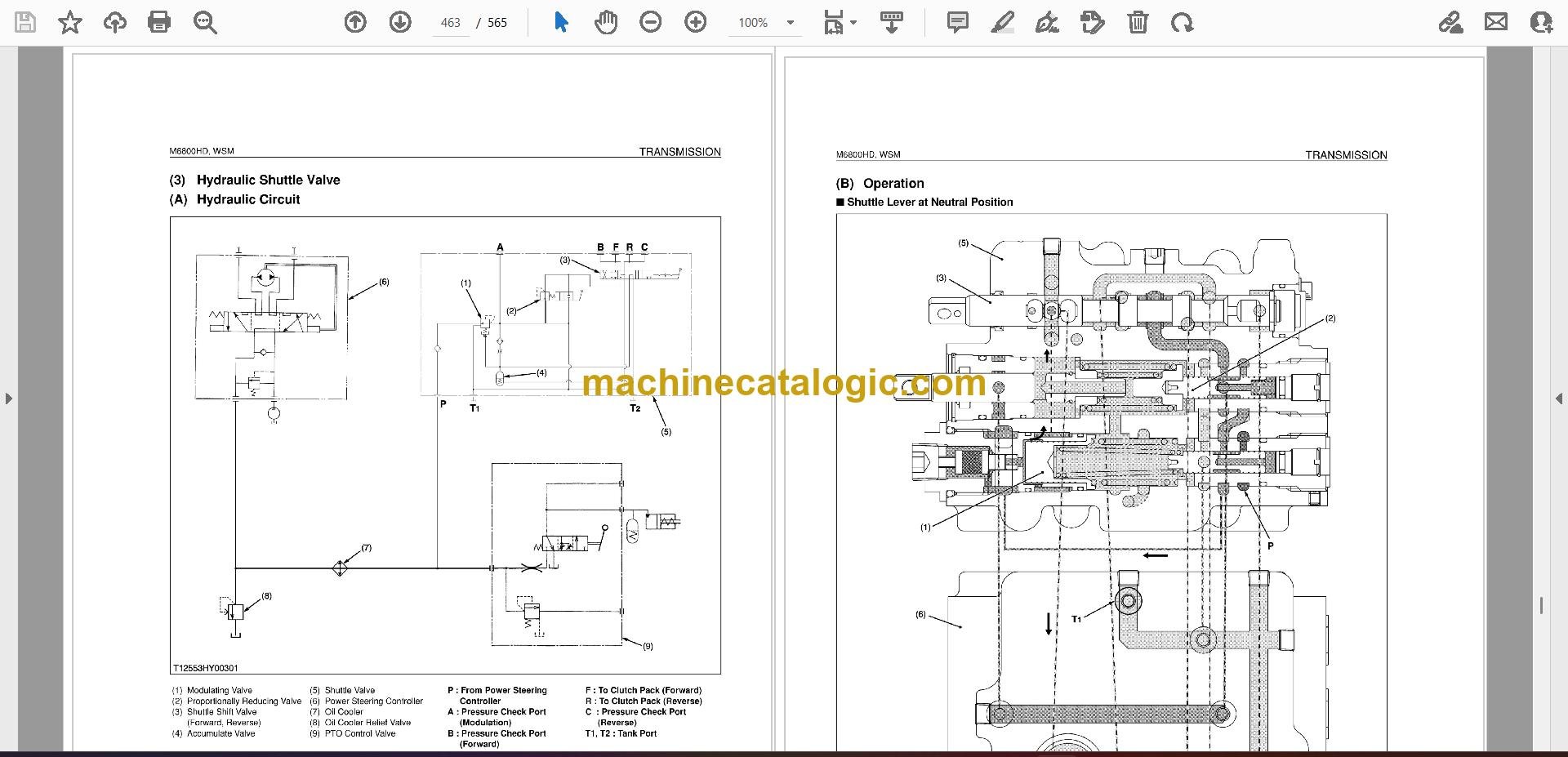
- Troubleshoot slow loader or three-point hitch hydraulics, set pressures, and replace worn valves or pumps
- Follow wiring diagrams to track dead lights, charging problems, or safety switch faults
Who this is for
This is for an M9000 owner-operator, small contractor, or shop mechanic who actually turns wrenches and needs factory repair procedures. If you just need to know how to run the tractor, change basic fluids, or see which part to order, you want the operator's manual and the parts book instead.
FAQ
Q: Is this a searchable PDF and are the wiring diagrams readable?
A: Yes, these manuals are usually searchable PDFs with wiring diagrams you can zoom in on for color codes and connector IDs.
Q: Will this cover my specific M9000 year or cab/2WD/4WD version?
A: It's written for the M9000 tractor line in general, and usually covers the common variants; you'll want to match by model and spec sheet.
Q: Is this the right document if I'm only doing routine maintenance?
A: It will work, but it's overkill; for basic maintenance, the operator's manual is easier to follow.
Bottom line: If you own or wrench on a Kubota M9000 and plan to do real repair work, this is the right manual. If you're just learning to operate it, it's not.
📘 Show Index
Table of Contents:
A Kubota Tractor workshop (service) manual generally covers the systems and service procedures listed below:
- General Information
- Identification and Serial Numbers
- General Precautions
- Handling Precautions for Electrical Parts and Wiring
- Lubricants, Fuel and Coolant
- Tightening Torques
- Maintenance and Check Intervals
- Special Tools
- Tires
- Engine — Mechanism and Servicing
- Engine Body
- Lubricating System
- Cooling System
- Fuel System
- Clutch — Mechanism and Servicing
- Structure and Operation
- Checking, Disassembling and Servicing
- Transmission — Mechanism and Servicing
- Gear / Hydrostatic (HST) Drive
- Shuttle and Range Shift
- PTO System
- Differential Gear System
- Rear Axle — Mechanism and Servicing
- Structure
- Disassembling and Servicing
- Brakes — Mechanism and Servicing
- Structure and Operation
- Checking, Adjusting and Servicing
- Front Axle (2WD / 4WD) — Mechanism and Servicing
- Structure
- Front Wheel Alignment
- Disassembling and Servicing
- Steering / Power Steering — Mechanism and Servicing
- Hydraulic Circuit
- Power Steering Body
- Hydraulic System — Mechanism and Servicing
- Hydraulic Pump
- Control Valve
- Position Control Valve
- Hydraulic Cylinder
- Three-Point Hitch and PTO
- Structure and Operation
- Checking and Servicing
- Electrical System
- Wiring Diagrams
- Starting System
- Charging System
- Lighting and Gauges
- Easy Checker / Diagnostics
To The Reader Index:
- [1] FEATURES
- [2] TRACTOR IDENTIFICATION
- [3] GENERAL PRECAUTIONS
- [4] HANDLING PRECAUTIONS FOR ELECTRICAL PARTS AND WIRING
- (1) Wiring
- (2) Battery
- (3) Fuse
- (4) Connector
- (5) Handling of Circuit Tester
- [5] LUBRICANTS, FUEL AND COOLING WATER
- [6] TIGHTENING TORQUES (GENERAL USE SCREWS, BOLTS AND NUTS)
- [7] MAINTENANCE
- [8] CHECK AND MAINTENANCE
- (1) Daily Check
- (2) Check Points of Initial 50 Hours
- (3) Check Points of Every 50 Hours
- (4) Check Points of Every 100 Hours
- (5) Check Points of Every 200 Hours
- (6) Check Points of Every 300 Hours
- (7) Check Points of Every 400 Hours
- (8) Check Points of Every 600 Hours
- (9) Check Points of Every 800 Hours
- (10) Check Points of Every 2 Years
- (11) Others
- [9] SPECIAL TOOLS
- [10] TIRES
- (1) Types of Tire
- (2) Tread Adjustement
- (2)-1 Front Wheels [2WD]
- (2)-2 Front Wheels [4WD]
- (2)-3 Rear Wheels
- (3) Wheel Hub
- (4) Tire Pressure
- (5) Tire Liquid Injection
- [11] IMPLEMENT LIMITATIONS
Kubota Software
Kubota PDF Manuals