The Kubota MX5200 is a mid-size compact utility tractor, same general class as a Deere 4-series or New Holland Boomer, used for loader work, brush hogging, tillers, and general farm or acreage chores. People reach for the workshop manual when they're past basic maintenance and need to actually repair something. That means chasing hydraulic issues, engine problems, driveline noise, or electrical gremlins with real specs and step-by-step procedures, not guesses.
What this manual helps you do
- Diagnose hard-start, smoke, or low-power problems on the MX5200 diesel and trace them through fuel, air, and compression checks
- Check, adjust, and rebuild front axle, steering, and driveline components when you've got slop, noise, or leaks
- Follow teardown and reassembly sequences on the transmission and rear housing, including HST or gear-drive related work, PTO, and differential repairs
- Troubleshoot slow or weak loader and three-point hydraulics, pressure-test circuits, and replace or reseal pumps, valves, and cylinders
- Set and verify electrical and wiring repairs, from charging and starting circuits to safety switches and instrument panel issues using the wiring diagrams
Who this is for
This MX5200 workshop manual is for owner-operators, small contractors, independent shops, and field techs who are actually tearing into the tractor, not just changing filters. If you only need how-to-drive info, service intervals, or dash light explanations, you want the operator's manual instead, not this workshop manual.
FAQ
Q: Is this a searchable PDF and are the wiring diagrams readable?
A: These manuals are normally delivered as searchable PDFs, and the wiring diagrams are laid out to zoom in clearly on a laptop or tablet.
Q: Will this cover my specific MX5200 year or tire/ROPS/cab variant?
A: MX-series workshop manuals usually cover the whole MX5200 model family, with notes for different options, not just one year.
Q: Is this the right document if I'm planning an engine or hydraulic rebuild?
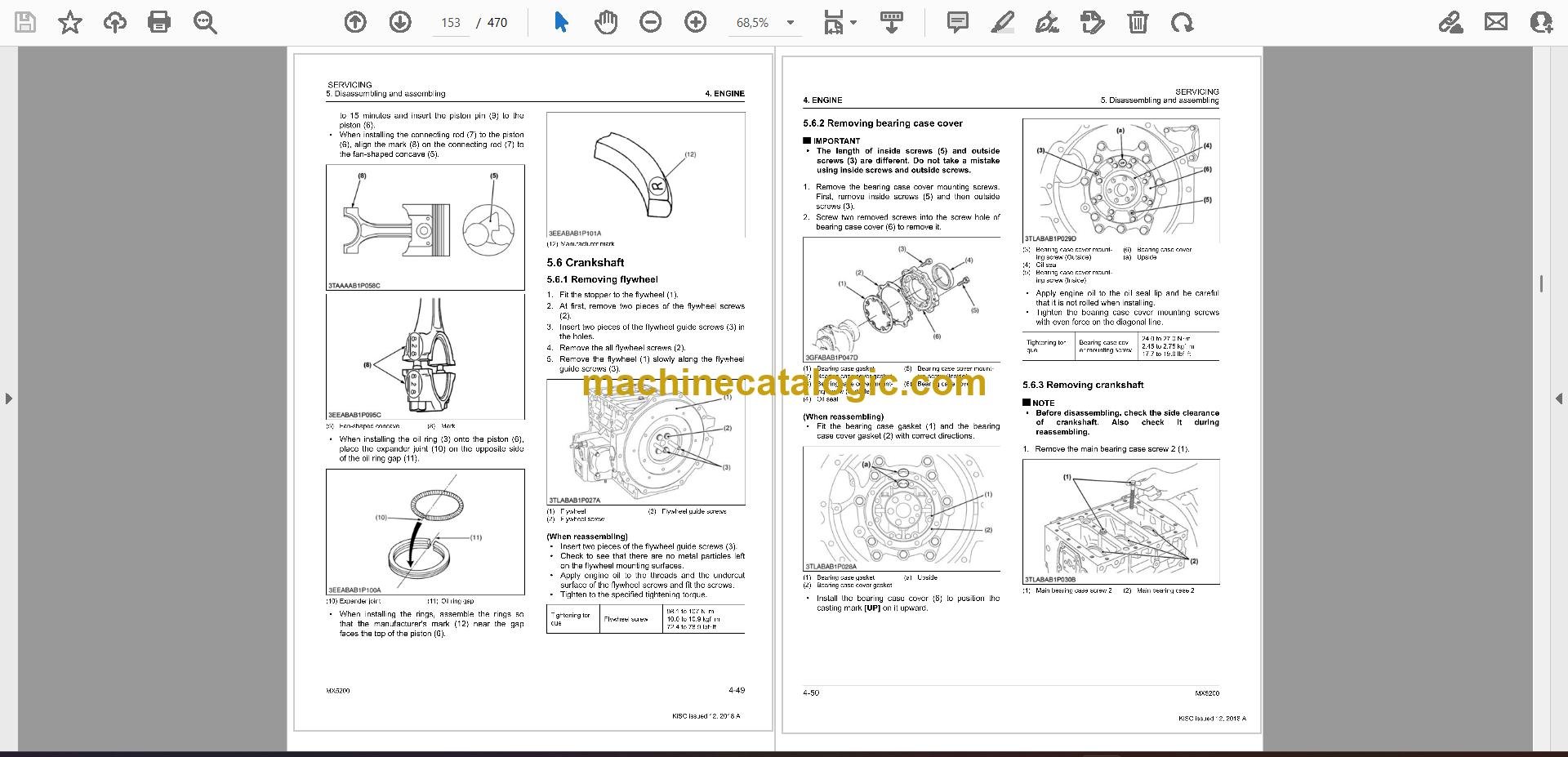
A: Yes, the workshop manual is the correct book for teardown, inspection procedures, and reassembly specs on the MX5200.
Bottom line: If you're fixing or diagnosing an MX5200 rather than just operating it, this is the right manual. If you only want basic use and maintenance, it's overkill.
📘 Show Index
Table of Contents:
A Kubota Tractor workshop (service) manual generally covers the systems and service procedures listed below:
- General Information
- Identification and Serial Numbers
- General Precautions
- Handling Precautions for Electrical Parts and Wiring
- Lubricants, Fuel and Coolant
- Tightening Torques
- Maintenance and Check Intervals
- Special Tools
- Tires
- Engine — Mechanism and Servicing
- Engine Body
- Lubricating System
- Cooling System
- Fuel System
- Clutch — Mechanism and Servicing
- Structure and Operation
- Checking, Disassembling and Servicing
- Transmission — Mechanism and Servicing
- Gear / Hydrostatic (HST) Drive
- Shuttle and Range Shift
- PTO System
- Differential Gear System
- Rear Axle — Mechanism and Servicing
- Structure
- Disassembling and Servicing
- Brakes — Mechanism and Servicing
- Structure and Operation
- Checking, Adjusting and Servicing
- Front Axle (2WD / 4WD) — Mechanism and Servicing
- Structure
- Front Wheel Alignment
- Disassembling and Servicing
- Steering / Power Steering — Mechanism and Servicing
- Hydraulic Circuit
- Power Steering Body
- Hydraulic System — Mechanism and Servicing
- Hydraulic Pump
- Control Valve
- Position Control Valve
- Hydraulic Cylinder
- Three-Point Hitch and PTO
- Structure and Operation
- Checking and Servicing
- Electrical System
- Wiring Diagrams
- Starting System
- Charging System
- Lighting and Gauges
- Easy Checker / Diagnostics
To The Reader Index:
- 1. SAFETY
- SAFETY FIRST
- 1. Working precautions
- 2. Preparing for emergencies
- 3. Working cautions
- 4. Starting the machine safely
- 5. Preventing fires
- 6. Preventing acid burns
- 7. Avoiding high pressure fluid
- 8. Avoiding hot exhaust
- SAFETY LABELS
- 1. Care of danger, warning and caution labels
- 2. GENERAL
- GENERAL WORKING PRECAUTIONS
- 1. Tightening bolts and nuts
- 2. Applying thread-locking fluid
- 3. Installing circlips
- 4. Installing spring pins
- 5. Handling split pin
- 6. Handling chain joint and split pin
- 7. Handling liquid gasket
- 8. Replacing O-rings
- 9. Replacing oil seals
- 10. Replacing floating seals
- 11. Connecting hydraulic hoses
- 12. Wrapping thread seal tape
- 13. Installing elbows with male seat
- 14. Connecting and disconnecting quick hose couplings
- 15. Handling the battery
- 16. Handling electrical wiring
- 17. Handling fuses
- 18. Handling connectors
- 19. Wiring color
- 20. Washing the machine with a high pressure washer
- 21. Dispose fluids correctly
- TIGHTENING TORQUES
- 1. General use screws, bolts and nuts
- 2. Stud bolts
- 3. Hydraulic fitting
- 3.1 Hydraulic hose fittings
- 3.2 Hydraulic pipe cap nuts
- 3.3 Adapters, elbows and others
- 4. Metric screws, bolts and nuts
- 5. American standard screws, bolts and nuts with UNC or UNF threads
- 6. Plugs
- GENERAL MACHINE INFORMATION
- 1. Machine identification
- 2. Specification table
- 2.1 Traveling speeds table [Manual Transmission type]
- 2.2 Traveling speeds table [HST type]
- 3. Dimensions
- 4. Tires, wheels, and ballast
- 4.1 Tires
Kubota Software
Kubota PDF Manuals