Scania DC09, DC13, DC16, OC16 Industrial Engines Installation Manual
These Scania industrial engines usually live in rough spots—generators out by a quarry, pumps on a muddy site, or plant gear that runs all day in a hot, dusty shed. This installation manual helps you mount, align, route, and hook up a DC09, DC13, DC16, or OC16 so it runs right and doesn’t shake your machine apart. Say you’re swapping an old power unit for a DC13 in a generator frame: this manual walks you through how to support the engine, align it to the driven equipment, and route hoses and wiring so you don’t chase vibration and leaks later.
Applications & Use Cases
- Trace and verify engine mounting points so your frame, brackets, and suspension don’t crack under load.
- Check and align the flywheel and coupling to the driven machine, then test for vibration before you sign off the install.
- Route fuel, coolant, and air lines the way Scania intends, so you can inspect, bleed, and service them without tearing half the rig apart.
- Isolate and test electrical connections—starter, charging, sensors—to avoid no-starts and mystery fault lamps.
- Inspect clearances around exhaust and intake, then route pipework so heat won’t cook nearby hoses or wiring.
FAQ
Q: Is this a PDF I can search on my laptop or tablet?
A: Yes, it’s typically supplied as a searchable PDF, so you can jump straight to sections by keyword.
Q: Can I print just the pages I need for the jobsite?
A: You usually can; most folks print the mounting, alignment, and wiring sections and keep the rest digital.
Safety Note
Always support and secure the engine properly before you trace mounts or loosen anything, because these units can shift suddenly and crush hands or feet.
Scania DC09, DC13, DC16, OC16 Industrial Engines Index:
- Changes from the previous issue
- Engine suspension
- Suspension design requirements
- Rigid engine suspension
- Flexible engine suspension
- Tightening torque for engine suspension
- Front engine suspension
- Rear engine suspension
- Permissible installation and operating angles
- Flywheel housing
- Calculation example for bending torque on flywheel housing
- Generator set dynamics
- Lifting the engine
- DC09 and DC13
- DC16 and OC16
- Accessibility for maintenance and repairs
- Installation requirements
- Clearances
- Downward facing centrifugal oil cleaner
- Engine alignment
- Aligning engine and shafts
- Calculation of angular deviation
- Measuring parallel displacement
- Shafts without flange
- Permissible deviations
- Power transmission
- Flexible coupling
- Friction clutch
- Transmission types
- Mechanical transmissions
- Belt transmissions
- Belt transmission in multi-engine installations
- Power take-off
- Front-mounted power take-offs
- Connection of flexible coupling to front end of crankshaft
- Crankshaft pulley with two or more belt grooves
- Torque take-off and transmissible power from the front end of the crankshaft
- Side-mounted power take-offs
- Side-mounted power take-offs for DC09 and DC13
- Side-mounted power take-offs for DC16 and OC16
- Hydraulic diagram for hydraulic pump
- Calculation example for torque take-off from power take-off
- Air compressor
- Torsional oscillations
- Data for torsional oscillation calculation
- Torsional oscillation calculations from Scania
- General tightening torques for screw joints
- Specification of normal tightening torques
- Union assemblies
- Thread inserts
- Tightening torques
- Hexagon screws, hexagon socket screws, Torx screws, hexagon nuts
- Flange screws with hexagonal head and hexagonal flange nuts
- Thread forming Torx screws and hexagon screws with captive washer
- Stud end in threaded hole, strength class 8.8/8
- Union nuts for ferrule
- Sticker “Powered by Scania”
- 01 02 Intake system & Ventilation.pdf
- Changes from the previous issue
- Intake air
- Intake air taken from outside engine room
- Ventilation of the engine room with fresh air line to the engine
- Intake air taken from engine room
- Ventilation requirements for gas engines
- Air cleaner
- Air cleaners with precleaner
- Air cleaners without precleaner
- Crankcase ventilation
- Open crankcase ventilation
- Closed crankcase ventilation
- Connection to turbocharger
- Cleanliness requirements
- Charge air pipe
- Stage IV/Tier 4f engines
- Inlet pipe for connection to turbocharger
- Mass flow sensor pipe
- Important data
- 01 02 Intake system and ventilation_Issue12_190220.pdf
- Changes from the previous issue
- Intake air
- Intake air taken from outside engine room
- Ventilation of the engine room with fresh air pipe to the engine
- Intake air taken from engine room
- Ventilation requirements for gas engines
- Air cleaners
- Air cleaners with precleaner
- Air cleaners without precleaner
- Crankcase ventilation
- Open crankcase ventilation
- Closed crankcase ventilation
- Connection to turbocharger
- Cleanliness requirements
- Charge air pipe
- Connection of combined sensor for atmospheric pressure and temperature
- Stage IV/Tier 4f engines
- Inlet pipe for connection to turbocharger
- Mass flow sensor pipe
- Important data
- 01 03_Fuel system(Issue 8.0).pdf
- Changes from the previous issue
- Fuel tank
- Position
- Positioned lower than the engine
- Positioned higher than the engine
- Other
- Fuel tank design
- Main tank and buffer tank
- Fuel lines
- Example of how the angles of inclination affect the fuel vacuum
- Fuel filter
- PDE and XPI engines
- XPI engines
- PDE engines
- Feed pump flow rates
- Risk of fire
- Fuel grade and power for PDE engines
- Important data
- 01 04 Exhaust System_Issue15_190220.pdf
- Changes from the previous issue
- Sound reduction
- Exhaust noise
- Exhaust system design
- Exhaust outlet
- Stage IV/Tier 4f
- Stage V
- Connection of exhaust system to engine
- V-clamp
- Stage IV/Tier 4f
- Weld flanges
- Exhaust bellows
- Stage III B/Tier 4i and less restrictive emission laws
- Exhaust pipe bends
- Weld flanges for connection to turbocharger
- Exhaust bellows
- Connections to SCR system
- Hydraulic exhaust brake for DC09 and DC13
- Exhaust bellows for Stage V engines
- Exhaust back pressure
- Exhaust back pressure for all engine types
- Exhaust back pressure for Stage V
- Exhaust back pressure for Stage IV/Tier 4f
- Exhaust back pressure Stage III B/Tier 4i
- Insulating the exhaust system
- Insulation of SCR components
- Insulation of Stage V and Stage IV/Tier 4f engines
- Maximum permissible temperature drop for Stage V and Stage IV/Tier 4f engines
- Protection against water ingress
- Multi-engine installation
- Dimensioning the exhaust system
- Calculation example
- Graph for calculating additional length in exhaust system
- Important data
- 01 05 Cooling system.pdf
- Changes from the previous issue
- Design and dimensioning
- Expansion tank
- Pressure drop and coolant flow
- Radiators and radiator fans
- Installation of radiator and radiator fan
- Radiator fans
- Engine-mounted radiators 1.1 m2 and 1.3 m2
- Cooling capacity
- Thermostat
- Connecting a cab heater
- Transmission oil cooling
- Connecting a transmission oil cooler
- Immersion heater
- Multi-engine installation with common cooling system
- Filling coolant
- Installation instructions for the cooling system
- Protective casing for the 1.1 m² cooling package
- Protective casing for the 1.3 m² cooling package
- Pipes and hoses for 1.1 m2 cooling package for DC09 and DC13 Stage V and Stage IV/T4f
- Pipes and hoses for 1.1 m2 cooling package for DC09 and DC13 Stage IIIB/T4i and earlier emission levels
- 1.1 m² radiator for the DC09 and DC13 with a high turbocharger and EGR system
- 1.1 m² radiator for the DC09 with a high turbocharger
- 1.1 m² radiator for the DC09 with a low turbocharger
- 1.1 m² radiator for the DC13 with a high turbocharger
- 1.1 m² radiator for the DC13 with a low turbocharger
- Pipes and hoses for 1.3 m² cooling package for DC13 Stage IV/T4f
- Pipes and hoses for 1.3 m² cooling package for the DC13 with a high turbocharger and EGR system
- 1.5 m² radiator for DC16 and OC16
- 01 06_Technical data (Issue 8.0).pdf
- Changes from the previous issue
- Heat rejection
- All-speed engines
- Single-speed engines
- Diesel engines
- Gas engines
- Air consumption
- All-speed engines
- Single-speed engines
- Diesel engines
- Gas engines
- Radiated heat
- All-speed engines
- Single-speed engines
- Diesel engines
- Gas engines
- Heat output to charge air cooler
- All-speed engines
- Single-speed engines
- Diesel engines
- Gas engines
- Maximum intake air temperature
- All-speed engines
- Single-speed engines
- Diesel engines
- Gas engines
- Exhaust flow and exhaust gas temperature
- All-speed engines
- Single-speed engines
- 01 07 Exhaust gas aftertreatment.pdf
- Changes from the previous issue
- SCR and reductant
- System overview – Stage V
- System overview of mechanics
- System overview of electrics
- Exhaust pipe
- Pipe lengths
- Pipe material
- Other requirements
- Tightening torque for V-clamps
- Components – Stage V
- Particulate filter unit
- Dimensions and attachment
- Clearances
- Differential pressure sensor
- SCR unit
- Dimensions
- Position
- Attachment
- Clearances
- Fitting and connection of reductant doser
- Exhaust gas temperature sensor
- NOx sensor
- NOx sensor position
- System overview – Stage IV/Tier 4f and Stage III B/Tier 4i
- System overview of mechanics
- System overview of electrics
- Exhaust pipe
- Pipe lengths
- Pipe material
- Other requirements
- Tightening torque for V-clamps
- Components – Stage IV/Tier 4f and Stage III B/Tier 4i
- Oxidation catalytic converter
- Dimensions
- Position
- Attachment
- Evaporator
- Dimensions
- Position
- Attachment
- Connection of reductant doser
- Hydrolysis catalytic converter
- Dimensions
- Position
- Attachment
- SCR catalytic converter
- Exhaust gas temperature sensor
- NOx sensor
- Reductant tank
- Tank volumes
- Dimensions
- Position
- Attachment
- Attaching the 38 and 60 litre tanks
- Attaching the 45 litre tank
- Attaching the 63 litre tank
- Attaching the 70 litre tank
- Connecting the reductant tank
- Connecting the 38 and 60 litre reductant tanks
- Connecting the 45 and 63 litre reductant tanks
- Connecting the 70 litre reductant tank
- Ventilation
- Available lengths of reductant hoses
- Coolant connections on the engine
- Warnings and torque reduction for Stage V
- Reaction at low reductant level
- Reaction to faults in the exhaust gas aftertreatment system.
- Regeneration of the particulate filter
- Warnings and torque reduction for Stage IIIB/IV/Tier 4i/Tier 4f
- Reaction at low reductant level
- Reaction to fault in SCR system
- Periodic hydrocarbon evaporation for Stage IV/V/Tier 4f engines
- Engines without exhaust brake
- Engines with exhaust brake
- Important data
- 01 08 Measuring instructions for installation inspection(Issue 4.0).pdf
- Changes from the previous issue
- Measuring instructions
- Parts and tools
- Sensor connections
- Tools
- Scania data logger
- Measuring cooling capacity – thermostat
- Parts for measuring pressure and temperature
- Parts for measuring pressure
- Parts for measuring temperature
- Extension cables
- Measuring instructions
- Ambient temperature
- Intake air temperature
- XPI engines
- PDE and gas engines
- Vacuum with new air filter
- XPI engines
- PDE and gas engines
- Pressure drop in the charge air circuit
- Applies only to diesel engines which don’t have a Scania charge air cooler
- Charge air temperature downstream of the charge air cooler
- XPI engines: Stage IV/Tier 4f
- XPI engines: Stage IIIB/Tier 4i and PDE and gas engines
- Exhaust back pressure
- Engines without SCR system connected
- Engines with SCR system, without oxidation catalytic converter
- Engines with SCR system and oxidation catalytic converter
- The exhaust temperature downstream of the turbocharger or exhaust brake and upstream of the SCR catalytic converter
- XPI engines: Stage IV/Tier 4f
- XPI engines: Stage IIIB/Tier 4i, PDE and gas engines
- Calculated exhaust mass flow rate
- Only applies to XPI engines: Stage IV/Tier 4f
- Coolant temperature upstream of the radiator
- Coolant temperature downstream of the radiator
- Fuel vacuum
- Applies only to diesel engines
- Fuel pressure in return line
- Applies only to diesel engines
- Supply pressure to gas regulator
- Only applies to gas engines
- Function test during starting sequence
- Calculated load at current rotational speed
- Vacuum in the engine compartment
- Temperature in the engine compartment
- By the engine control unit
- By the radiator
- By the exhaust brake and EGR valve actuators
- By the NOx sensor control units
- Temperature in the reductant tank area
- Only applies to XPI engines: Stage IV/Tier 4f and Stage IIIB/Tier 4i
- 01 09 Emission-related installation instructions(Issue 5.0).pdf
- Disclaimer
- Emission-related instructions for Tier 4 Final
- Information regarding the Installation manual
- Sampling of exhaust emissions
- Labeling requirements
- Attaching a duplicate emission control information label
- Label for the fuel inlet
- Cooling capacity requirements
- DC16 085A, certified configuration
- Equipment-Based Constraints
- Required Warning Lamps
- Warning lamps for low reductant level and fault in the SCR system
- Warning lamps for engine malfunction
- 1. Visualizing CAN messages in your own user interface
- Emission-related instructions for Stage V
- Equipment-Based Constraints
- 03 01 Electrical system_Issue12_181201.pdf
- Introduction
- Changes from the previous issue
- Different requirements
- Grounding
- Abbreviations
- Safety during electric welding
- Batteries and alternators
- Batteries
- Connection of batteries
- Battery cables
- Battery master switch
- Alternator charging for marine engines
- Marine engines with split ground system
- Ground connection on gas engines
- Electrical cables
- Routing cables
- Calculating cable cross-section
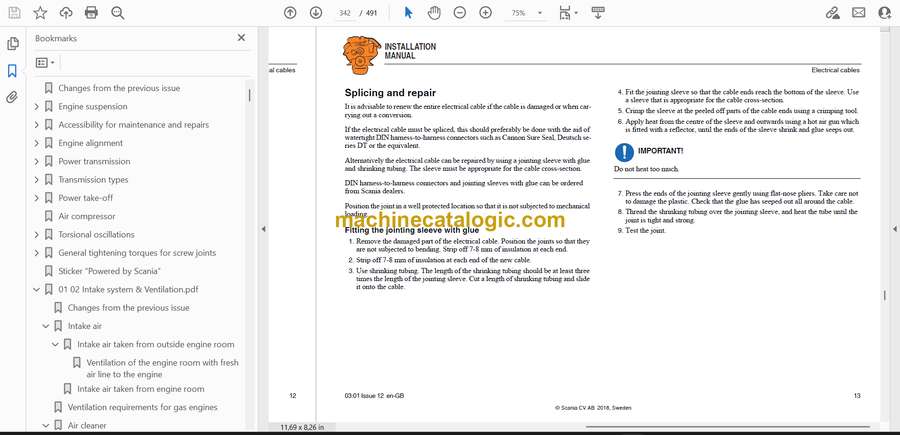
- Splicing and repair
- Fitting the jointing sleeve with glue
- Connection to engine
- Connection to engine without Scania base system
- Current consumption of the electrical system
- Engine interface
- Industrial engines, diesel
- Industrial engines, gas
- Marine engines without SCR system
- Marine engines with SCR system
- Pin numbering for harness-to-harness connectors
- C4001: Harness-to-harness connector for engine control unit
- C4002 on industrial engines: Harness-to-harness connector for exhaust gas aftertreatment management system, electric throttle and EGR system
- C4002 on marine engines: Harness-to-harness connector for connecting limp home mode
- Connection of harness-to-harness connector C4002
- C4071: Harness-to-harness connector for voltage to variable geometry turbocharger and warning lamps for the SCR system
- C4089: Harness-to-harness connector for the connection of limp home mode and voltage to SCR system and exhaust routing valve
- C4109: Harness-to-harness connector for connecting reductant pump
- C4094: Harness-to-harness connectors for ignition coils and throttle actuator at gas mixer
- C4126: Accelerator pedal sensor
- Starting and shutdown procedure for gas engines
- Starting procedure
- Shutdown procedure
- Connection of starter motor or alternator
- Industrial engines
- Marine engines
- Connection of coolant level monitor
- Connecting a coolant level monitor on an industrial engine
- Coolant level monitor on marine engines with heat exchanger
- Connection of coolant level monitor on marine engines with keel cooling
- Connection of oil level sensor
- Engine control unit
- Operating voltage
- Protective ratings
- Connection of throttle control
- Connection of limp home mode
- Engine running signal
- Connecting auxiliary equipment
- Connection of the water separating prefilter on marine engines
- Connecting fuel heaters for industrial engines with XPI
- Installation of the supply connector for engine heater
- Recessed fitting with expansion screw
- Separate fitting with bracket
- Lubrication before connection
- Work description for harness-to-harness connectors
- Harness-to-harness connector for engine interface
- Harness-to-harness connector for engine control unit
- 03 05 CAN Interface _ 03.05 Issue 13 _ 20190424.pdf
- Changes from the previous issue
- Introduction
- General guidelines
- Abbreviations
- Explanations
- Summary of CAN messages sent to the engine
- Summary of CAN messages sent from the engine
- Detailed description of CAN messages sent to engine
- DLN1-Proprietary, all-speed engines
- DLN1-Proprietary, single-speed engines
- Generator Total AC Power
- Tachograph TCO1
- Cruise Control/Vehicle Speed – K
- DLN6-Proprietary
- Time/Date
- TSC1-KE
- TSC1-TE
- TSC1-AE
- TSC Proprietary, single-speed engines
- Cooling Control Proprietary
- CM1-RDE
- CM1
- ETC1
- ETC2
- KWP2000 Physical Addressing
- KWP2000 Functional Addressing
- MABC (Marine Aftertreatment Bypass Control) – K
- ADC (Aftertreatment Desorption Control) – K
- OHECS (Off-Highway Engine Ctrl Selection) – K
- OHECS (Off-Highway Engine Ctrl Selection) – T
- ECM1 (Engine Control Message 1) – K
- ECM1 (Engine Control Message 1) – T
- Detailed description of CAN messages sent from the engine
- Engine Temperature
- Engine Fluid Level/Pressure – E
- Inlet/Exhaust Conditions
- DLN2-Proprietary
- DLN7-Proprietary
- DLN8
- DPFC1 (Diesel Particulate Filter Control)
- EEC1
- EEC2
- EEC3
- BAM-E
- Engine Configuration Messages
- Engine Configuration-Proprietary
- BAM-REX
- Cruise Control/Vehicle Speed – E
- Fuel Economy
- Fuel Consumption
- Engine Hours, Revolutions
- DM1 EMS
- DM1 EEC3
- General Purpose Message 1
- KWP2000 Physical Addressing
- Vehicle Electrical Power
- MABS (Marine Aftertreatment Bypass Status) – E
- ADS (Aftertreatment Desorption Status) – E
- AT1S1
- 03 10 Fault codes DM1(Issue6.0).pdf
- DM1
- Abbreviations
- Fault type identifier
- List of fault codes
Develon