Takeuchi TL130, TL140, TL150 Crawler Loader Operators Manual (AT7E013)
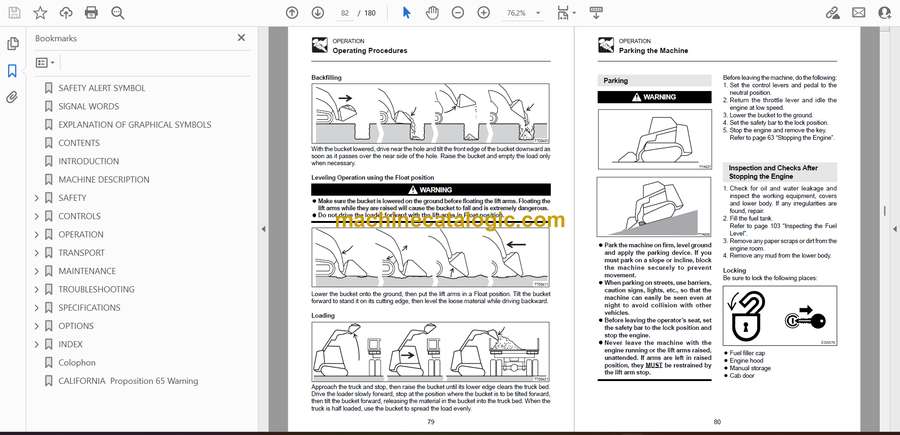
These TL130, TL140 and TL150 tracked loaders live in mud, demo rubble, soft fill and tight residential sites, so this operators manual is what I’d keep handy in the cab or truck. It walks you through how the controls are supposed to respond, how the machine should feel under load, and what to check when something doesn’t behave right. For example, if the loader starts nosing down when you’re carrying a bucket of gravel on a slope, this is the book I’d use to verify operating technique, traction limits and the daily checks that prevent that from turning into a recovery job.
Applications & Use Cases
- Explain control functions so new operators don’t ride the relief valves or shock‑load the undercarriage.
- Set up safe operating habits on slopes, near trenches, and when working close to structures or trucks.
- Plan daily walk‑around checks to spot leaks, loose track components and cracked attachments before a shift.
- Verify proper warm‑up and shutdown routines to avoid hard starts and premature hydraulic wear.
- Troubleshoot odd behavior under load, like sluggish travel, weak lifting, or jerky auxiliary hydraulics.
FAQ
Q: Can I keep a digital copy on my phone or tablet in the field?
A: Yes, it’s practical to load a PDF on a mobile device so you can zoom in on diagrams and control descriptions right next to the machine.
Q: Is it worth printing parts of this manual?
A: Many techs print the operating checks and safety pages, laminate them, and keep them in the cab for quick reference between jobs.
Safety Note
Always read the operating and safety guidance before working on slopes, near people, or under any raised attachment.
Takeuchi TL130, TL140, TL150 Crawler Loader Index:
- SAFETY ALERT SYMBOL
- SlGNAL WORDS
- EXPLANATION OF GRAPHICAL SYMBOLS
- CONTENTS
- INTRODUCTION
- MACHINE DESCRIPTION
- SAFETY
- General Precautions
- Observe all safety rules
- Wear appropriate clothing and personal protective equipment
- Provide a fire extinguisher and first aid kit
- Never remove safety equipment
- Use a signal person and flagman
- Avoid fire and explosion hazards
- Exhaust fumes from the engine can kill
- Handling asbestos dust
- Be careful not to get crushed or cut
- Using optional products
- Never modify the machine
- Preparing Precautions
- Know the working area
- Check the strength of the bridge
- Always keep the machine clean
- Perform inspection and maintenance daily
- Emergency Exit
- Starting Precautions
- Maintain three point contact when mounting and dismounting
- Clear the area of other persons before starting the machine
- Start the engine from the operator’s seat
- Starting with jumper cables
- After starting the engine
- In cold weather
- Operating Precautions
- Ensure good visibility
- Do not permit riders on the machine
- Operate the machine only from the operator’s seat
- Check for safety in the surrounding area before starting
- Keep your body inside the operator’s cab
- Cautions on traveling and turning
- Cautions on traveling on slopes
- Use caution when floating the lift arms
- Do not drive into materials at high speed
- Operate on snow or ice with extra care
- Do not carry the bucket over the heads of people
- Caution against the falling of an unstable load
- Do not suddenly stop or lower the working equipment
- Avoid overloading and off-center loads
- Keep a safe distance from electrical power lines
- Watch out for hazardous working conditions
- Travel in narrow or congested places
- Precautions when passing through tunnels or by high walls
- Do not enter soft ground
- Loaders are NOT designed for lifting loads
- Danger of flying objects
- Cautions on Towing
- Stopping Precautions
- Transporting Precautions
- Load and unload the machine safely
- Transport the machine safely
- Maintenance Precautions
- Attach a “DO NOT OPERATE” tag
- Use the correct tools
- Replace important safety parts periodically
- Anti-explosive lighting
- Do not allow unauthorized personnel in the work area
- Prepare the work area
- Always clean the machine
- Stop the engine before performing maintenance
- Stay clear of moving parts
- Securely block the machine or any component that may fall
- Securely block the raised lift arms
- Secure the rear door when opened
- Cautions on tilting up the canopy
- Place heavy objects in a stable position
- Use caution when fueling
- Handling of hoses
- Be careful with hot and pressurized components
- Be careful with hot cooling systems
- Be careful with fluids under pressure
- Release all pressure before working on the hydraulic system
- Be careful with grease under pressure
- Disconnect the battery
- Avoid battery hazards
- Have a Takeuchi service agent repair welding cracks or other damage
- Safety signs
- Checks after maintenance
- Disposing of wastes
- Safety Signs (Decals)
- CONTROLS
- Names of Components
- Doors and Covers
- Starter Key
- Cab Door
- Side Window
- Engine Hood
- Rear Door
- Emergency Exit
- Lift Arm Stop
- Fuel Filler Cap
- Seat and Seat Belt
- Instrument Panel
- Warning Lamps
- Indicators
- Meters
- Switches
- Starter Switch
- Horn Switch
- Float Switch
- Auxiliary Hydraulic Switches
- Travel Speed Switch
- Light Switches
- Wiper Switches (Option)
- Levers and Pedals
- Safety Bar
- Throttle Lever
- Right Control Lever
- Left Control Lever
- Auxiliary Pedal (If equipped)
- Accessories
- Heater (Option)
- Auxiliary Hydraulic Lines
- High Flow Hydraulic System (If Equipped)
- External Power Socket (Option)
- Interior Light (Option)
- OPERATION
- Before Starting Operation
- Mounting and Dismounting
- Walk-Around Inspection
- Daily Inspection
- Starting and Stopping the Engine
- Before Starting the Engine
- Starting the Engine
- Warming Up the Engine
- Stopping the Engine
- Machine Operation
- Lever Pattern
- Warming Up the Hydraulics
- Inspection After Warm-up
- Operating the Left Control Lever
- Operating the Right Control Lever
- Operating the Auxiliary Hydraulics
- Operating Procedures
- Prohibited Operations
- Cautions on Operating
- Cautions on Traveling on Slopes
- Operations Possible with this Machine
- Parking the Machine
- Parking
- Inspection and Checks After Stopping the Engine
- Handling in Cold Weather
- Preparing for Cold Weather
- Cautions after Completing Operations
- After Cold Weather is Over
- Handling Rubber Crawlers
- Prohibited Actions
- Cautions
- TRANSPORT
- Loading and Unloading
- Securing the Machine
- Cautions on Transporting
- MAINTENANCE
- General
- Maintenance Description
- Cautions on Maintenance
- Service Data
- Fuel and Lubricant Chart
- Expendables
- Tools
- Tightening Torques
- Important Parts
- Maintenance Chart
- Walk-Around Inspection
- Inspecting by Opening the Engine Hood and Rear Door
- Inspecting by Walking Around the Machine
- Inspecting While Sitting in the Operator’s Seat
- Daily Inspection (Every 10 Hours)
- Inspecting and Replenishing the Coolant
- Inspecting and Replenishing the Engine Oil
- Inspecting the Water Separator
- Inspecting the Fuel Level
- Inspecting the Hydraulic Oil Level and Replenishing
- Lubricating the Working Equipment
- After First 50 Hours (New Machines Only)
- Replacing the Hydraulic Oil Return Filter
- Replacing the Engine Oil and Oil Filter
- Inspecting and Adjusting the Fan Belt
- Replacing the Line Filter
- Every 50 Hours
- Inspecting and adjusting the Crawler Tension
- Inspecting the Battery Fluid Level and Replenishing
- Draining the Fuel Tank
- Every 100 Hours
- Cleaning the Water Separator TL130 / TL150
- Every 250 Hours
- Cleaning the Air Cleaner
- Cleaning the Radiator and Oil Cooler Fins
- Replacing the Engine Oil and Oil Filter
- Inspecting and Adjusting the Fan Belt
- After First 500 Hours (New Machines Only)
- Replacing the Travel Motor Gear Oil
- Every 500 Hours
- Replacing the Fuel Filter
- Replacing the Feed Pump Filter (TL140)
- Replacing the Hydraulic Oil Return Filter
- Replacing the Line Filter
- Every 1000 Hours
- Cleaning the Engine Cooling System
- Replacing the Air Cleaner Elements
- Replacing the Hydraulic Oil and Cleaning the Suction Strainer
- Replacing the Travel Motor Gear Oil
- Inspecting and Adjusting the Engine Valve Clearance
- Retightening the Engine Cylinder Head Bolts
- Inspecting the Engine Fuel Injection Pressure and Spray Condition
- Every 2000 Hours
- Inspecting the Engine Fuel Injection Timing
- Inspecting the Engine Fuel Injection Valve
- When Required
- Replacing the Bucket or Attachment
- Lubricating the Levers
- Inspecting and Replenishing the Windshield Washer Fluid
- Tilting Up the Canopy
- Inspecting the Rubber Crawlers
- Long-term Storage
- TROUBLESHOOTING
- Symptoms that are not Malfunctions
- If the Engine Overheats
- If the Battery Goes Dead
- After the Fuel Runs Out
- Bleeding the Air from the Fuel System
- If a Fuse Blows
- Inspecting and Replacing the Fuse
- Inspecting the Fusible Link
- If a Warning Lamp Flashes
- Other Symptoms
- To Lower the Lift Arms
- Towing
- SPECIFICATIONS
- Main Specifications
- Machine Dimensions
- Operating Range
- OPTIONS
- General Precautions
- Precautions on Safety
- Precautions on Installing Attachments
- Precautions on Operating Attachments
- Seat (with Switch)
- Air Conditioner
- Ventilate periodically
- Always maintain good visibility
- Do not overcool
- Do not turn the air conditioner on until the engine is started
- Let hot air out first
- Caution on refrigerant (gas)
- NAMES OF COMPONENTS
- Air Conditioner Switch
- Temperature Control Dial
- Fan Switch
- Outlets
- Heating and Dehumidifying (in cold weather or when the humidity is high)
- Cooling
- Defogging the Windows
- INSPECTION AND MAINTENANCE
- Cleaning the Condenser
- Inspecting and Adjusting the Air Conditioner Belt
- Cleaning the Filter
- Inspecting the Refrigerant (gas) Level
- Off-Season Inspection
- Condition of the refrigerant
- Quick Couplers
- INDEX
- A ~ E
- D ~ I
- I ~ O
- O ~ S
- S ~ W
- Colophon
- CALIFORNIA Proposition 65 Warning
Weidemann