Develon RC14, RC22, RC25, RC34 Attachments User Manual (AA099-0107)
Develon RC14, RC22, RC25, RC34 Attachments User Manual (AA099-0107)
Develon RC14, RC22, RC25, RC34 Attachments Index:
RC14/22/25/34
Foreword
• Please read and understand this manual before operation, inspections and maintenance of the attachment. Keep this manual with your equipment all the time for your quick and easy reference, and read it regularly.
• Do not operate the attachment until you have been trained in the use of all operating controls and understand the attachment operation.
• Get a replacement manual from DEVELON or local distributor if you lost it.
• If you transfer the attachment to the other, do transfer this manual as well.
• The figures in this manual are for better understanding and may not correspond exactly to the attachment. For exact shape, refer to the parts list or ask DEVELON or local distributor.
• For the purpose of constant product improvement, some parts of this manual may be changed. If you found the parts unclear or not corresponding to the attachment, call and consult DEVELON or local distributor.
• Important information on safety is described in the safety information chapter of this book. Be familiarized with the instructions on the safe operation and observe the instructions before and during operation.
• Injury, death or damage caused by unauthorized product modifications and operation under unallowed application will not be responsible by HD HYUNDAI INFRACORE. Consult DEVELON or local distributor for such modifications and applications.
• Use HD HYUNDAI INFRACORE genuine parts. HD HYUNDAI INFRACORE takes no responsibility for damages caused by use of non-DEVELON Genuine spare parts.
• For warranty, please refer to the warranty conditions which provided separately from DEVELON or local distributor.
Safety Information
Remember! Safety is Up to You
Signal Words
Basic Safety Information
Know Yourself
Know Your Equipment
Know the Work Site
Know the Rules
Preparation for Safe Operation
Install the Attachment on the Suitable Carrier
Protect the Operator from the Flying Splinters
Safety Instructions on the Attachment Installation
Check the Attachment and Carrier
Check Safety in Work Site
Safety Information for Operation
Never Operate in Unallowed Applications
Operate from the Top Downwards
Never Use for Transportation Purpose
Never Use for Hammering or Ramming
Prepare a Escape for the Carrier
Stop Operation on Finding Uncertainties
Pay Attention During Operation
Safety Information for Maintenance
Follow the Manual
Use Proper Tools
Ensure that the Attachment and Carrier Stop Completely
Pay Attention to Hot Oil and High-pressure in Hydraulic System
Wet Ground May Be Slippery
Do Not Alter or Modify
Product Information
Main Components
RC14
RC22/RC25/RC34
• Rotating crusher ass’y
• Operation manual
• Standard accessories (fittings, hoses, blade adjust kit, etc)
• Standard tool kit
• Parts list
Option Components
• Standard mounting adapter1) (can be installed on most popular carriers)
• Mounting pin & bush set1)
• Special tools for cylinder maintenance
• Piping kit2) (including the hydraulic rotation circuit)
• Slewing Brake (for RC22/25/34)
Mounting Dimension for the Adapter Plate
Technical Specifications
Markings and Labels
RC14
RC22/25/34
DEVELON Logo
ID Plate
Stay Clear
Lifting Point
Greasing Port
Keep Away
Do not Reset
Caution in Operation
Risk of Serious Injury
Installation
Lifting
• Move the crusher with the jaws completely closed and hydraulic lines plugged.
• When lifting the crusher, use only the lug provided and sufficiently powerful lifting equipment.
• Ropes and rugs must be in good condition.
Requirements on the Carrier
• Carrier weight: The excavator may fall over if the capacity is not good enough to use the attachment or if it is equipped with a long boom and/or a long reach arm. Proper excavator should be decided for use with the attachment or such long boom a…
• Hydraulic system: The hydraulic system of the carrier must be suitable for the attachment. Low flow rate and pressure results in slow working speed and low crushing force respectively. Check the specification of the carrier.
Installation of Hydraulic Piping on the Carrier
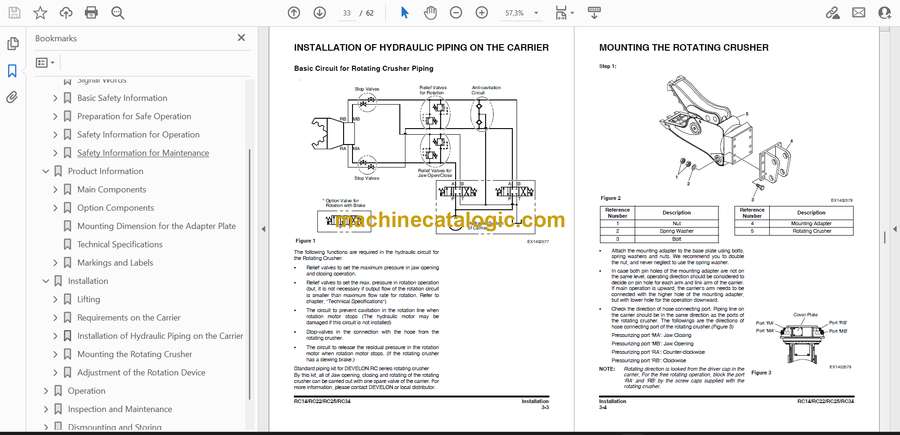
Basic Circuit for Rotating Crusher Piping
• Relief valves to set the maximum pressure in jaw opening and closing operation.
• Relief valves to set the max. pressure in rotation operation (but, it is not necessary if output flow of the rotation circuit is smaller than maximum flow rate for rotation. Refer to chapter, “Technical Specifications”)
• The circuit to prevent cavitation in the rotation line when rotation motor stops (The hydraulic motor may be damaged if this circuit is not installed)
• Stop-valves in the connection with the hose from the rotating crusher.
• The circuit to release the residual pressure in the rotation motor when rotation motor stops. (If the rotating crusher has a slewing brake.)
Mounting the Rotating Crusher
• Attach the mounting adapter to the base plate using bolts, spring washers and nuts. We recommend you to double the nut, and never neglect to use the spring washer.
• In case both pin holes of the mounting adapter are not on the same level, operating direction should be considered to decide on pin hole for each arm and link arm of the carrier. If main operation is upward, the carrier’s arm needs to be connecte…
• Check the direction of hose connecting port. Piping line on the carrier should be in the same direction as the ports of the rotating crusher. The followings are the directions of hose connecting port of the rotating crusher.(Figure 3)
• Before mounting the rotating crusher, please put it on the flat place to take care of the direction of the mounting adapter as the drawing.
• Set the carrier’s engine speed to low idle, and move the stick of carrier slowly until its hole is aligned with that in the mounting adapter. Insert the mounting pin and assemble the stopper and its fasteners. According to mounting adapter, the s…
• Move the shovel cylinder and align the hole of carrier link with that in the mounting adapter in the same way as the Step 2.
• Remove the end caps from the connection ports on the rotating crusher and the stop valves on piping line, then connect the main port and rotation port each other with proper hydraulic hoses.
• The connecting threads must be undamaged and clean from sands, water, etc.
• Open the stop valves on piping line.
Adjustment of the Rotation Device
• Port for pressure check is positioned in both ports ‘RA’ and ‘RB’. Place a pressure gauge into either port, and set the minimum pressure unscrewing the pressure relief valve to the end. The pressure gauge must be for 400 bar or more.
• Place the rotating crusher to the ground or the other strong structure so that the rotating crusher can not rotate.
• Increase pressure by screwing the screw adjuster until the pointer of the pressure gauge reaches the recommended pressure with the rotation actuator of the carrier switched on.
• Pay attention to the max pressure since motor life will be reduced if it is used over maximum pressure.
• Position the rotating crusher for rotation, and rotate it.
• Set the rotation speed by adjusting the flow control valve in the carrier’s rotation pipe.
• The proper rotation speed is 7 ~ 12 rpm and it must not exceed 15 rpm.
Operation
Preparation for Safe and Correct Operation
• Mechanical connection between the rotating crusher and the carrier
• Locking status of the mounting pins
• Hydraulic connections between the rotating crusher and the carrier exact setting of the relief pressure
• No oil leaks from the hydraulic connections and any parts of the rotating crusher
• No defective or loosened parts of the rotating crusher
• Cracks, wear, loss, etc.
• Corresponding the jaw movements and the rotating direction with the appropriate actuating switch in the carrier’s cab
• Smooth opening and closing of the jaws
• Smooth rotating of the rotating crusher
• No abnormal sound and no vibration during the operation
Greasing
• Recommended greasing Interval: Every 2 hours
• 4 ~ 5 strokes from a grease gun to each greasing nipples are sufficient in each case
• Adapt greasing interval and amount of grease to working conditions
• Insufficient greasing may cause abnormal wear of the joint pin or slewing bearing
• Grease with the following properties are recommended:
• Recommended grease
Operating Temperature
Correct Working Method
Do Crushing from the Top Downwards.
Do not Operate to Either Side of the Carrier with the Boom and Arm Extended.
Make Sure the Strength of Structure Which Support the Carrier.
Ensure Position of the Carrier.
Do not Use for Transport Purposes.
Do not Operate with the Carrier’s Hydraulic Cylinders Fully Extended or Retracted.
Do not Support the Carrier with the Rotating Crusher.
Do not Move an Object with the Rotating Crusher.
Advance the Working Position in Small Distance.
Never Use As a Hammer.
Never Use As a Lever.
Do not Move the Carrier While Crushing is in Progress
Never Pull at Heavy Elements
Do not Rotate the Rotating Crusher While Crushing is in Progress
• Underwater use
• Cutting high temperature object
• Bitting off ladle slag in iron works
Do not Cut Large Steel Fabrications
Inspection and Maintenance
General Information
• Check, whenever inspecting, if there is a crack at the welded part of the attachment (visual inspection).
• Check, whenever inspecting, the wear and rounding of the jaws, cutter blades and teeth. Change worn blades and teeth in good time.
• Check, whenever inspecting, if there are oil leaks at the hydraulic components or the hydraulic connections of the hydraulic attachment.
• Check, whenever inspecting, if all fasteners such as bolts, nuts and snap-rings come loose, and retighten them to the prescribed tightening torque, if necessary. Broken parts must be replaced immediately. Refer to chapter, “Tightening torques” fo…
• Check that the blade clearances. The blade clearance should not exceed 2 mm. For steel cutting, the maximum blade clearance is 1 mm. Refer to chapter, “Changing the cutter blades” for detail information. Adjust the clearance of cutter blade accor…
• The hydraulic components of the hydraulic attachment – such as hydraulic cylinders, speed-up valve, rotation motor, etc. – are precision made hydraulic elements. These parts are strongly recommended to maintain by authorized DEVELON service.
• Absolute cleanliness and great care are basic and essential matters in handling of any hydraulic components. Dirt is the worst enemy in hydraulic system.
• Sealing components such as packing, O-rings and plugs in the hydraulic system should be oiled with very clean oil before assembly.
Maintenance Intervals
Every 2 Hours
• Grease the joint pins.
Daily
• Retighten loose components. Especially:
• Check the wear or breakage of the cutter blades.
• Check if the hydraulic connection become loose.
Weekly
• Check the wear of the jaws and rotating crusher body.
• Check carefully if there is a crack in the welded part of the attachment.
• Check the hydraulic components of the carrier.
• Check abnormal sound or vibration during the jaw movements and rotating component.
Every 1000 Hours, or Yearly
Changing the Cutter Blades
• Always wear the eye protective glasses and use a plastic or copper hammer when removing and inserting the cutter blades. Because the cutter blades are made of very hard material, the metal chips may fly off to eye and cause serious injury if they…
• Use only DEVELON genuine fixing bolts and lock-washers. Ensure that they are tightened correctly to the prescribed tightening torque.
• If the condition of the bolts and lock-washers is not good, always use new bolts and lock-washers when fitting new cutter blades.
• Make sure there is no particle at the contact surface between the jaw and blades. Cutter blades must contact the jaw completely.
Adjustment of the Cutter Blade Clearance
• Close the jaws of the rotating crusher or pulverizer.
• Measure cutter blade clearance using a feeler gauge
• If clearance is greater than the specified maximum clearance, adjust the blade clearance according to the following procedures.
• Permissible maximum blade clearance is: 2 mm
• Blade clearance of 0.2 ~ 0.5 mm is recommended to be achieved after adjustment.
Tightening Torques
Replacing the Teeth
Welding Guide for the Jaws and Teeth
Hydraulic Oil
• Stiff operation of the speed-up valve
• Risk of cavitation in the pumps and hydraulic motor
• Bypassing the filter, impurities in oil not filtered
• Efficiency losses (internal leaks)
• Damage to seals and oil leaks
• Accelerated wear in moving parts due to insufficient lubrication
• The viscosity range in the special oil must be in the given range (15 ~ 1000 cSt at any ambient temperature)
• The lubrication properties must be good enough
• The corrosion resistance properties must be good enough
• The oil filter must allow maximum particle size of 25 microns (0.025 mm).
• The oil filter material must be fiber cloth or very fine metallic mesh to withstand pressure fluctuations.
• The oil filter must have a volume flow capacity of at least twice the hydraulic attachment’s maximum flow
• The working life of the hydraulic elements is significantly shortened
• Valves do not function properly due to spool stick
• Wear of cylinder rod and seals
• Shortened working life and reduced efficiency of hydraulic oil (overheats of oil, deteriorates of oil quality, electro- chemical changes in hydraulic oil)
Dismounting and Storing
• When dismounting the attachment from the carrier, put the attachment on the firm and flat groud after check if there is no obstacle within the swing area of the carrier.
• Also the jaw of the crusher or pulverizer must be kept completely close.
• Take care of the safety against the attachment after dismounting so that it can’t fall over.
• After turn stop valves to “OFF” position, disconnect hydraulic hoses from the stop valves.
• Apply end caps and plugs to hoses and stop valves to prevent contamination.
• The attachment recommended to be deposited for storage on a wooden support of sufficient size and strength.
• Also the jaw of the crusher or pulverizer must be kept completely close.
• Collect any oil which runs out when the hydraulic hoses are disconnected and dispose of it correctly.