• Please read and understand this manual before operation, inspections and maintenance of the pile driver. Keep this manual with your equipment all the time for your quick and easy reference, and read it regularly.
• Do not operate the pile driver until you have been trained in the use of all operating controls and understand the pile driver operation.
• Get a replacement manual from DEVELON Infracore dealer if you lost it.
• If you transfer the pile driver to the other, do transfer this manual as well.
• The figures in this manual are for better understanding and may not correspond exactly to the pile driver. For exact shape, refer to the parts list or ask DEVELON Infracore.
• For the purpose of constant product improvement, some parts of this manual may be changed. If you found the parts unclear or not corresponding to the pile driver, call and consult DEVELON Infracore dealer or service center.
• Important information on safety is described in the safety information chapter of this book. Be familiarized with the instructions on the safe operation and observe the instructions before and during operation.
• Injury, death or damage caused by unauthorized product modifications and operation under unallowed application will not be responsible by DEVELON Infracore. Consult DEVELON Infracore for such modifications and applications.
• Use DEVELON Infracore genuine parts. DEVELON Infracore takes no responsibility for damages caused by use of non- DEVELON Infracore spare parts.
• For warranty, we refer you to the warranty conditions provided separately.
Safety Information
Remember! Safety is Up to You
Signal Words
Basic Safety Information
Know Yourself
Know Your Equipment
Know the Work Site
Know the Rules
Preparation for Safe Operation
• The vibrating ripper should only be mounted on a carrier with sufficient load capacity.
• In case of using a quick coupler (hitch), determine the total weight including the quick coupler.
• Carriers below this weight class will not provide the required degree of stability and could even fall over during vibrating ripper use, causing personnel injury or machine damage. Carriers above this weight class may apply excessively high mecha…
• Make sure the vibrating ripper is compatible and match in capacity with carrier hydraulic systems.
• To protect the operator from injury due to flying rock splinters, the operator’s cab must be equipped with a protective shield or splinter guard. For information on the cab protector, consult carrier manufacturer or DEVELON Infracore dealer.
• Mounting the vibrating ripper requires the presence of an assistant, who must be instructed by the carrier driver. The carrier driver and assistant should agree beforehand on clear hand signals.
• To avoid equipment damage, follow the carrier maintenance schedule before operating the vibrating ripper.
• Check the vibrating ripper for wear, getting loose, breakage or crack. Do not operate in case any damages or failure is found.
Recommended Carrier Weight (in tone) for Vibrating Ripper Models
Safety Information ON Safe Operating
• Always operate the vibrating ripper from the operator’s seat in the carrier cab, and also close the splinter guard on the driver’s cab during vibrating ripper operations.
• The vibrating ripper must not be used for disallowed applications. Refer to “Correct Working Methods” on page 5-3 of this manual for instructions on how to handle the vibrating ripper, and applications for which the vibrating ripper is unsuitable…
• Stop the operation if an abnormal noise or vibration is detected during the operation. Check the carrier and vibrating ripper.
• Never use the vibrating ripper in or underwater unless compressed air is supplied to the vibrating ripper. Refer to “Correct Working Methods” on page 5-3 for details.
Safety Information on Maintenance
• Pay careful attention to all relevant safety regulations. Most accidents occur when the instructions are not observed.
• Maintenance work must be performed with the carrier completely stopped, the stop valves shut off. The carrier must be on firm and flat ground with all the control levers switched off.
• Use only the lifting points provided and sufficiently strong lifting equipment when lifting the vibrating ripper.
• Do not start maintenance on the vibrating ripper until it has cooled because the vibrating ripper is heated up during operation. Some components, for example, tooth point, valve, piston or hydraulic connection parts become very hot.
• The hydraulic oil may be very hot and may cause severe scald. Before disconnecting hydraulic lines, bleed all hydraulic pressure in the lines. And, always relieve tank pressure of the carrier.
• Oil spouted out from the crack or small hole on hydraulic system can penetrate the skin and cause serious injury. Therefore, be sure that all the connections are tight and pipes and hoses are in good condition. Use a sheet of cardboard or wood to…
• Only the proper teeth must be used for maintenance. Use of improper teeth may cause personal injury, or damage to the vibrating ripper.
• Oily, greasy ground may be very slippery. Collect any oil and grease, and dispose it correctly for safety and environment.
• Keep personnel away from the vibrating ripper while servicing the tooth or hydraulic system.
• Unauthorized alteration on the vibrating ripper may cause the vibrating ripper serious troubles or reduce vibrating ripper life and performance. These cases cannot be guaranteed by DEVELON Infracore
Product Information
Configuration of the DEVELON Vibrating Ripper
Information for Ordering and Service
Markings and Labels
Communication Indicator
DEVELON Logo
Name Plate
Check Oil Gauge Mark
Stay Clear
Safety
Technical Specifications
VR14/VR22/VR34/VR42/VR50/VR70
Installation
Carrier Requirements
• Carrier weight:
• Mounting dimension:
• Hydraulic line:
• Hydraulic pressure:
• Oil flow:
• Oil cooler:
Mounting the Vibrating Ripper on the Carrier
Connecting the Hydraulic Lines of the Pile Driver
• To avoid vibrating ripper damage, the hydraulic oil of the carrier must be kept clean. Check the contamination of the oil, then, if necessary, change the oil or flush the oil through a external filtration system, and replace the carrier oil filte…
• In case of using a newly installed one way piping, remove the contamination in the hydraulic line through bypass flushing (without connecting the vibrating ripper).
• Check the pressure setting of the relief valve on the vibrating ripper hydraulic line, this pressure-relief setting must be at least 30 ~ 40 bar higher than the measured maximum operating pressure of the vibrating ripper.
• The sealing faces and connecting threads of the hoses or fittings must be undamaged and free of sand or similar foreign particles.
Connection Ports of the Vibrating Ripper
Dismounting the Vibrating Ripper from the Carrier
Inspection After Installation
• The oil flow supplied to the vibrating ripper:
• The operating pressure of the vibrating ripper:
• The relief pressure of the one way piping:
Operating the Vibrating Ripper
• It must be used only for the usage designed by manufacturer
• The protection equipment like wire net must be placed into the operator cabin of the excavator so as to protect the operator from the broken pieces by breaking under operation.
• You must use only the hydraulic oil designated by the excavator and machine manufacturers. Only use hydraulic oils with sufficient viscosity.
• Stop to use the vibrating ripper when the hydraulic oil temperature reaches over 80 c-degree or below 0 c- degree.
• There is a risk of accident by the broken pieces by breaking under operation; the safe zone must be made more than the operation capacity of the excavator. If the person comes onto the zone, stop to operate the crushing immediately.
How to Operate Vibrating Ripper
• In case of ripping work, operator should work pushing the power of the arm and the bucket cylinder folding toward to the direction of (1) with moving boom cylinder up and down.
• In case of ripping with vibration, operator should make power to the bottom of tooth pulling the stone to the direction of (1).
• The relief pressure of the one way piping: must be measured with the stop valve shut off. And, it must be set to 30 ~ 40 bar higher than the measured maximum operating pressure of the vibrating ripper.
• Structure and working principle of Vibrating Ripper is extremely different with Breaker, never use same way of breaker such as continual hit with pressing the stone to vertical direction.
• Vibration speed must be within 1,400 rpm to 3,000 rpm. In case of speed slow down under 2,000 rpm or heavy pressure on vibrating ripper.
• Stop operation, move to find the crack of stone and start ripping operation.
• Do not make vibration over 10 sec in one point when the vibrating ripper can not make crack in the rock or the tooth of ripper does not penetrate to the rock.
Correct Working Methods
Never Push Vibrating Ripper
Never Turn the Carrier Using Ripper Tooth
Never use as lever to pull ripper tooth out.
Never Break Over 10 sec. on One Point
Never use to strong stone such as granite and marble.
Warm Up the Vibrating Ripper
Maintenance
General Information
• Absolute cleanliness and great care are basic and essential matters in the handling of any hydraulic components of the vibrating ripper. (Dirt is the worst enemy of hydraulic systems.)
• Vibrating ripper parts must be handled carefully and stored clean using lint free cloth or cleaning papers for hydraulic use.
• Do not use anything other than the correct cleaning fluid for cleaning hydraulic parts. (Never use water, steam, paint thinners or acid fluid)
• Only the proper tools must be used for maintenance. Use of improper tools may cause personal injury, or damage to the vibrating ripper
• Unauthorized alteration on the vibrating ripper may cause the vibrating ripper serious troubles or reduce vibrating ripper life and performance. DEVELON Infracore cannot guarantee these cases.
• Put the recommended oil into the gear box under red ball of oil level gauge cork.
• Check the tooth, bolts, nuts before starting operation.
• If necessary, replace or fasten parts with putting Loctite no.271 of adhesives sealants
• You must follow the regular maintenance, the way and time according to the manual, and especially take on intensive care of the part to take a risk of damage, wear and tear.
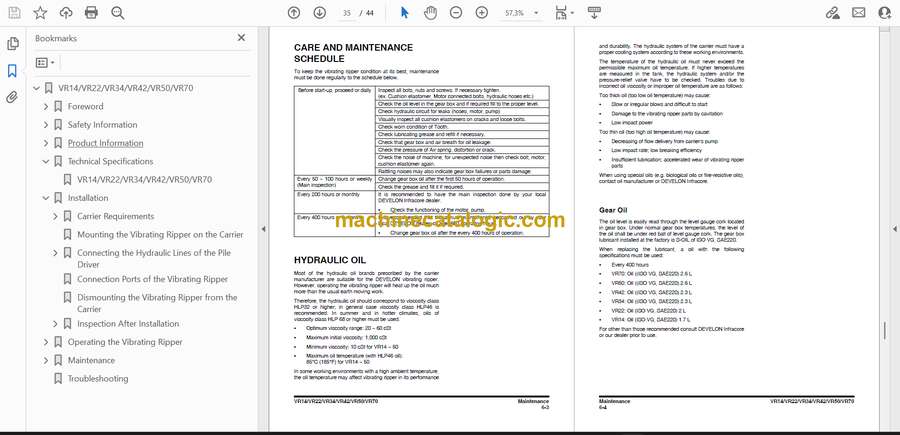
Care and Maintenance Schedule
• Check the functioning of the motor, pump.
• Change gear box oil after the every 400 hours of operation.
Hydraulic Oil
• Optimum viscosity range: 20 ~ 60 cSt
• Maximum initial viscosity: 1,000 cSt
• Minimum viscosity: 10 cSt for VR14 ~ 50
• Maximum oil temperature (with HLP46 oil): 85°C (185°F) for VR14 ~ 50
• Slow or irregular blows and difficult to start
• Damage to the vibrating ripper parts by cavitation
• Low impact power
• Decreasing of flow delivery from carrier’s pump
• Low impact rate; low breaking efficiency
• Insufficient lubrication; accelerated wear of vibrating ripper parts
Gear Oil
• Every 400 hours
• VR70: Oil ((ISO VG, SAE220) 2.6 L
• VR50: Oil ((ISO VG, SAE220) 2.6 L
• VR42: Oil ((ISO VG, SAE220) 2.3 L
• VR34: Oil ((ISO VG, SAE220) 2.3 L
• VR22: Oil (ISO VG, SAE220) 2 L
• VR14: Oil (ISO VG, SAE220) 1.7 L
Hydraulic Oil Filter
• Accelerated parts wear
• Stick or seizure of moving parts or score on the sliding surface of moving parts
• Oil leak and decreasing of vibrating ripper efficiency
• Deterioration of oil quality
• Full time vibrating ripper operation
• Operation without vibrating ripper work
Working in High or Low Ambient Temperatures
High Ambient Temperature
Low Ambient Temperature
Grease
• Every 2,000 hours
• Adjust greasing interval and amount of grease to the vibrating ripper models and working conditions.
Bracket and Adapter
Air Spring Management
Air Release for Long Term Rest
Storage of the Pile Driver
Short Periods of Non-use
Long Periods of Non-use
• The gear box lubrication oil shall be removed.
• The complete gear box be filled by the type of oil.
• All the hydraulic connections must be sealed with clean plugs to prevent oil leak or dirties from getting in to the vibrating ripper.
• The vibrating ripper must be stored in a vertical position with the hydraulic motors facing downwards
• The vibrating ripper must be stored in a dry location.