Format: PDF (Printable Document)
File Language: English
File Pages: 200
File Size: 31.92 MB (Speed Download Link)
Brand: Kohler
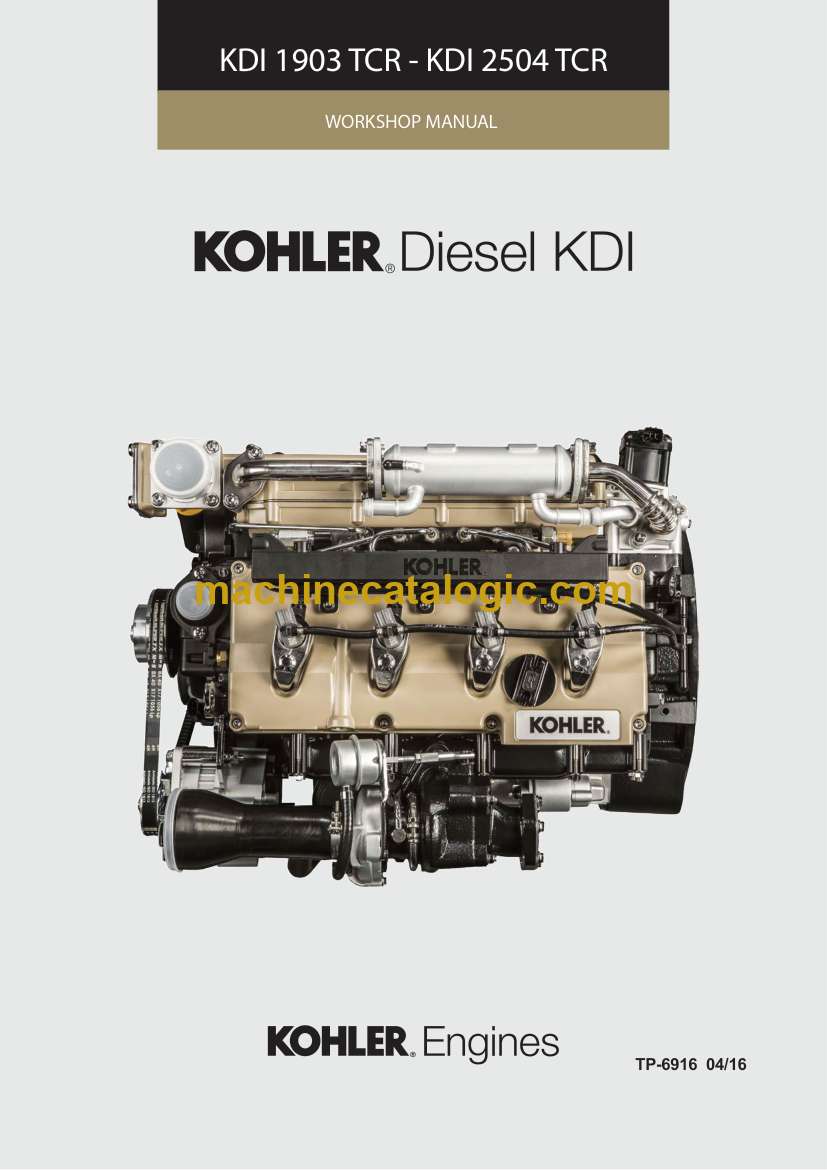
Model: KDI 1903TCR, KDI 2504TCR
Book No: TP6916
Type of Document: Workshop Manual
$ 40
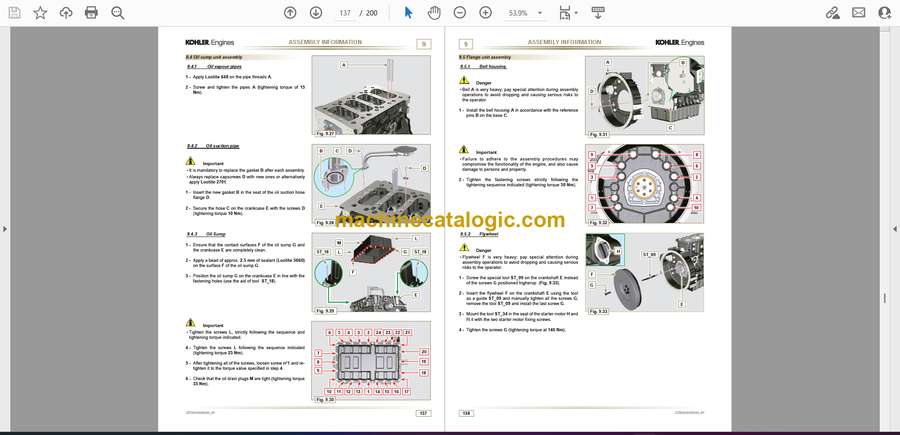
These Kohler KDI 1903TCR and 2504TCR engines usually live in compact loaders, small telehandlers, generators and industrial gear that work hard in dust, mud and temperature swings. This workshop manual is what I’d pull when we’re doing a full teardown or major repair and want the engine back in the frame once, not twice. For example, if a machine comes in with hard starting and low power after a previous “quick fix,” this book lets you strip, inspect, and reassemble the engine and fuel system in a structured way so you can verify each step and avoid rework.
Applications & Use Cases
FAQ
Q: Is this manual practical to use on a laptop or tablet in the shop?
A: Yes, it’s well-suited to digital use—you can zoom diagrams, search terms, and keep it open next to the machine while you work.
Q: Should I still print pages from it?
A: I’d print the key procedures and torque charts for the job, mark them up with notes, and keep them next to the engine to avoid handling a device with dirty hands.
Safety Note
Always lock out the machine, support components securely, and follow all engine-lifting instructions before starting any teardown.
1 GENERAL INFORMATION 12
1.1 Useful information 12
1.2 Manufacturer and engine identification 13
1.3 Name plate for EPA regulations 14
1.4 Identification of main internal components of the engine and operating references 15
1.5 Identification of external components of the engine 17
2 TECHNICAL INFORMATION 19
2.1 Engine specifications 19
2.2 Engine dimensions (mm) 21
2.3 Performance diagrams 22
2.4 Oil 23
2.4.1 SAE classification 23
2.4.2 International lubricant specifications 23
2.5 Fuel 24
2.5.1 Fuel for low temperatures 24
2.5.2 Biodiesel fuel 24
2.5.3 Emissions – Regarding installation instructions 25
2.6 Coolant 25
2.7 Battery features 25
2.8 Scheduled maintenance 26
2.9 Fuel system 27
2.9.1 Injection circuit (2000 bar) 27
2.9.2 Fuel return circuit 28
2.9.3 High-pressure injection pump (2000 bar) 29
2.9.4 Electronic injector 30
2.9.5 Common rail 31
2.9.6 Fuel filter 32
2.9.7 Electric fuel pump (optional) 33
2.9.8 Guards for fuel injection circuit components 34
2.10 Lubrication circuit 35
2.10.1 Lubrication circuit diagram 35
2.10.2 Oil pump 36
2.10.3 Lub. oil filter and Oil Cooler 37
2.11 Coolant circuit 38
2.11.1 Coolant circuit diagram 38
2.11.2 Coolant pump 39
2.11.3 Radiator with intercooler (optional) 39
2.11.4 Thermostatic valve 39
2.11.5 EGR gas circuit cooling (EGR Cooler) 39
2.12 Intake and exhaust circuit 40
2.12.1 Turbocharger 40
2.12.2 Catalyst (optional) 40
2.12.3 Intake and exhaust circuit diagram with EGR 41
2.12.4 Air cleaner (optional) 42
2.13 Electric system 43
2.13.1 ECU input and output signals diagram 43
2.13.2 Control unit (ECU) 44
2.13.2.1 Installation rules 44
2.13.3 Engine electrical wiring 45
2.13.3.1 Wiring disconnection 46
2.14 Sensors and switches 48
2.14.1 Speed sensor on phonic wheel 48
2.14.2 Phase sensor indicator on camshaft 48
2.14.3 T-MAP sensor 48
2.14.4 Common Rail pressure sensor 48
2.14.5 Fuel filter water detection sensor 49
2.14.6 Fuel temperature sensor on fuel injection pump 49
2.14.7 Oil pressure switch 49
2.14.8 Coolant temperature sensor 49
2.14.9 Air cleaner clogging switch 50
2.15 Electrical components 50
2.15.1 Alternator 50
2.15.2 Poly-V belt alternator (optional) 50
2.15.3 Starter Motor 50
2.15.4 EGR valve 51
2.15.5 Cold starting device 51
2.15.6 Fuel intake regulating valve (SCV) 51
2.15.7 Electric fuel pump (optional) 52
2.16 Timing system and tappets 53
2.16.1 Components identification 53
2.16.2 Timing system phasing angles 54
2.16.3 Rocker arm gudgeon 54
2.16.4 Rocker arm 54
2.16.5 Hydraulic tappets 55
2.16.5.1 Hydraulic tappet operation 55
2.16.5.2 Difficult operating conditions 55
2.17 Balancer device 56
2.18 Components handling 57
2.18.1 High-pressure fuel injection pump 57
2.18.2 Electronic injector 57
2.18.3 Common Rail 57
2.18.4 Turbocharger 57
2.19 Turbocharger 58
2.19.1 What to do and what not to do 58
2.19.2 Practical operating rules 58
2.19.3 Before installing a new turbocharger 59
2.19.4 Installation instructions 60
2.19.5 Replacement instructions 60
3 SAFETY INFORMATION 61
3.1 Pre-start check 61
3.2 Safety precautions 61
3.3 General remarks 61
3.3.1 Manufacturer’s notes 61
3.3.2 Notes for the end user 61
3.4 Safety label description 63
3.4.1 Adhesive safety plates 63
3.4.2 Warnings 63
3.4.3 Safety guards 63
3.5 Information and safety labels 64
3.6 Safety and environmental impact 64
3.7 Location of safety labels on engine 65
4 STORAGE INFORMATION 67
4.1 Product preservation 67
4.2 Engine storage (up to 6 months) 67
4.3 Engine storage (over 6 months) 67
4.4 Engine starting after storage 67
5 LIQUID DRAINAGE INFORMATION 69
5.1 Coolant liquid 69
5.2 Engine oil 70
6 INFORMATION FOR REPLACING FUNCTIONAL UNITS 71
6.1 Electronic injector replacement 71
6.1.1 Fuel return tubes disassembly (Common Rail/electronic injectors) 71
6.1.2 High pressure fuel tubes disassembly (Common Rail/electronic injectors) 72
6.1.3 Electronic injector disassembly 72
6.1.4 Electronic injector assembly 72
6.1.5 High-pressure fuel lines assembly 73
6.1.6 Fuel return tubes assembly 73
6
–
ED0053029590_07
INDEX
6.2 High-pressure fuel injection pump replacement 74
6.2.1 High pressure fuel tube disassembly (from injection pump to Common Rail) 74
6.2.2 Timing system carter oil filling flange disassembly 75
6.2.3 High-pressure fuel injection pump disassembly 75
6.2.4 High-pressure fuel injection pump assembly 76
6.2.5 High-pressure line assembly (injection pump / Common Rail) 77
6.2.6 Timing system carter oil filling flange assembly 77
6.3 EGR cooler unit replacement 78
6.3.1 Disassembly 78
6.3.2 Assembly 78
6.4 EGR valve replacement 79
6.4.1 Disassembly 79
6.4.2 Assembly 79
6.5 Coolant pump replacement 80
6.5.1 Disassembly 80
6.5.2 Assembly 81
6.6 Target wheel replacement 81
6.6.1 Disassembly 81
6.6.2 Assembly 83
6.7 Oil pump replacement 83
6.7.1 Coolant pump disassembly 83
6.7.2 Crankshaft and phonic wheel pulley disassembly 83
6.7.3 Timing system carter disassembly 83
6.7.4 Oil pump disassembly 83
6.7.5 Oil pump assembly 84
6.7.6 Timing system carter assembly 84
6.7.7 CRANKSHAFT AND PHONIC WHEEL PULLEY ASSEMBLY 85
6.7.8 Coolant pump assembly 86
6.8 Oil pressure valve replacement 86
6.8.1 Disassembly 86
6.8.2 Assembly 86
6.9 Oil steam separator replacement 87
6.9.1 Disassembly 87
6.9.2 Assembly 87
6.10 Oil Cooler Unit and lub. oil filter replacement 88
6.10.1 Oil Cooler unit disassembly 88
6.10.2 Oil filter cartridge replacement 88
6.10.3 Oil Cooler unit assembly 89
6.11 Fuel filter replacement 90
6.11.1 Disassembly 90
6.11.2 Assembly 90
7 INFORMATION FOR DISASSEMBLY 92
7.1 Recommendations for disassembly 92
7.2 EGR circuit disassembly 92
7.2.1 EGR Cooler Unit 92
7.2.2 EGR Valve 93
7.3 Electric components disassembly 93
7.3.1 Electric wiring 93
7.3.2 Starter motor 94
7.3.3 Belt and alternator 95
7.3.4 Sensors and switches 95
7.3.4.1 Oil pressure switch 95
7.3.4.2 Coolant temperature sensor 95
7.3.4.3 Speed sensor 95
7.3.4.4 Camshaft phase sensor 96
7.3.4.5 T-MAP sensor 96
7.3.4.6 Fuel filter water detection sensor 96
7.4 Turbocharger disassembly 96
7.5 Exhaust manifold disassembly 97
7.6 Coolant recirculation components disassembly 97
7.6.1 Oil Cooler manifold 97
7.6.2 Coolant pump 98
7.6.3 Thermostatic valve 98