Mitsubishi S6R-Y2PTAW Diesel Engine Service Manual (TP6562)
These S6R-Y2PTAW engines usually sit in generators or heavy industrial equipment that run long hours in hot, dusty plants or harsh outdoor sites. This service manual is what I’d keep beside me when I need to pinpoint a fault instead of just throwing parts at the problem. For example, if the engine starts hunting under load, I’d use this book to step through fuel and governor checks in a logical order, so I can prove which component is at fault before I open anything up.
Applications & Use Cases
- Trace hard-start or no-start complaints by following the diagnostic flow and verifying fuel, air, and timing conditions in sequence.
- Isolate irregular noise or vibration by comparing clearances, runout checks, and alignment procedures.
- Disassemble and reassemble major components with the right order of removal, inspection points, and re-torque stages.
- Adjust linkages, valve gear, and control settings so the engine carries rated load without overspeed or smoke issues.
- Verify repairs by using the recommended test steps after overhaul or component replacement.
FAQ
Q: Is this manual practical to use on a tablet in the field?
A: Yes, it’s usable on a tablet; you can zoom diagrams and search terms, which speeds up fault tracing on-site.
Q: Should I still print sections of it?
A: I’d print the procedures I’m doing that day, so I can mark notes, oil spots don’t ruin my device, and I can keep the steps right next to the engine.
Safety Note
Always lock out the prime mover and follow all engine shutdown and isolation procedures before opening any system.
📘 Show Index
Mitsubishi S6R-Y2PTAW Diesel Index:
- BINDING
- INTRODUCTION
- How to use this manual
- Methods of presentation
- Terms used in this manual
- Abbreviations
- Units of measurement
- Safety Cautions
- Fire and explosion
- Keep flames away
- Keep surrounding area neat and clean
- Avoid accessing crankcase until engine cools
- Care about fuel, oil and exhaust gas leakage
- Use explosion-proof lighting apparatus
- Prevent electrical wires from short-circuiting
- Keep fire extinguishers and first-aid kit handy
- Stay clear of all rotating and moving parts
- Install protective covers on rotating parts
- Ensure safety of neighboring people before starting engine
- Stay clear of moving parts during engine running
- Lockout and Tagout
- Keep engine stopped during servicing
- Always restore engine turning tools after use
- Be careful of burns
- Do not touch the engine during or immediately after operation
- Slowly and carefully open radiator cap
- Add coolant only after the coolant temperature dropped
- Never remove heat shields
- Be careful of exhaust fume poisoning
- Operate engine in well-ventilated area
- Protect ears from noises
- Be careful of falling down
- Lift engine correctly
- Do not climb onto the engine
- Establish firm scaffold during work
- Be careful of handling fuel, engine oil and LLC
- Use only specified fuel, engine oil and long- life coolant (LLC)
- Handle LLC (long life coolant) carefully
- Proper disposal of waste oil and coolant (LLC)
- Service battery
- Handle the battery correctly
- When abnormality occurs
- Stop overheated engine after cooling run
- Avoid immediate restart after abnormal stop
- Avoid continuous engine operation with too low oil pressure
- Stop the engine immediately if the fan belt breaks
- Other cautions
- Modification of engine prohibited
- Never break the seals
- Pre-operational check and periodic inspection/maintenance
- Break-in operation
- Warming-up operation
- Avoid engine operations in a overload condition
- Cooling operation before stopping engine
- Protection of engine against water entry
- Maintenance of air cleaner or pre-cleaner
- Observe safety rules at work site
- Work clothing and protective gear
- Use of tools optimum for each work
- Avoidance of prolonged time of starter operation
- Do not turn off battery switch during operation
- Cautionary instructions for transporting engine
- Avoid continuous engine operation in a low load condition
- Ventilation of engine room
- Avoid contact with high-pressured fuel
- About warning labels
- Maintenance of warning labels
- GENERAL CONTENTS
- GENERAL
- 1. External view
- 2. System flow diagrams
- 2.1 Fuel system – flow diagram
- 2.2 Lubrication system – flow diagram
- 2.3 Cooling system – flow diagram
- 2.4 Inlet and exhaust system – flow diagram
- 3. Engine serial number location
- 4. Main specification
- 5. Tips on disassembling and reassembling
- 5.1 Disassembling
- 5.2 Reassembling
- SERVICE DATA
- 1. Maintenance service data
- 1.1 General
- 1.2 Engine main part
- 1.3 Fuel system
- 1.4 Lubrication system
- 1.5 Cooling system
- 1.6 Inlet and exhaust system
- 1.7 Electrical system
- 2. Tightening torque table
- 2.1 Major bolt tightening torque
- 2.1.1 Engine main part
- 2.1.2 Inlet and exhaust system
- 2.1.3 Fuel system
- 2.1.4 Fuel injection pump
- 2.1.5 Lubrication system
- 2.1.6 Cooling system
- 2.1.7 Electrical system
- 2.2 Standard bolt and nut tightening torque
- 2.3 Standard eyebolt tightening torque
- 2.4 Standard union nut tightening torque
- 2.5 High-pressure fuel injection pipe tightening torque
- SERVICE TOOLS
- 1. General tools
- 2. Special tools
- DETERMINATION OF OVERHAUL
- 1. Determining overhaul timing
- 2. Testing compression pressure
- DISASSEMBLY OF BASIC ENGINE
- 1. Disassembling cylinder head and valve mechanism
- 1.1 Removing fuel injection nozzle
- 1.2 Removing rocker shaft assembly and push rod
- 1.3 Disassembling rocker shaft assembly
- 1.4 Removing valve bridge
- 1.5 Removing rocker case
- 1.6 Removing cylinder head assembly
- 1.7 Removing valve and valve spring
- 1.8 Bridge guide
- 2. Disassembling and inspecting flywheel, timing gear and camshaft
- 2.1 Removing flywheel
- 2.2 Removing timing gear case
- 2.3 Measuring timing gear backlash and end play
- 2.4 Removing fuel injection pump accessory drive
- 2.5 Removing idler gear
- 2.6 Removing idler shaft
- 2.7 Removing camshaft gear
- 2.8 Removing camshaft
- 3. Disassembling and inspecting damper and front cover
- 3.1 Removing damper
- 3.2 Removing crankshaft pulley
- 3.3 Removing front cover
- 4. Disassembling cylinder liner, piston and connecting rod
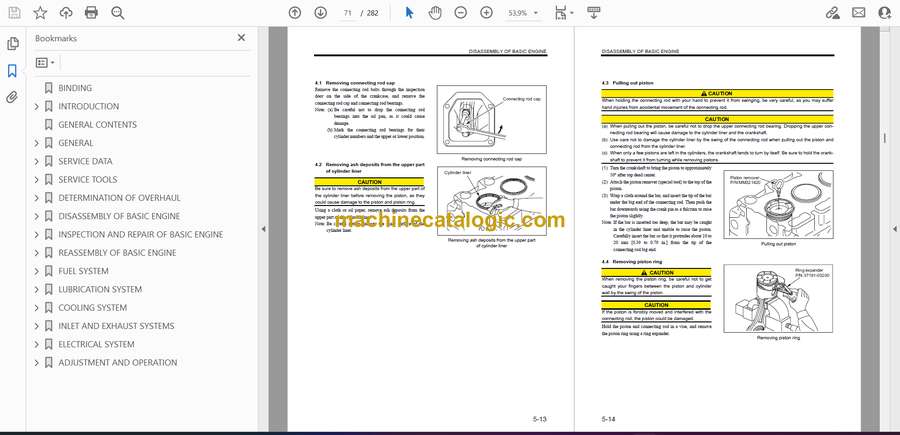
- 4.1 Removing connecting rod cap
- 4.2 Removing ash deposits from the upper part of cylinder liner
- 4.3 Pulling out piston
- 4.4 Removing piston ring
- 4.5 Removing piston pin and piston
- 5. Disassembling and inspecting crankcase, crankshaft and main bearing
- 5.1 Inverting crankcase
- 5.2 Removing main bearing cap
- 5.3 Removing crankshaft
- 5.4 Removing piston cooling nozzle
- INSPECTION AND REPAIR OF BASIC ENGINE
- 1. Inspecting and repairing cylinder head and valve mechanism
- 1.1 Measuring rocker bushing inside diameter and rocker shaft outside diameter
- 1.2 Replacing rocker bushing
- 1.3 Measuring valve stem outside diameter and valve guide inside diameter
- 1.4 Replacing valve guide and stem seal
- 1.5 Inspecting valve face
- 1.6 Refacing valve face
- 1.7 Refacing valve seat
- 1.8 Replacing valve seat
- 1.9 Lapping valve and valve seat
- 1.10 Measuring perpendicularity and free length of valve spring
- 1.11 Inspecting clearance between valve bridge and cotter/rotator
- 1.12 Inspecting tappet
- 1.13 Measuring pushrod runout
- 1.14 Measuring distortion of cylinder head bottom face
- 2. Inspecting and repairing cylinder liner, piston and connecting rod
- 2.1 Measuring cylinder liner inside diameter
- 2.2 Measuring cylinder liner flange protrusion
- 2.2.1 When cylinder liner is not replaced
- 2.2.2 When cylinder liner is replaced
- 2.2.3 Measuring cylinder liner top ridge height
- 2.2.4 Inserting cylinder liner shim
- 2.3 Replacing cylinder liner
- 2.4 Visual inspection of piston
- 2.5 Measuring piston outside diameter
- 2.6 Measuring clearance between piston ring groove and piston ring
- 2.7 Measuring piston pin bore
- 2.8 Measuring piston protrusion
- 2.9 Standard for piston ring replacement
- 2.9.1 Visual inspection of piston ring
- 2.9.2 Measuring piston ring end gap
- 2.10 Measuring piston pin outside diameter
- 2.11 Measuring connecting rod bushing inside diameter
- 2.12 Replacing connecting rod bushing
- 2.13 Inspecting connecting rod bend and twist
- 2.14 Inspecting connecting rod bearing
- 2.15 Measuring connecting rod end play
- 2.16 Weight difference of connecting rod assembly in one engine
- 2.17 Measuring connecting rod big end bore diameter and roundness
- 2.18 Inspecting serrated portion of connecting rod big end
- 2.19 Measuring connecting rod bearing thickness
- 3. Inspecting and repairing damper and crankshaft pulley
- 3.1 Inspecting damper
- 3.2 Inspecting crankshaft pulley
- 4. Inspecting and repairing flywheel, timing gear and camshaft
- 4.1 Measuring flywheel face and radial runouts
- 4.2 Measuring timing gear backlash
- 4.3 Measuring idler bushing inside dia. and shaft diameter
- 4.4 Measuring idler gear end play
- 4.5 Replacing idler bushing
- 4.6 Measuring cam lift
- 4.7 Measuring camshaft runout
- 4.8 Measuring camshaft journal outside diameter
- 4.9 Inspecting camshaft bushing
- 4.10 Replacing camshaft bushing
- 4.10.1 Removing camshaft bushing
- 4.10.2 Installing camshaft bushing
- 4.11 Measuring camshaft end play
- 5. Inspecting and repairing crankcase, crankshaft and main bearing
- 5.1 Measuring crankshaft crankpin and journal outside diameters
- 5.2 Grinding crankshaft
- 5.3 Measuring crankshaft end play
- 5.4 Measuring crankshaft runout
- 5.5 Replacing oil seal slinger
- 5.5.1 Removing oil seal slinger
- 5.5.2 Installing oil seal slinger
- 5.6 Replacing crankshaft gear
- 5.6.1 Removing crankshaft gear
- 5.6.2 Installing crankshaft gear
- 5.7 Inspecting main bearing surface
- 5.8 Measuring thickness of main bearing shell
- 5.9 Replacing main bearing
- 5.10 Measuring crankcase top surface distortion
- 5.11 Measuring main bearing fitting bore
- REASSEMBLY OF BASIC ENGINE
- 1. Reassembling crankcase, crankshaft and main bearing
- 1.1 Installing main bearing upper shells
- 1.2 Installing thrust plates
- 1.3 Installing crankshaft
- 1.4 Installing lower main bearing and lower thrust plate
- 1.5 Installing main bearing caps
- 1.6 Installing main bearing cap bolt
- 1.7 Measuring crankshaft end play
- 1.8 Inverting crankcase
- 2. Reassembling piston and connecting rod
- 2.1 Reassembling piston and connecting rod
- 2.2 Installing piston ring
- 2.3 Preparation for installing piston
- 2.4 Installing upper connecting rod bearing
- 2.5 Installing piston
- 2.6 Installing connecting rod cap
- 2.7 Measuring piston protrusion
- 3. Reassembling damper of front cover
- 3.1 Installing front cover
- 3.2 Installing front oil seal
- 3.3 Installing pulley and damper
- 4. Reassembling flywheel, timing gears and camshaft
- 4.1 Installing rear plate
- 4.2 Rotating crankshaft
- 4.3 Installing idler shaft
- 4.4 Installing camshaft
- 4.5 Installing camshaft gear
- 4.6 Installing fuel injection pump accessory drive
- 4.7 Installing idler gear
- 4.8 Inspecting and adjusting timing gear after installation
- 4.9 Inspecting backlash and end play
- 4.10 Installing timing gear case
- 4.11 Installing rear oil seal
- 4.12 Installing flywheel
- 4.13 Measuring flywheel face and radial runouts
- 4.14 Installing pickup
- 4.15 Installing oil pump and oil strainer
- 4.16 Installing oil pan
- 5. Reassembling cylinder head and valve mechanism
- 5.1 Reassembling cylinder head
- 5.2 Installing tappet
- 5.3 Applying liquid gasket
- 5.4 Installing cylinder head gasket
- 5.5 Installing cylinder head assembly
- 5.6 Tightening cylinder head bolt
- 5.6.1 2-step tightening method
- 5.6.2 Angle tightening method
- 5.7 Installing rocker case
- 5.8 Installing bridges and bridge cap
- 5.9 Installing rocker shaft assembly
- 5.10 Inspecting valve timing
- 5.11 Installing fuel injection nozzle assembly
- 5.12 Adjusting valve clearance
- FUEL SYSTEM
- 1. Removing fuel system
- 1.1 Removing fuel pipe and fuel filter
- 1.2 Removing and inspecting fuel control link and actuator
- 1.3 Removing and inspecting stop solenoid
- 1.4 Removing fuel injection pump
- 2. Disassembling, inspecting and assembling fuel system
- 2.1 Disassembling and inspecting fuel filter
- 2.2 Reassembling fuel filter
- 2.3 Disassembling and inspecting fuel injection nozzle
- 2.4 Inspecting and adjusting fuel injection valve opening pressure
- 2.5 Inspecting fuel spray pattern of fuel injection nozzle
- 2.6 Cleaning and exchange at defective injection
- 2.6.1 Removing nozzle tip
- 2.6.2 Cleaning and inspecting nozzle tip
- 2.7 Reassembling fuel injection nozzle
- 2.8 Disassembling and inspecting fuel injection pump
- 2.8.1 Preparing fuel injection pump disassembly
- 2.8.2 Disassembling rack set cap
- 2.8.3 Disassembling spring case
- 2.8.4 Disassembling return spring
- 2.8.5 Disassembling coupling assembly and fuel feed pump
- 2.8.6 Disassembling delivery valve
- 2.8.7 Disassembling plunger assembly
- 2.8.8 Disassembling controller rack
- 2.8.9 Disassembling tappet
- 2.8.10 Disassembling camshaft
- 2.8.11 Disassembling rear cover
- 2.8.12 Disassembling plunger assembly
- 2.9 Inspecting fuel injection pump
- 2.9.1 Inspecting plunger barrel
- 2.9.2 Inspecting delivery valve
- 2.9.3 Inspecting tappet
- 2.9.4 Inspecting bearing
- 2.9.5 Inspecting valve holder
- 2.9.6 Inspecting pump case
- 2.9.7 O-ring and bellow on each unit
- 2.9.8 Inspecting camshaft
- 2.9.9 Inserting oversize sleeve to camshaft
- 2.9.10 Inspecting plunger spring and delivery valve spring
- 2.10 Reassembling fuel injection pump
- 2.10.1 Installing bearing and front cover
- 2.10.2 Installing camshaft and center bearing
- 2.10.3 Installing rear cover
- 2.10.4 Measuring thrust clearance of camshaft
- 2.10.5 Installing tappet roller assembly
- 2.10.6 Installing tappet
- 2.10.7 Reassembling plunger assembly
- 2.10.8 Installing controller rack
- 2.10.9 Positional relationship between plunger and barrel
- 2.10.10 Removing plunger assembly
- 2.10.11 Measuring control rack sliding resistance
- 2.10.12 Reassembling delivery valve
- 2.10.13 Reassembling bellow
- 2.10.14 Reassembling fuel feed pump
- 2.10.15 Reassembling flywheel
- 2.10.16 Reassemblig coupling assembly
- 2.10.17 Reassembling controller rack return spring
- 2.11 Adjusting fuel injection pump
- 2.11.1 Adjusting pre-stroke (injection timing)
- 2.11.2 Adjusting injection interval
- 2.11.3 Adjusting injection volume
- 2.12 Disassembling and inspecting fuel feed pump
- 2.13 Reassembling fuel feed pump
- 2.13.1 Tightening priming cap
- 2.14 Fuel feed pump test
- 2.14.1 Fuel feed pump air-tightness test
- 2.14.2 Fuel feed pump fuel feeding pressure test
- 2.14.3 Priming pump suction capacity test
- 2.14.4 Fuel feed pump fuel feed rate test
- 2.15 Disassembling and inspecting fuel injection pump accessory drive
- 2.16 Inspecting outer and inner diameters of fuel injection pump accessory drive bearing engagement section
- 2.17 Reassembling fuel injection pump accessory drive
- 3. Installing fuel system
- 3.1 Installing fuel injection pump
- 3.1.1 Checking fuel injection timing
- 3.1.2 Installing coupling on driving side
- 3.1.3 Checking before installing fuel injection pump
- 3.1.4 Reassembling fuel injection pump
- 3.1.5 Adjusting clearance between flywheel and coupling
- 3.2 Installing fuel control link
- 3.2.1 Reassembling fuel control link
- 3.3 Adjusting and confirmation working of stop solenoid
- 3.3.1 Adjusting stop solenoid
- 3.3.2 Stop solenoid working inspection
- 4. Adjusting governor controller
- 4.1 Wiring controller
- 4.2 Initial setting of controller
- 4.3 Adjusting governor during idling
- LUBRICATION SYSTEM
- 1. Removing lubrication system
- 2. Disassembling and inspecting lubrication system
- 2.1 Disassembling and inspecting oil pump and safety valve
- 2.2 Disassembling and inspecting oil pump and safety valve
- 2.2.1 Measuring oil pump gear backlash
- 2.2.2 Measuring side clearance between gears and case
- 2.2.3 Measuring end clearance between gears and case
- 2.2.4 Measuring drive and driven gear shaft outside diameters and bushing inside diameter
- 2.2.5 Measuring spindle outside diameter and idler gear bushing inside diameter
- 2.2.6 Inspecting oil pump safety valve spring
- 2.2.7 Adjusting backlash when installing oil pump
- 2.3 Reassembling oil pump and safety valve
- 2.4 Disassembling relief valve
- 2.4.1 Measuring relief valve pressure
- 2.5 Reassembling relief valve
- 2.6 Disassembling and inspecting oil cooler and oil thermostat
- 2.6.1 Inspecting oil cooler
- 2.6.2 Inspecting oil thermostat
- 2.7 Reassembling oil cooler and oil thermostat
- 2.8 Disassembling oil filter
- 2.9 Inspecting oil filter
- 2.10 Inspecting oil filter alarm
- 2.11 Reassembling oil filter
- 3. Installing lubrication system
- COOLING SYSTEM
- 1. Removing cooling system
- 1.1 Removing tension pulley
- 1.2 Removing 2-way water pump and thermostat
- 1.3 Removing water pump and thermostat
- 2. Disassembling, inspecting and reassembling cooling system
- 2.1 Disassembling and inspecting fan drive
- 2.2 Inspecting fan drive
- 2.3 Reassembling fan drive
- 2.4 Disassembling and inspecting tension pulley (2-way water pump)
- 2.4.1 Inspecting tension pulley
- 2.4.2 Reassembling tension pulley
- 2.5 Disassembling and inspecting tension pully (water pump)
- 2.5.1 Inspecting tension pulley
- 2.5.2 Reassembling tension pulley
- 2.6 Disassembling and inspecting 2-way water pump
- 2.6.1 Inspecting water pump in installed condition
- 2.6.2 Removing impeller
- 2.6.3 Removing water pump shaft
- 2.6.4 Inspecting 2-way water pump
- 2.7 Reassembling 2-way water pump
- 2.7.1 Installing unit seal
- 2.7.2 Installing water pump shaft
- 2.7.3 Installing ball bearing
- 2.8 Disassembling and inspecting water pump
- 2.8.1 Inspecting water pump mounted on engine
- 2.8.2 Removing impeller
- 2.8.3 Removing water pump shaft
- 2.9 Inspecting water pump
- 2.10 Reassembling water pump
- 2.10.1 Installing water pump oil seal
- 2.10.2 Installing water pump bearing
- 2.10.3 Installing unit seal
- 2.10.4 Installing water pump shaft
- 2.10.5 Installing water pump oil seal
- 2.10.6 Installing floating seat and impeller
- 2.11 Disassembling thermostat (water pump side)
- 2.11.1 Inspecting water thermostat
- 2.12 Disassembling thermostat (2-way water pump side)
- 2.12.1 Inspecting thermostat
- 3. Installing cooling system
- 3.1 Installing water pump and thermostat
- 3.2 Installing 2-way water pump and thermostat
- 3.3 Installing tension pulley
- INLET AND EXHAUST SYSTEMS
- 1. Removing inlet and exhaust systems
- 1.1 Removing turbocharger and exhaust manifold
- 1.2 Removing air cooler assembly
- 2. Air cooler
- 2.1 Disassembling air cooler
- 2.2 Inspecting air cooler
- 2.2.1 Cleaning air cooler
- 2.2.2 Inspecting air cooler for leakage
- 3. Exhaust manifold
- 3.1 Disassembling and inspecting exhaust manifold
- 3.2 Reassembling exhaust manifold
- 4. Turbocharger
- 4.1 Disassembling turbocharger
- 4.1.1 Preparing for disassembly
- 4.1.2 Removing compressor cover
- 4.1.3 Removing diffuser
- 4.1.4 Removing compressor wheel
- 4.1.5 Removing snap ring
- 4.1.6 Removing insert and oil deflector
- 4.1.7 Removing shaft & turbine wheel
- 4.1.8 Removing snap ring and bearing
- 4.2 Cleaning
- 4.3 Inspecting turbocharger
- 4.3.1 Bearing housing
- 4.3.2 Bearing
- 4.3.3 Shaft and turbine wheel
- 4.3.4 Inspecting insert and measuring piston ring end gap
- 4.4 Reassembling turbocharger
- 4.4.1 Installing shaft & turbine wheel and bearing
- 4.4.2 Installing thrust bearing
- 4.4.3 Installing O-ring
- 4.4.4 Installing oil deflector
- 4.4.5 Reassembling insert sub-assembly
- 4.4.6 Installing snap ring
- 4.4.7 Measuring clearance between shaft & turbine wheel and turbine housing
- 4.4.8 Installing compressor wheel
- 4.4.9 Measuring play of shaft & turbine wheel in axial direction
- 4.4.10 Measuring clearance between turbine backplate and back side of turbine wheel
- 4.4.11 Installing turbine housing
- 4.4.12 Installing diffuser
- 4.4.13 Installing turbine housing
- 4.4.14 Installing V-clamp
- 5. Installing inlet and exhaust system
- 5.1 Installing air cooler assembly
- 5.2 Installing turbocharger and exhaust manifold
- ELECTRICAL SYSTEM
- 1. Removing electrical system
- 1.1 Removing starter
- 1.2 Removing alternator
- 2. Disassembling, inspecting and reassembling electrical system
- 2.1 Disassembling and inspecting starter
- 2.1.1 Removing magnet switch
- 2.1.2 Removing rear bracket
- 2.1.3 Removing armature and yoke assembly
- 2.1.4 Removing center bracket
- 2.1.5 Removing pinion set
- 2.2 Inspecting and repairing starter
- 2.2.1 Inspecting continuity of magnet switch (between M terminal and C terminal)
- 2.2.2 Inspecting continuity of magnet switch (between M terminal and case)
- 2.2.3 Inspecting insulation of magnet switch (between M terminal and B terminal)
- 2.2.4 Inspecting continuity of magnet switch (between M terminal and B terminal)
- 2.2.5 Measuring armature shaft runout
- 2.2.6 Measuring armature shaft bearing fitting face
- 2.2.7 Measuring commutator radial runout
- 2.2.8 Measuring undercut depth
- 2.2.9 Measuring commutator outside diameter
- 2.2.10 Inspecting armature coil
- 2.2.11 Inspecting continuity of yoke assembly
- 2.2.12 Inspecting insulation between field coil and yoke
- 2.2.13 Inspecting overrunning clutch
- 2.2.14 Inspecting brushes for wear
- 2.2.15 Measuring brush spring load
- 2.3 Inspecting safety switch
- 2.4 Installing starter
- 2.4.1 Installing pinion shaft
- 2.4.2 Installing lever and pinion shaft
- 2.4.3 Installing armature, yoke, brush and brush holder
- 2.4.4 Installing rear bracket
- 2.4.5 Measuring armature end play
- 2.4.6 Measuring pinion shaft end play
- 2.4.7 Installing magnet switch
- 2.4.8 Installing safety switch
- 2.4.9 Measuring pinion gear retraction length
- 2.5 Disassembling and inspecting alternator
- 2.6 Inspecting and repairing alternator
- 2.6.1 Inspecting rectifier
- 2.6.2 Inspecting rotor
- 2.6.3 Inspecting stator
- 2.6.4 Inspecting brushes
- 2.7 Reassembling alternator
- 3. Installing electrical system
- 3.1 Installing alternator
- 3.2 Installing starter
- ADJUSTMENT AND OPERATION
- 1. Adjusting engine
- 1.1 Inspecting and adjusting valve clearance
- 1.1.1 Inspecting clearance between bridge and valve rotator
- 1.1.2 Using turning gear
- 1.1.3 Inspecting valve clearance
- 1.1.4 Adjusting both inlet and both exhaust valve heights by valve bridge
- 1.1.5 Adjusting valve clearance
- 1.2 Bleeding fuel system
- 1.2.1 Bleeding air from fuel filter
- 1.2.2 Bleeding air from fuel injection pump
- 1.2.3 Clamping method of priming pump cap
- 1.3 Inspecting and adjusting fuel injection timing
- 1.3.1 Fuel injection timing and its indication location
- 1.3.2 Determining top dead center of No.1 cylinder compression stroke
- 1.3.3 Inspecting fuel injection timing
- 1.3.4 Adjusting fuel injection timing
- 1.3.5 Inspecting and adjusting low idle speed and high idle speed
- 2. Adjusting V-belt tension
- 3. Break-in operation
- 3.1 Starting up
- 3.2 Inspecting engine condition after starting up
- 3.3 Break-in operation time
- 3.4 Inspection and adjustment after break-in operation
Kohler