$ 0
0
$ 0
0

Mustang 80M Compact Excavator Operator Manual

Format: PDF (Printable Document)

File Language: English

File Size: 7.92 MB (Speed Download Link)

Brand: Mustang

Model: 80M

Machine Type: Compact Excavator

Publication No.: 50940492 (Rev. B)

Edition Date: July 2018

Type of Document: Operator Manual (operation, controls, safety and routine maintenance)

Searchable: Yes, text is searchable and copyable

Delivery: Instant download after payment

Categories: ,

$ 40

Share:

Mustang 80M Compact Excavator Operator Manual

A compact excavator like the 80M digs trenches, footings and utility runs in places a bigger machine cannot get into, and it spends a lot of its life with different people in the seat. This operator manual is the book for running it: safety, controls, starting, travelling, steering and the upkeep that keeps it working.

It is Mustang publication 50940492, Rev. B, edition date July 2018, written in English and covering the 80M. If a machine came to you without its book, or a new customer is about to drive off with one, this is the copy to have beside the seat.

What this manual helps you do

  • Start the engine by the book, using the checks in 13-1 before starting and the steps in 13-2 for starting up.
  • Operate the machine with the monitors, switches, control levers and pedals explained in section 12, then move on to travelling and steering in 13-4 and 13-5.
  • Check the Maintenance Table for service intervals, including 24-2 for the hydraulic breaker and 25-2 for nonperiodic services.
  • Look up bolt values in the 22-2 torque table and dimensions in the specifications and dimensional diagrams.
  • Follow the safety sections on operating, transport, towing, battery and servicing precautions, and read the warning label locations in 10-1.

Who this is for

Rental fleet managers and owner-operators will get the most from it. Use it to brief a new operator on the controls and precautions before the machine leaves the yard, and to settle service interval questions afterwards.

Keep the 80M's book handy and the daily check is one less thing to explain at handover.

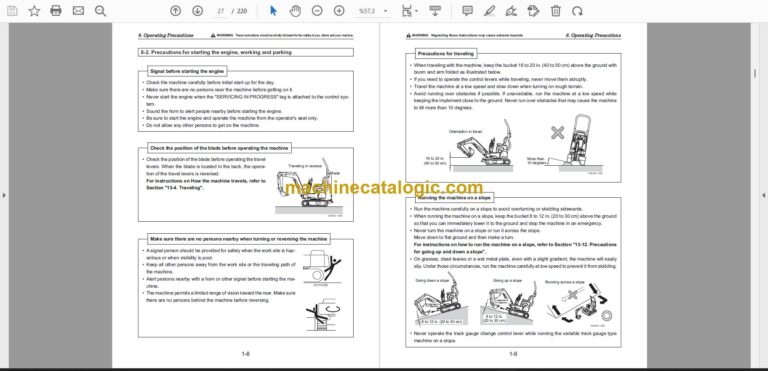
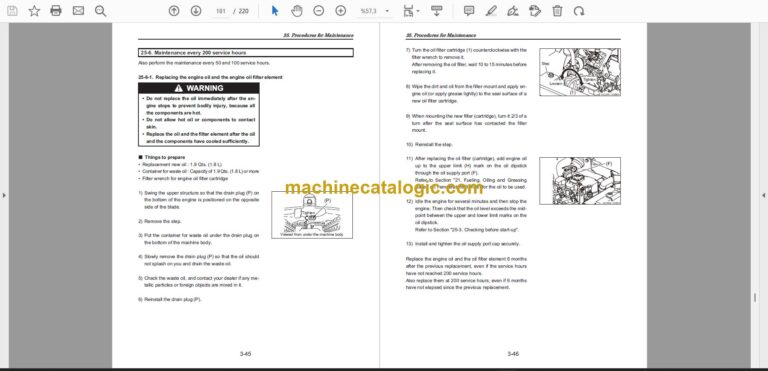
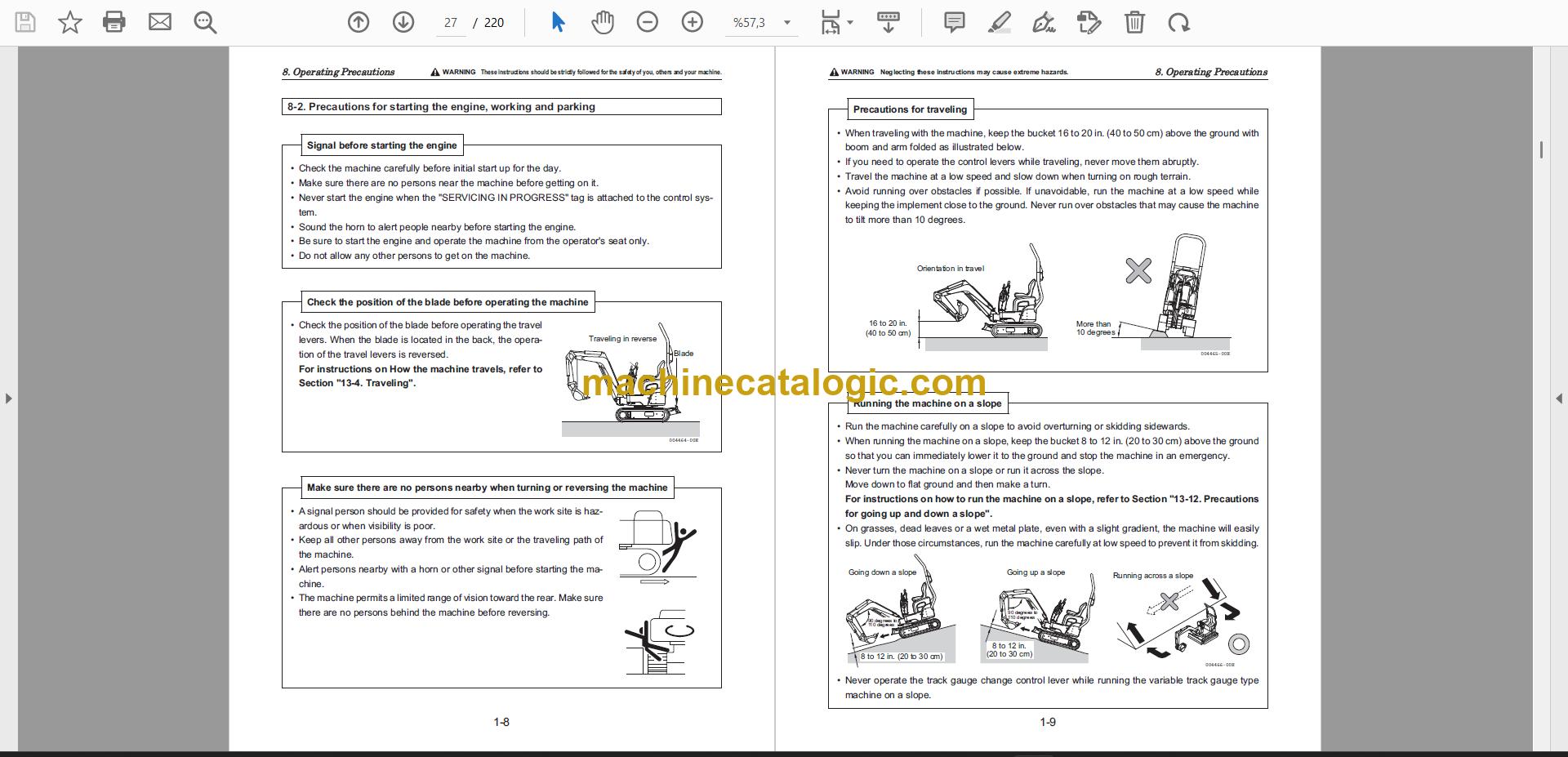
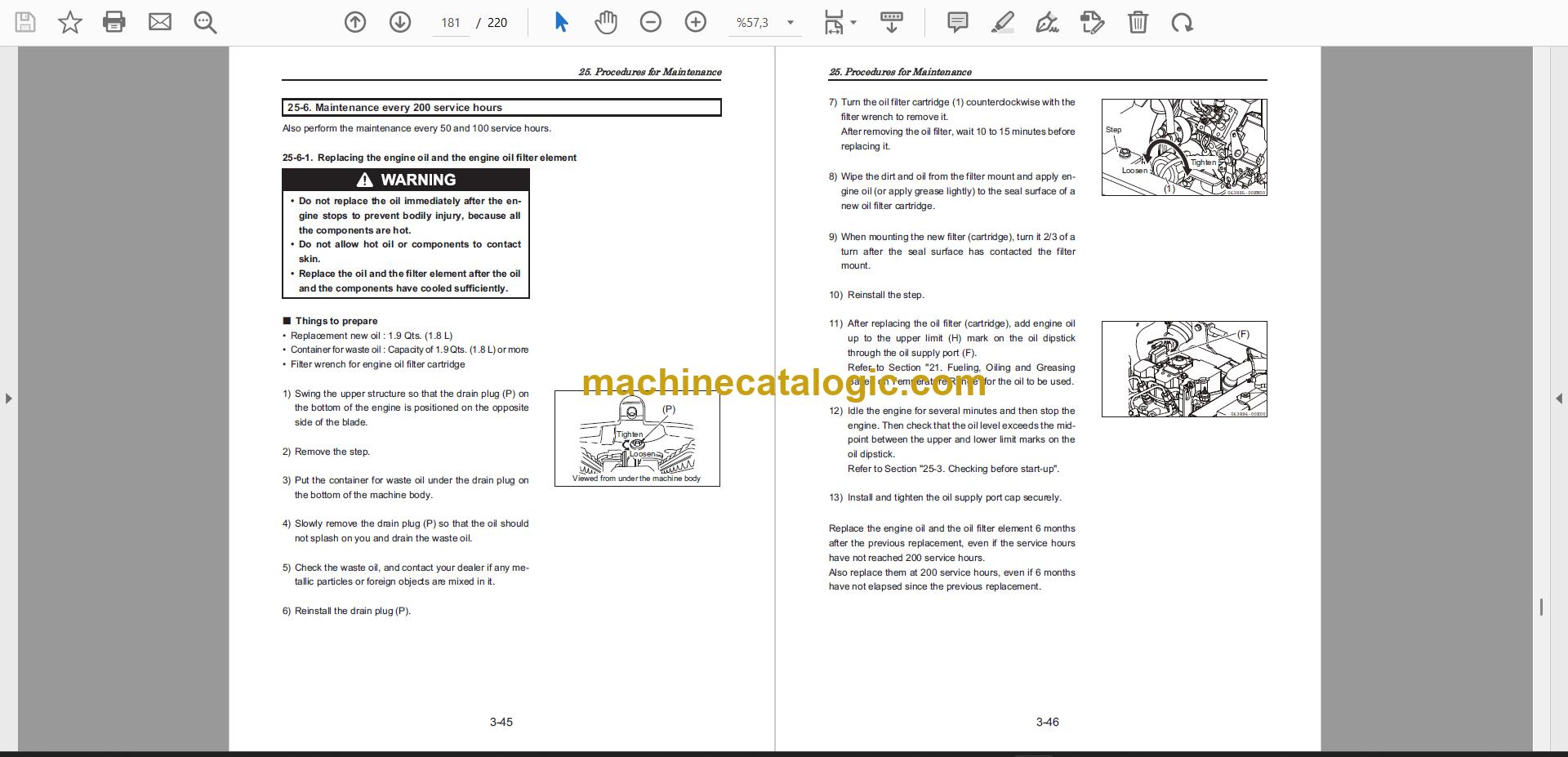
Preview of the Mustang 80M Compact Excavator Operator Manual (PDF, sample pages)

Does this manual fit your machine?

Mustang model 80M
Machine type Compact Excavator
Publication No. 50940492 (Rev. B)
Edition date July 2018

Check the model and serial number on your machine’s serial plate before ordering.

What’s inside

  • Troubleshooting: Troubleshooting; 17-4. Troubleshooting
  • Torque values: 22-2. Torque table
  • Maintenance intervals / schedule: Maintenance Table; 24-2. Service intervals when using the hydraulic breaker; 25-2. Nonperiodic services
  • Technical specifications: SPECIFICATIONS AND DIMENSIONAL DIAGRAMS

FAQ

Where do I find the serial number plates?
Section 5 gives the location of the machine serial number plate (5-1), the engine serial number plate (5-2) and the EPA emission control plates (5-3). Section 5-4 covers ordering replacement parts and service calls.

Which section covers servicing with a hydraulic breaker?
Open 24-2, Service intervals when using the hydraulic breaker, in the Maintenance Table area. Nonperiodic services are in 25-2.

What does the book say about starting and driving?
Section 13 runs from checking before starting the engine, through starting up and the checks after starting, to travelling and steering.

Is there help with a machine fault?
Yes, the Troubleshooting section (17-4) is there for problems with the machine. Section 12-1 explains the monitors.

📘 Show Index

Table of Contents:

  • 1. Introduction
    • 2. Safety Information
    • 3. Product Overview
    • 3-1. Intended uses
    • 3-2. Break in period
    • 3-3. Conditions to insure compliance with EPA emission standards
    • 3-4. Emission system warranty
    • 4. Operation License
    • 5-1. Location of machine serial number plate
    • 5-2. Location of engine serial number plate
    • 5-3. Location of EPA emission control plates
    • 5-4. Ordering replacement parts and service calls
  • SAFETY
    • 7. Basic Precautions
    • 8. Operating Precautions
    • 8-1. Precautions before starting the engine
    • 8-3. Precautions for transportation
    • 8-4. Precautions for the battery
    • 8-5. Precautions for towing
    • 9. Precautions for Servicing
    • 9-1. Precautions before servicing
    • 9-2. Precautions during servicing
    • 10. Safety Messages (Warning Labels)
    • 10-1. Location of warning labels
  • OPERATION
    • 11. Identification of Important Parts
    • 11-1. Overview of the machine
    • 11-2. Controls and switches
    • 12. Description of Control Devices
    • 12-1. Monitors
    • 12-2. Switches
    • 12-3. Control levers and pedals
    • 12-4. Engine hood
    • 12-6. Fuse
    • 13. Operating Instructions
    • 13-1. Checking before starting the engine
    • 13-2. Starting up the engine
    • 13-3. Operating and checking instructions after starting the engine
    • 13-4. Traveling
    • 13-5. Steering
    • 13-6. Stopping the machine
    • 13-7. Swinging the upperstructure
    • 13-8. Operating the implement
    • 13-9. Operating the track gauge change
    • 13-10. Precautions for operating the implement
    • 13-11. Precautions for working
    • 13-13. Escaping from the mud
    • 13-14. Operations using the bucket
    • 13-15. Replacing the bucket
    • 13-16. Reversing the bucket
    • 13-17. Parking the machine
    • 13-18. Inspection requirements after completing operation
    • 13-19. Stopping the engine
    • 13-20. Inspection requirements after stopping the engine
    • 13-21. Locking
    • 13-22. Handling the rubber crawlers
    • 13-23. Piping connection of the service port (P.T.O.)
    • 14. Transportation
    • 14-1. Loading and unloading the machine
    • 14-2. Precautions for loading the machine
    • 14-3. Precautions for transporting the machine
    • 14-4. Suspending the machine
    • 15. Care and Service in Cold Weather
    • 15-1. Preparing for cold weather
    • 15-2. Precautions after a day's work
    • 15-3. After cold weather ends
    • 16. Long-term Storage
    • 16-1. Before storing
    • 16-2. Storing
    • 16-3. Using the machine again
    • 17. Troubleshooting
    • 17-1. Phenomena that do not constitute faults
    • 17-2. Towing
    • 17-3. If the battery is over discharged
    • 17-4. Troubleshooting
  • MAINTENANCE
    • 18. Precautions for Servicing
    • 19. Basic Servicing Practices
    • 19-1. Oils, fuel, and cooling water
    • 19-2. Electrical equipment
    • 19-3. Hydraulic system
    • 20. Consumables
    • 21-1. Fuel and oil
    • 21-2. Cooling water
    • 22-1. Required tools
    • 22-2. Torque table
    • 24. Maintenance Table
    • 24-1. Table of service time intervals
    • 24-2. Service intervals when using the hydraulic breaker
    • 25. Procedures for Maintenance
    • 25-1. First services
    • 25-2. Nonperiodic services
    • 25-3. Checking before start-up
    • 25-4. Maintenance every 50 service hours
    • 25-5. Maintenance every 100 service hours
    • 25-6. Maintenance every 200 service hours
    • 25-7. Maintenance every 250 service hours
    • 25-8. Maintenance every 400 service hours
    • 25-9. Maintenance every 500 service hours
    • 25-10. Maintenance every 1000 service hours
    • 25-11. Maintenance every 2000 service hours
  • SPECIFICATIONS AND DIMENSIONAL DIAGRAMS
  • OPTIONAL PARTS AND ATTACHMENTS
    • 27. General Precautions
    • 27-1. Safety precautions
    • 27-2. Precautions for mounting an attachment (implement)
    • 29. Optional Parts and Attachments
    • 29-1. Optional parts and attachments

Mustang PDF Manuals

Related Manuals

0
0
Your Cart
Your cart is emptyReturn to Shop