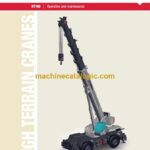
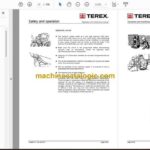
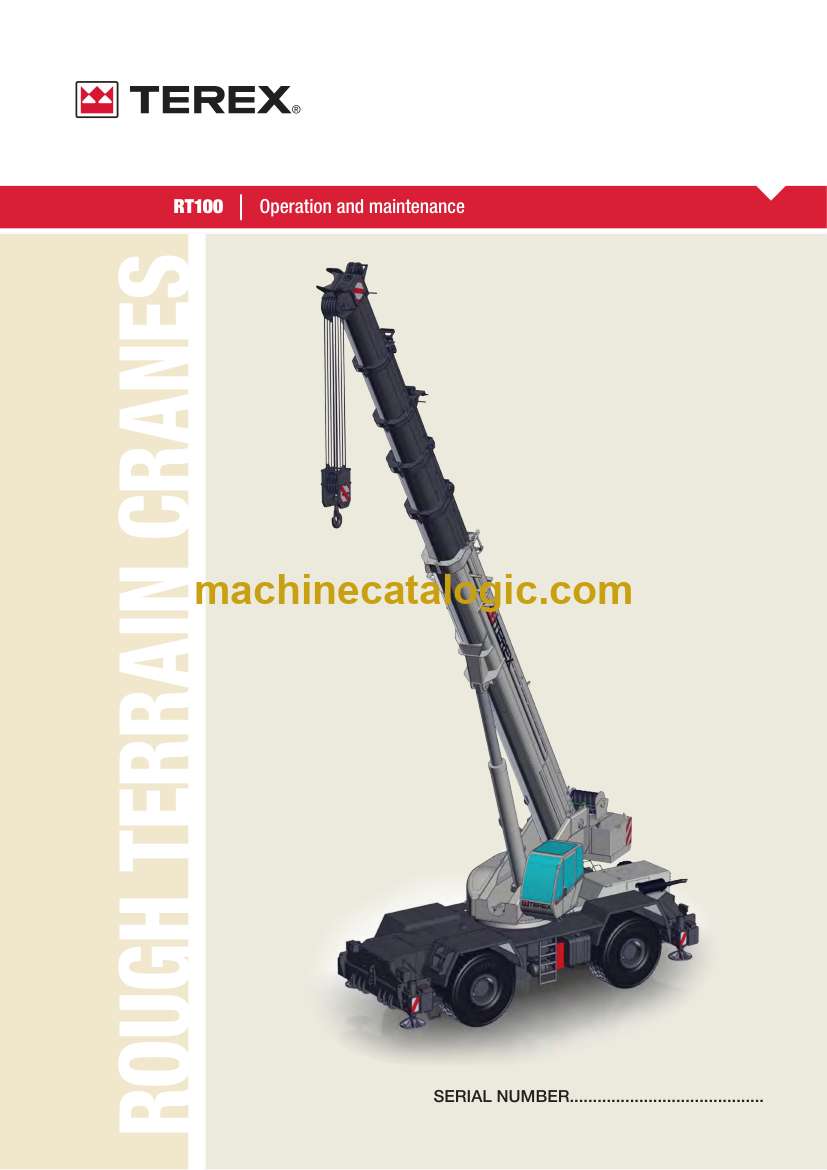
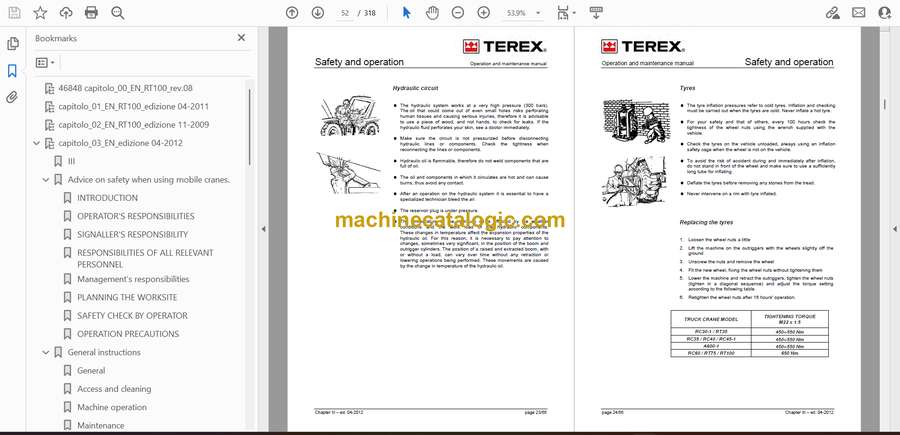
Terex RT100 Rough Terrain Cranes Operation and Maintenance Manual
The Terex RT100 Rough Terrain Crane is a large-capacity lifting machine built to handle demanding, uneven work environments. This Operation and Maintenance Manual covers boom sequencing, outrigger deployment, hydraulic power distribution, steering system behavior, and detailed service schedules. Crews rely on it to maintain stability during challenging lifts and extend component life through proper preventive maintenance.
Applications & Use Cases
-
Planning lifts involving multi-section boom configurations
-
Diagnosing hydraulic drift, slow winch response, or unstable swing
-
Ensuring correct outrigger setup for maximum stability
-
Maintaining brakes, driveline, and steering systems
-
Structuring long-term maintenance plans
FAQ
Does it include full hydraulic and mechanical system diagrams?
Yes, with complete routing and subsystem detail.
Is it good for field technicians?
Very. It provides fast diagnostic paths and clear maintenance indicators.
Safety Note
Never lift without confirming firm outrigger footing; large-capacity cranes amplify risk instantly.
📘 Show Index
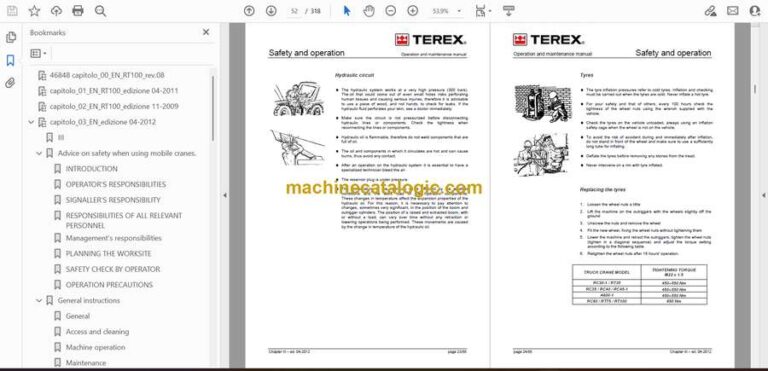
Terex RT100 Rough Terrain Cranes Index:
- 46848 capitolo_00_EN_RT100_rev.08
- capitolo_01_EN_RT100_edizione 04-2011
- capitolo_02_EN_RT100_edizione 11-2009
- capitolo_03_EN_edizione 04-2012
- III
- Advice on safety when using mobile cranes.
- INTRODUCTION
- OPERATOR’S RESPONSIBILITIES
- SIGNALLER’S RESPONSIBILITY
- RESPONSIBILITIES OF ALL RELEVANT PERSONNEL
- Management’s responsibilities
- PLANNING THE WORKSITE
- SAFETY CHECK BY OPERATOR
- OPERATION PRECAUTIONS
- General instructions
- General
- Access and cleaning
- Machine operation
- Maintenance
- Electrical circuit
- Hydraulic circuit
- Tyres
- Replacing the tyres
- Instructions for reading the load table
- Choosing the best configuration
- Reduction of operating loads
- Extension secured to brackets
- Mounted extension
- Special instructions for lifting on tyres
- Special instructions for lifting on outriggers
- Special instructions for lifting with mechanical element extended
- Max. forces exerted on ground (daN)
- Actions of the wind
- Safety devices
- Load and movement limiter
- Limit stop device
- In compliance with the safety regulations, the crane truck is equipped with:
- 1. Lifting limit stop device that blocks the manoeuvre, preventing the block from getting too close to the boom head
- 2. A “three dead turns” lowering limit stop device that prevents complete unwinding of the rope from the winch drum.
- Deadman Safety Device
- Machine operation
- Engine starting
- 1. Make sure the gearshift lever is in the neutral position “N”.
- 2. Select the fast or slow gears according to needs (where applicable).
- 3. Turn the ignition key.
- 4. The battery level, braking system air circuit, engine oil pressure and coolant temperature warning lights on the instrument panel come on.
- 5. Beep the horn.
- 6. The parking brake must be applied.
- 7. Turn the ignition switch to the second position to start the engine.
- Switching off the engine
- Securing the block (hook) to the truck crane
- Driving on road
- Driving on the worksite
- Machine stabilization
- Support surfaces
- Extension of the boom
- Lifting rope
- Eccentric rigging (unbalanced)
- Symmetrical rigging (balanced)
- Changing the number of tackles
- Blocks and hooks
- Harnessing the load
- Extensions assembly – disassembly
- Work with main winch and auxiliary winch
- Lifting with several mobile cranes
- Towing
- Transporting the crane on a self-propelled trailer
- capitolo_04_EN_RT100_edizione 07-2011
- RCL RT100 EN ed. 07-2011 EU
- capitolo_05_EN_RT100_edizione 08-2012
- capitolo_06_EN_edizione 07-2012
- capitolo_07_EN_edizione 04-2011
Terex