Takeuchi TL10V2 Track Loader Workshop Manual (CU9E024) (SN 410000003-)
A TL10V2 spends its life in mud, stone, and demolition debris, so when something’s off, you need a clear sequence to get in, fix it, and button it back up safely. This workshop manual is what I’d use to trace a hydraulic leak in the loader arms, pull the offending component, inspect it properly, then reinstall and test the system so it doesn’t come back on the next job.
Applications & Use Cases
- Planned overhauls of major components like final drives or loader arms, following step‑by‑step removal and reinstallation sequences.
- Tracing hydraulic faults, using the manual’s routing and connection guidance to isolate a bad line, fitting, or valve.
- Undercarriage work, to correctly support the machine, remove tracks, and verify alignment and tension on reassembly.
- Engine and cooling system service, to access tight areas cleanly and bleed or refill systems without introducing new issues.
- Post‑repair checks, using the outlined inspections to confirm everything is torqued, routed, and guarded before the loader goes back to work.
FAQ
Q: Can I use this manual on a tablet in the field?
A: Yes, it’s practical on a tablet; you can zoom diagrams, search terms, and keep it clean in the cab while you work.
Q: Is it still worth printing parts of it?
A: Definitely; I print the procedures I’m doing that day so I can mark notes, oily fingerprints, and torque reminders right next to the steps.
Safety Note
Always follow the manual’s support, lockout, and pressure‑relief instructions before loosening or removing any component.
Takeuchi TL10V2 Track Loader Index:
- REVISION HISTORY
- FOREWORD
- Directional terms: front, rear, left, right
- Machine serial number
- Symbols used in this manual
- Manual structure
- 1. SAFETY
- SAFETY ALERT SYMBOL
- SAFETY PRECAUTIONS
- Observe all safety rules
- Wear safe clothing and protective gear
- Install an extinguisher and a first aid kit
- Lockout/Tagout (LOTO)
- Use the correct tools
- Regularly replace the safety-critical parts
- Explosionproof lighting
- Prohibit access by unauthorized persons
- Prepare the work area
- When the canopy is tilted up
- Keep the machine clean
- Stop the engine before performing maintenance
- Keep clear of the moving fan and belt
- When working under the machine
- When working on the machine
- Securing the working equipment
- Secure the engine hood and guard when they are open
- Place heavy components in a stable position
- Caution when filling with fuel or oil
- Handling of hoses
- Be careful with hot and pressurized components
- Handling of radiator
- Be careful with oils under pressure
- Release the residual pressure from the hydraulic system before performing maintenance
- Be careful with grease under pressure
- Handling of the accumulator
- Disconnect the battery
- Use caution when handling batteries
- Have a service agent repair welding cracks or other damage
- Checks after maintenance
- Disposing of wastes
- CAUTIONS WHEN WORKING
- Before starting work
- When disassembling or assembling
- When removing/installing the hydraulic unit
- When connecting/disconnecting the hoses or pipes
- Handling of seals
- Pressure adjustment for hydraulic devices
- 2. SERVICE DATA
- DIMENSIONAL DRAWING
- Machine dimensions
- Operating range
- SPECIFICATION TABLES
- Performance
- Dimensions
- Mass
- Engine
- Hydraulic system
- Brake device
- Undercarriage
- Operating device
- Working equipment
- Hydraulic system
- TABLE OF MASSES
- Upper structure
- Lower structure
- Attachments
- LUBRICANT AND FUEL CHART
- PERFORMANCE CRITERIA
- Standard values table
- Hydraulic pump assignment table
- Machine without high-flow equipment
- Machine with high-flow equipment
- Methods for inspecting performance
- 1. Engine speed
- 2. Hydraulic oil pressure
- 3. Cylinder speed
- 4. Travel speed
- 5. Crawler shoe 5 rotations
- 6. Straight-ahead traveling
- 7. Hydraulic cylinder natural drop
- 8. Natural travel drop
- 9. Crawler tension
- 10. Bucket front edge
- TIGHTENING TORQUE
- Hydraulic hose
- Bite-type pipe fitting for steel pipe
- Joint for piping
- Joint for piping (O-ring seal type)
- Bolts and nuts (JIS strength category 10.9)
- HYDRAULIC CIRCUIT DIAGRAM
- Standard flow specification
- Serial No.: 410000003 to 410001026
- Serial No.: 410001027 to 410005238 / 410100001 to 410100196
- Serial No.: 410005239 or later / 410100197 or later
- High flow and pattern change specification
- Serial No.: 410000003 to 410001026
- Serial No.: 410001027 to 410005238 / 410100001 to 410100196
- Serial No.: 410005239 or later / 410100197 or later
- High flow specification
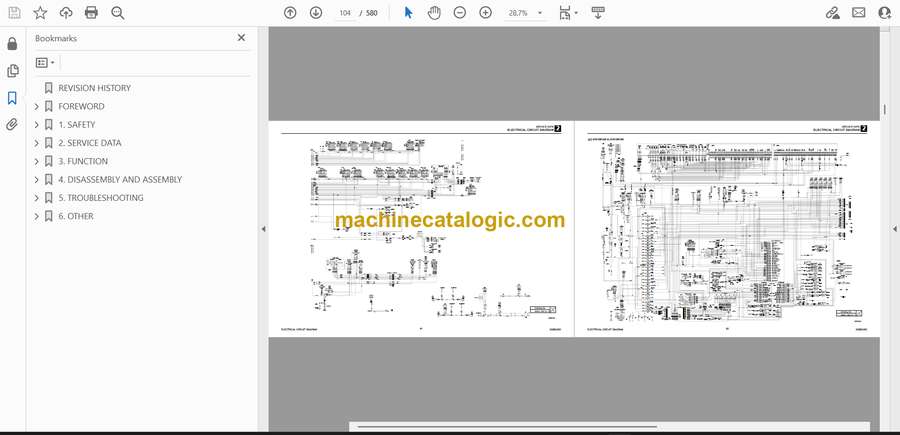
- ELECTRICAL CIRCUIT DIAGRAM
- Symbols in electrical circuit diagram
- Wire color symbols
- Wire color table
- Wire types
- Schematic diagram
- Serial No.: 410000003 to 410000416
- Serial No.: 410000417 to 410001124
- Serial No.: 410001125 to 410001680
- Serial No.: 410001681 to 410002412
- Serial No.: 410002413 to 410002934
- Serial No.: 410002935 to 410004530
- Serial No.: 410004531 to 410004776
- Serial No.: 410004777 to 410005238
- Serial No.: 410005239 or later
- Serial No.: 410100001 to 410100013
- Serial No.: 410100014 to 410100108
- Serial No.: 410100109 to 410100147
- Serial No.: 410100148 to 410100196
- Serial No.: 410100197 or later
- Schematic diagram
- Multifunctional attachments
- HYDRAULIC DEVICE LAYOUT DIAGRAM
- 3. FUNCTION
- HST PUMP
- Hydraulic pump
- Control section
- Charge check valve/high-pressure relief valve assembly
- Charge check valve
- High-pressure relief valve
- Charge relief valve
- Flushing valve
- GEAR PUMP
- CONTROL VALVE
- At the neutral position
- AUX1 operation
- Arm-raising operation
- Arm-lowering operation
- Bucket roll-back operation
- Bucket dump operation
- Flow rate adjustment valve
- When arm float is turned off
- Arm float operation
- Main relief valve
- Overload relief valve
- SUB VALVE
- When the solenoid valve A is not energized:
- When the solenoid valve A is energized:
- When the solenoid valve B is not energized:
- When the solenoid valve B is energized:
- PILOT VALVE
- When the lever (1) is in the neutral position:
- When the lever (1) is tilted:
- When the lever (1) is kept at a certain position:
- SOLENOID VALVE (PARKING BRAKE)
- PROPORTIONAL CONTROL SOLENOID VALVE (ACTIVE POWER CONTROL)
- PROPORTIONAL SOLENOID VALVE (1ST SERVICE)
- CYLINDER
- TRAVEL MOTOR
- 4. DISASSEMBLY AND ASSEMBLY
- SERVICE STANDARDS
- Track roller A
- Track roller B
- Sprocket
- Idler
- Clearance for pin and bushing
- Replacing the pin and bushing
- DRIVE SYSTEM
- Engine
- Radiator
- Construction diagram
- Removing the engine
- Installing the engine
- Hydraulic pump (without high-flow equipment)
- Hydraulic pump (with high-flow equipment)
- Construction diagram
- Removing the hydraulic pump
- Installing the hydraulic pump
- Fuel tank
- Construction diagram
- Removing the fuel tank
- Installing the fuel tank
- TRAVEL SYSTEM
- Track roller (Serial No.: 410000003 to 410000666)
- Track roller (Serial No.: From 410000667)
- Front idler
- Grease cylinder
- Travel motor
- Construction diagram
- Removing the crawler
- Installing the crawler
- Removing the track roller A and C
- Installing the track roller A and C
- Removing the track roller B
- Installing the track roller B
- Removing the front idler
- Installing the front idler
- Removing the travel motor
- Installing the travel motor
- FRAME
- Tilting up the canopy and cab
- How to raise (tilt up) the canopy and cab
- How to lower the canopy/cab
- Lift arm stopper
- How to install the stopper
- How to remove the stopper
- Floor frame
- Construction diagram
- Removing the floor frame
- Installing the floor frame
- Cover
- Construction diagram
- Removing the covers
- Installing the covers
- Canopy mounting assembly
- Canopy exterior assembly
- Canopy interior assembly
- Cab mounting assembly
- Cab exterior assembly
- Front door assembly
- Side window assembly
- Cab interior assembly
- Construction diagram
- Removing the canopy assemble/cab assemble
- Installing the canopy/cab
- OPERATING DEVICE
- Hydraulic pilot unit
- Construction diagram (machine without selector valve)
- Construction diagram (machine with selector valve)
- Disassembly and assembly
- Removal and installation of the accumulator
- ATTACHMENTS
- Mechanical quick-hitch
- Hydraulic quick-hitch
- Construction diagram
- Removing the quick-hitch
- Installing the quick-hitch
- Lift arm
- Hydraulic piping (machine without high-flow)
- Hydraulic piping (machine with high-flow, machine with 2nd auxiliary line piping)
- Block coupler (machine without high-flow)
- Block coupler (machine with high-flow, machine with 2nd auxiliary line piping, machine with 1/2 quick coupler)
- Construction diagram
- Removing the lift arm
- Installing the lift arm
- HYDRAULIC TANK
- Construction diagram
- Removing the hydraulic tank
- Installing the hydraulic tank
- Filling with hydraulic oil
- Bleeding the air
- HST PUMP
- Construction
- Pump assembly (1/4)
- Pump assembly (2/4)
- Pump assembly (3/4)
- Pump assembly (4/4)
- Disassembly
- Assembly
- Inspection and adjustment
- Checking the parts
- Adjusting the rotational torque of the servo piston
- Measurement of the servo piston’s rotational torque
- Neutral adjustment of the pump
- Adjustment of displacement limiter
- GEAR PUMP
- Construction
- Exploded diagram
- Internal construction diagram
- Disassembly and assembly
- General precautions
- Disassembly
- Assembly
- GEAR PUMP (HIGH FLOW)
- Construction
- Exploded diagram
- Internal construction diagram
- Disassembly and assembly
- General precautions
- Disassembly
- Assembly
- CONTROL VALVE
- Construction
- Disassembly
- General precautions
- Removing the spool
- Removing the check valve and load check valve
- Removing the main relief valve
- Removing the overload relief valve
- Removing the flow ratio adjuster valve
- Removing the arm float valve and leveling cancel valve
- Removing the solenoid valve
- Removing other parts
- Assembly
- Main unit
- Spool assembly
- Check valve, load check valve
- Installing the overload relief valve
- Installing the arm float valve and leveling cancel valve
- Installing the solenoid valve
- Installing other parts
- Adjustment
- Adjusting the flow ratio
- Flow rate adjustment
- SUB VALVE
- Construction
- Disassembly and assembly
- General precautions
- Disassembly
- Inspection and adjustment
- PILOT VALVE
- Construction
- Special tools
- Installation jig A
- Installation jig B
- Disassembly and assembly
- General precautions
- Disassembly
- Assembly
- Inspection and adjustment
- PROPORTIONAL CONTROL SOLENOID VALVE
- Construction
- Disassembly and Assembly
- Inspection and adjustment
- PROPORTIONAL SOLENOID VALVE (1ST SERVICE)
- Construction diagram
- Disassembly and assembly
- Service standards
- TRAVEL MOTOR
- WIRE HARNESS
- Electrical wiring assembly: 06842-00121-01
- Wire harness: 06842-00127-01
- Wire harness: 06842-00145-01
- Wire harness: 06942-00201-02
- Wire harness: 06842-00143-01
- Wire harness: 06842-00144-01
- Wire harness: 06842-00174-00
- Wire harness: 06842-00139-00
- Wire harness: 06942-00179-00
- Unit assembly: 06842-00163-01
- GPS device assembly: 06842-00126-00 (06842-00125-00)
- Wire harness: 06942-00172-00
- Battery assembly: 06844-00012-00
- Radio assembly: 06847-00003-01
- Wire harness: 06847-00004-00
- Attachment wiring assembly (machine with mechanical quick-hitch): 06842-00172-00
- Wire harness: 06842-00171-00
- Attachment wiring assembly (machine with hydraulic quick-hitch): 06842-00123-00
- Wire harness: 06842-00162-00
- 5. TROUBLESHOOTING
- ABOUT THE TROUBLESHOOTING SECTION
- Notes on troubleshooting and servicing
- OVERALL MACHINE
- No operation is possible.
- All systems working, but insufficient power.
- Lift arm and bucket fail to move or are too slow.
- TRAVELING
- Traveling fails.
- Right or left travel speed decelerates and the machine veers to one side.
- Operating temperature of the travel system is too high.
- 2nd-speed travel is not possible.
- LIFT ARM
- Arm cylinder does not move
- Arm cylinder moves too slowly or lacks force
- When the control lever is pulled slowly, the lift arm drops once.
- Spontaneous drop of the lift arm is too large.
- BUCKET
- Bucket cylinder does not move.
- Bucket cylinder is slow or lacks force.
- Spontaneous drop of the bucket is too large
- SERVICE
- Prescribed pressure is not supplied to the 1st service.
- HST PUMP
- HST system
- Hydraulic pump
- GEAR PUMP
- CONTROL VALVE
- SUB VALVE
- PILOT VALVE
- PROPORTIONAL SOLENOID VALVE (ACTIVE POWER CONTROL, 1ST AUXILIARY LINE PIPING)
- CYLINDER
- 6. OTHER
- MAINTENANCE SOFTWARE MANUAL
- CONTENTS
- 1. OUTLINE
- 2. CONNECTION METHODS
- 2-1. Items needed
- 2-2. Installation of the PLUS+1 GUIDE Service Tool
- 2-3. Installation of the Maintenance Tool driver
- 2-4. Connection to the machine and startup of the Maintenance Software
- 3. DESCRIPTION OF FUNCTIONS
- 3-1. Home
- 3-2. Machine status
- Inputs1
- Inputs2
- Outputs
- CAN
- Feedback
- Error code
- Vehicle status
- 3-3. Engine status
- Engine status
- DPF status
- SCR status
- 3-4. AUX1 Setting
- AUX1
- Grip setting
- Stroke setting
- 1way current setting
- 2way current setting
- HF current setting
- 3-5. Active power control
- Active power control (without selector valve)
- Active power control (with selector valve)
- Active power control
- 3-6. Other
- Option
- Hourmeter
- Misc
- Display
- Immobilizer
- AIR CONDITIONER
- Compressor assembly
- Condenser assembly
- Air conditioner unit
- AC component
- AIR CONDITIONER SYSTEM
- Overview of System Operation
- Truck and Heavy Equipment Systems
- Air Conditioner—System Operation
- Heater System Operation
- Environmental Effects on System Operation
- Chapter Review
- Inspection and Maintenance without gauges
- Discussion of Inspection & Maintenance Survey Results
- Visual Inspection – System Off
- Electrical System Inspection
- Performance Inspection – Engine Running
- Heater System Inspection
- Preventive Maintenance Worksheet
- Chapter Review
- Troubleshooting & Service Procedures
- Troubleshooting Overview
- The Key–Understanding System Function
- A Troubleshooting Example
- Manifold Gauge Set Installation
- Troubleshooting by Manifold Gauge Set Readings
- Review of Frequent Problem Areas
- Conclusion
- TABLE OF VEHICLE ERROR CODES
- ENGINE ERROR CODES
Takeuchi