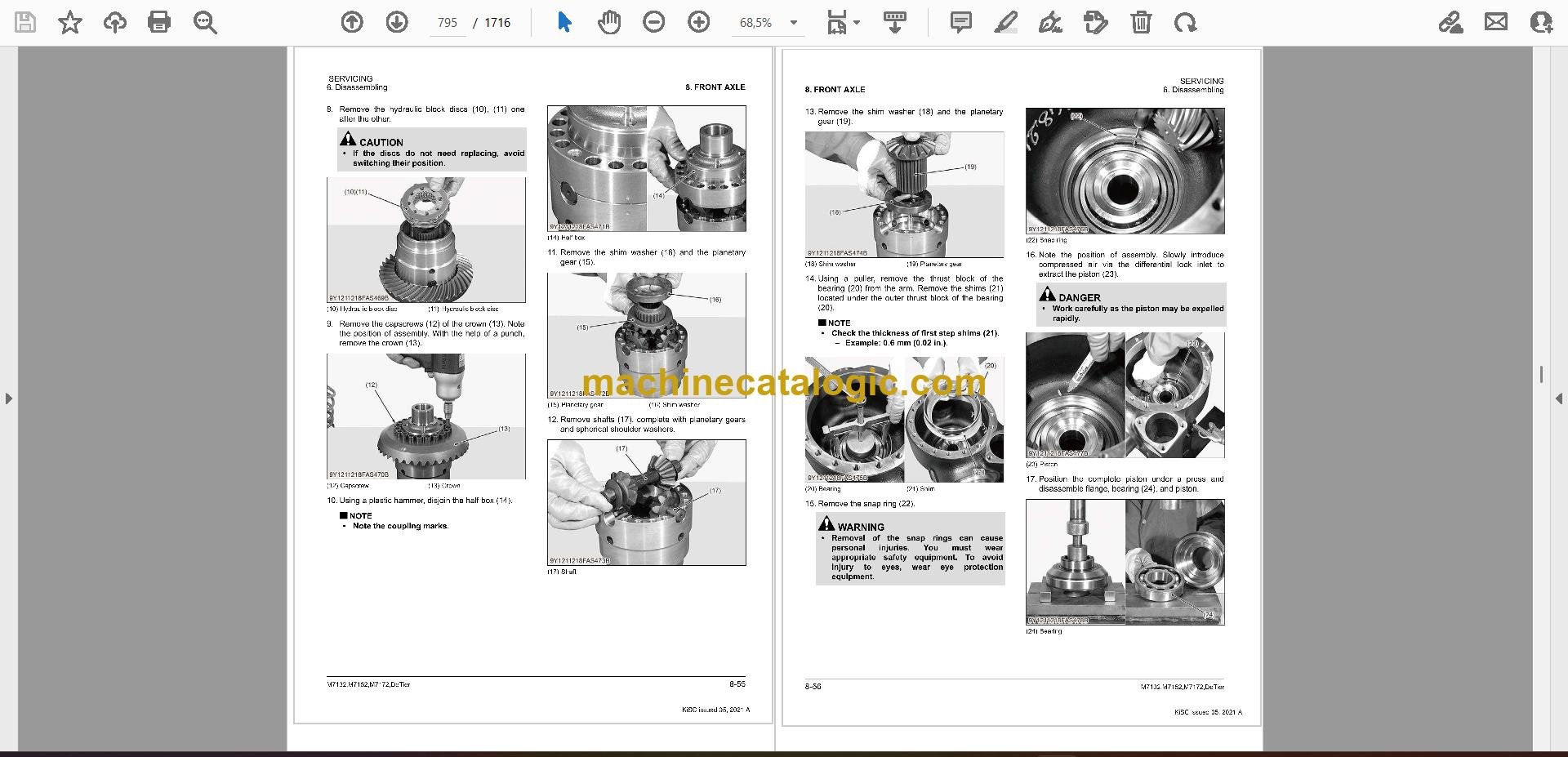
The Kubota M7152 is a mid-size ag tractor, the sort you bale with, pull heavier implements, and run loaders or hydraulics all day. People reach for the workshop manual when something deeper than filters and grease fittings needs attention. They're trying to fix leaks, driveline issues, electrical gremlins, or get torque specs right so they don't have to redo a job next weekend.
What this manual helps you do
- Diagnose hydraulic problems in the loader, remotes, and three-point when they get weak or jerky
- Trace and repair wiring issues for lights, dash warnings, and safety switches using proper diagrams
- Rebuild or replace engine and fuel system parts with the right disassembly order and reassembly specs
- Check and adjust clutch, transmission, and front axle components when shifting or 4WD engagement gets rough
- Follow step-by-step procedures to remove, inspect, and reinstall PTO and hitch components after a failure
Who this is for
This is for an owner-operator, farm shop, or small contractor who is actually going to tear into an M7152 and wants dealer-level procedures. If you only need basic controls, service intervals, and which button does what, you want the operator's manual instead, not this workshop manual.
FAQ
Q: Is this a searchable PDF, and are the wiring diagrams readable?
A: These workshop manuals are usually scanned or native PDFs you can search, and the wiring diagrams are laid out so you can zoom in and follow circuits.
Q: How do I know it covers my exact tractor?
A: If your tractor is a Kubota M7152, this is the right workshop manual family. For very early or late production changes, you may still want to confirm by serial with a dealer.
Q: Is this the right document if I'm doing my own repairs?
A: Yes, if you're doing real repair work on an M7152, this is the correct type of manual. For parts numbers or exploded views for ordering, you'd still use the separate parts catalog.
Bottom line: If you own or service a Kubota M7152 and plan to wrench on it beyond basic maintenance, this is the manual you're looking for. If you just want how to operate it, skip this one.
📘 Show Index
Table of Contents:
A Kubota Tractor workshop (service) manual generally covers the systems and service procedures listed below:
- General Information
- Identification and Serial Numbers
- General Precautions
- Handling Precautions for Electrical Parts and Wiring
- Lubricants, Fuel and Coolant
- Tightening Torques
- Maintenance and Check Intervals
- Special Tools
- Tires
- Engine — Mechanism and Servicing
- Engine Body
- Lubricating System
- Cooling System
- Fuel System
- Clutch — Mechanism and Servicing
- Structure and Operation
- Checking, Disassembling and Servicing
- Transmission — Mechanism and Servicing
- Gear / Hydrostatic (HST) Drive
- Shuttle and Range Shift
- PTO System
- Differential Gear System
- Rear Axle — Mechanism and Servicing
- Structure
- Disassembling and Servicing
- Brakes — Mechanism and Servicing
- Structure and Operation
- Checking, Adjusting and Servicing
- Front Axle (2WD / 4WD) — Mechanism and Servicing
- Structure
- Front Wheel Alignment
- Disassembling and Servicing
- Steering / Power Steering — Mechanism and Servicing
- Hydraulic Circuit
- Power Steering Body
- Hydraulic System — Mechanism and Servicing
- Hydraulic Pump
- Control Valve
- Position Control Valve
- Hydraulic Cylinder
- Three-Point Hitch and PTO
- Structure and Operation
- Checking and Servicing
- Electrical System
- Wiring Diagrams
- Starting System
- Charging System
- Lighting and Gauges
- Easy Checker / Diagnostics
To The Reader Index:
- 1. SAFETY
- SAFETY FIRST
- 1. Working precautions
- 2. Preparing for emergencies
- 3. Working cautions
- 4. Starting machine safely
- 5. Preventing fires
- 6. Preventing acid burns
- 7. Avoiding high pressure fluid
- 8. Avoiding hot exhaust
- 9. Cleaning exhaust filter
- SAFETY LABELS
- 2. GENERAL
- GENERAL
- 1. General working precautions
- 2. Tightening bolts and nuts
- 3. Applying thread-locking fluid
- 4. Installing circlips
- 5. Installing spring pins
- 6. Handling split pin
- 7. Handling chain joint and split pin
- 8. Handling liquid gasket
- 9. Replacing O-rings
- 10. Replacing oil seals
- 11. Replacing floating seals
- 12. Connecting hydraulic hoses
- 13. Wrapping thread seal tape
- 14. Installing elbows with male seat
- 15. Connecting and disconnecting quick hose couplings
- 16. Handling the battery
- 17. Handling wire harness
- 18. Handling fuses
- 19. Handling connectors
- 20. Wiring color
- 21. Washing the machine with a high pressure washer
- 22. Dispose fluids correctly
- 23. Using DEF/AdBlue®
- TIGHTENING TORQUES
- 1. General use screws, bolts and nuts
- 2. Stud bolts
- 3. Hydraulic fittings
- 3.1 Hydraulic hose tightening torque
- 3.2 Hydraulic pipe cap nuts
- 3.3 Adaptors, elbows and nuts
- 3.4 Hydraulic pipes tightening torque
- 3.5 Hydraulic joint nut tightening torque
- 3.6 Hydraulic pipe joint tightening torque (PT thread)
- 4. Pneumatic fittings
- 4.1 Tightening torque for pneumatic fittings
- TRACTOR IDENTIFICATION
- 1. Model name and serial number
- SPECIFICATION TABLE
- TRAVELING SPEEDS
Kubota Software
Kubota PDF Manuals